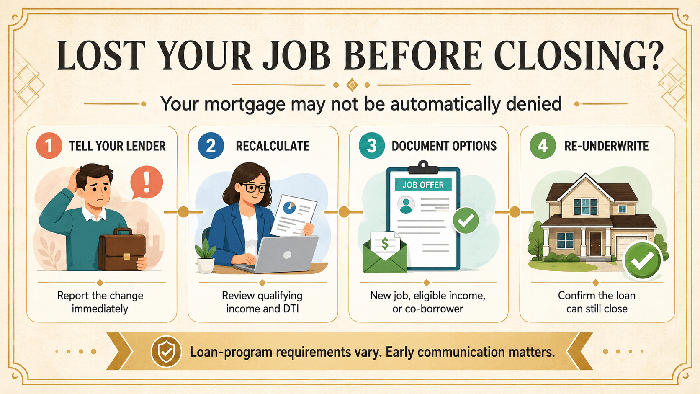
A loss of employment during mortgage process won’t necessarily lead to an automatic denial of your mortgage. However, lenders will have to review your application again and possibly put the closing on hold until they verify new qualified replacement income. A new job, qualified replacement income, or a co-borrower may help the loan close. Resolution will depend on the specific loan program, employment, and the new underwriting review.
How Job Loss Affects Mortgage Approval
For mortgage applications, if you lose your job before closing, your lender must determine whether you still meet the income and debt-to-income requirements. In this case, the loan application must be reviewed again, or re-underwritten. A job loss before closing does not necessarily mean an automatic denial of the mortgage application. The lender must verify that the job loss does not mean that any income used to qualify for the mortgage is also lost.
Why Lenders Reverify Employment Before Closing
As you are probably aware, loans are approved based on your employment and qualifying income. As such, it is common practice for mortgage lenders to verify employment a few days before closing.
For Fannie Mae, employment income is generally reverified within 10 business days prior to the note date. Freddie Mac, meanwhile, also requires its borrowers to provide a 10-business-day employment verification before closing. However, the requirements and methodology for verification are tailored to the specific loan program.
For the reasons stated above, the lender must review the file if the employment status has been verified as closed, even if the lender hasn’t yet received the final employment verification.
Can You Still Qualify After Starting a New Job?
Loss of employment during mortgage process can significantly impact your application and loan approval. Lenders typically assess the stability of your income and employment history to determine your eligibility for a mortgage. If you experience a job loss while your application is under review, it may cause the lender to reconsider your financial situation. However, some lenders may still be willing to work with you, depending on your overall financial profile and the specifics of the loan program. It’s important to quickly communicate any changes in your employment status, as being transparent can help address challenges that come up during this time.
Conventional Loans After Starting a New Job
Borrowers of conventional mortgages, as long as the new employment along with the income meets the agency criteria, qualify. Fannie Mae has set up guidelines that allow certain borrowers to qualify with an executed employment contract even if they haven’t received their first paycheck. As long as the new job starts within 90 days following the date of the mortgage, the borrower meets all the required documentation, employment, and income standards, Fannie Mae would confirm the mortgage. A lender still reviews the employment history and income to see if the new job income would qualify.
FHA Loans After Starting a New Job
FHA believes every borrower should not be required to have a specific amount of time with their current employer before given the opportunity to qualify for a mortgage. The lender assesses your employment history and current income to see if the new job income will continue. FHA also recognizes an anticipatory income of a new job that will begin a new job within 60 days of the closing of the mortgage. A recent loss of employment during mortgage process therefore does not necessarily require the borrower to wait several months before applying again.
VA Loans After Starting a New Job
VA underwriting is concerned with whether or not the borrower’s income is steady and adequate for the mortgage and obligations. A Veteran does not become ineligible for a VA loan simply because they have a new job. The new job/income must be evaluated by the lender prior to closing. The VA has determined that employment and income changes discovered prior to closing must be reported for further underwriting consideration. The decision depends on factors such as the strength of the employment history, the type of work, pay structure, and how likely the income will continue.
USDA Loans After Starting a New Job
USDA will consider qualifying income from a new job for certain situations. A borrower does not qualify for USDA if they have a new job if the job will begin more than 60 days after closing. USDA requires the lender to confirm that the borrower has adequate APR reserves to cover the monthly obligations and the new mortgage. USDA generally requires a one-year employment history, but that history may include a combination of education and military service and does not have to be with the current employer.
Can You Close Before Starting a New Job?
An employment offer alone does not qualify borrowers for closing loans prior to starting work, but closing loans for purchase transactions on a one-unit primary residence prior to starting work is allowable, provided that fixed-base income has been demonstrated.
For the purchase-money transaction, Fannie Mae permits closing loans before work begins, as long as the employment offer or contract has been signed. Be advised that the start date may be up to 90 days after the closing date.
In the absence of receipt of the first paycheck prior to closing on the loan, additional reserves would have to cover the mortgage and other expenses pending the commencement of employment. Other programs have their own guidelines regarding closing prior to starting work. Thoroughly reviewing employment offers is prudent prior to assuming closing without receiving pay.
How a Change in Pay Structure Affects Qualification
A new job may not solve a loss of employment during mortgage process if the new income cannot be used immediately. Moving from one fixed salary to another fixed salary is generally easier to document because the lender can verify the new base pay and recalculate the debt-to-income ratio. Qualifications may become more complicated when the new job includes:
- Commission income
- Overtime or bonuses
- Variable hours
- Tips or seasonal earnings
- 1099 or self-employment income
These income types commonly require an established earnings history before they can be averaged and used for mortgage qualification. A higher potential income does not help if the borrower has not received it long enough to meet the applicable loan-program requirements. The lender must evaluate the new position, start date, compensation structure, and likelihood that the income will continue. The loan may also need to be re-underwritten or resubmitted through the automated underwriting system. Borrowers should send the complete employment offer to their loan officer before assuming the new income will qualify.
Lost Your Job During the Mortgage Process? Act Fast
Employment changes before closing can affect mortgage approval, income qualification, and clear-to-close. Get your file reviewed immediately before the loan is delayed or denied.Can Another Borrower or Income Source Help Save the Mortgage?
The lender can still review whether the loan qualifies if the lost employment income is considered no longer available. The lender is free to use other income sources on the application, as long as they are within the guidelines. If you are considering an FHA loan or a VA loan, here are some potential sources of income that may be considered:
- The income of a prospective co-borrower
- Retirement income (as long as it is permitted on the loan program)
- Social Security | disability income
- Income from a rental property that is fully documented
- Other income that may be allowed on the loan program
- Adding an eligible co-borrower (assuming the requirements of the program and the lender are met)
Adding an eligible co-borrower may be an option, but the lender must fully evaluate that person’s credit, income, assets, and liabilities. Some programs even set restrictions on who can be added to a mortgage. For example, USDA doesn’t allow non-occupying co-borrowers or co-signers on its guaranteed loan program.
What to Do Immediately After Losing Your Job Before Closing
Loss of employment during mortgage process should be reported to the loan officer as soon as possible. If the change is found during the lender’s final employment verification, it may unnecessarily delay the process. After losing a job:
- Report the termination to the loan officer
- Provide the lender with a letter of separation
- Send any offers of new employment as soon as they are available
- Avoid taking out new loans while waiting for the loan to be underwritten
- Record all large transfers and keep all deposit receipts
- Ask what, if anything, can be done to the closing date, approval of the loan, or the lock of the interest rate
The lender can then determine whether the existing loan will remain applicable or whether new employment and income information is required to proceed to closing.
Documents Needed After Starting a New Job
Different loan programs have different procedures for considering documentation for newly offered employment. Generally, the requirements depend on numerous factors, such as whether the applicant has actually started the new job. Some of the documentation that may be required includes:
- Signed employment contract/offer letter
- New job contact information
- New job title and employment date
- Pay/compensation
- Recently issued pay stubs.
- Updated employment verification
- Bank statements to show cash on hand
- Documentation of ending employment (if requested)
Some borrowers may incur additional requirements if they qualify before their first paycheck. For instance, with Fannie Mae, there are specific documentation and reserve requirements for qualifying contracts. Submitting the required documentation to the underwriter in advance can reduce closing delays by allowing the underwriter to confirm whether the new income can be used.
Hypothetical Mortgage Approval Example
Let’s say a borrower has a conventional loan approved for a purchase and loses a salaried job before the closing. That salary is key to qualifying, so the lender cannot use the previous income.
The borrower gets a salaried job in the same industry and with the same title, and the new job starts three weeks after the closing. The borrower provides an employment offer or contract, salary, and a starting date, along with cash on hand to meet the reserve requirements.
A lender may use the new income if certain conditions in Fannie Mae purchase transactions are met. These conditions allow qualified employment to begin up to 90 days after the note date. The loan will need to be evaluated and processed under the new terms and conditions. This example is for the purpose of this discussion only. Loss of employment during the mortgage process does not guarantee that the borrower will qualify under these conditions.
Final Thoughts on Losing Employment During Mortgage Process
Losing employment prior to closing can result in loan denial if there are no alternative means to meet the qualifying conditions. Fortunately, it does not necessarily mean the borrower must restart the mortgage process.
Replacement income, new employment, or an additional qualified borrower can help facilitate a new loan, depending on the required programs and the other loan application.
The single most important factor is to notify the loan officer of the change. The lender is required to analyze the revised circumstances. The borrower will be advised of the decision to continue, restructure, or postpone the loan based on the revised circumstances.
FAQs About Job Loss and Employment Changes During a Mortgage
Does a Temporary Layoff or Furlough Affect Mortgage Approval?
It can. The lender must determine whether you remain employed, when you expect to return to work, and what qualifying income you will receive during the interruption. A temporary furlough or approved leave may be treated differently from permanent job termination, but the lender must document that your income is stable enough to support the mortgage.
What Happens If I Lose a Second Job but Keep My Primary Job?
Losing a second job may not affect approval if that income was not used to qualify, and your remaining income still satisfies the loan requirements. If the lender included second-job income in the original approval, it must remove that income, recalculate your debt-to-income ratio, and determine whether the loan can still be approved.
Can Savings Replace Income After Losing a Job?
Savings generally cannot replace lost employment income dollar for dollar. However, substantial savings may strengthen the application by providing cash reserves or covering required payments before new employment begins. Certain conventional, jumbo, portfolio, or non-QM programs may allow eligible assets to be converted into qualifying income. These options have specific requirements for assets, documentation, loan-to-value ratios, occupancy, and reserves.
Can I Qualify for a Mortgage While on Paid Medical or Parental Leave?
Yes, qualifying may be possible. An approved temporary leave does not automatically mean you are unemployed. The lender will review your current leave income, regular employment income, expected return-to-work date, and right to return to your job. Under Fannie Mae’s temporary-leave guidelines, the income calculation depends partly on whether you will return before the first mortgage payment date. Eligible liquid reserves may sometimes supplement reduced temporary-leave income.
What Happens to My Rate Lock If an Employment Issue Delays Closing?
If the delay extends beyond the rate-lock expiration date, you may need a rate-lock extension. Whether an extension is available, how much it costs, and who pays the fee depend on the lender’s policy and the rate-lock agreement. A change in verified income may also affect the locked rate or loan pricing because the borrower’s application has materially changed. The Consumer Financial Protection Bureau recommends checking the expiration date on the Loan Estimate and asking the lender about extension options as soon as a delay becomes likely.
This article about “Loss of Employment During Mortgage Process: Can You Still Close?” was updated on August 24th, 2026.