
Mortgage interest rates are one of the biggest factors in the cost of buying a home or refinancing a mortgage. Even a tiny change in mortgage interest rates can really affect how much you pay each month, your debt-to-income ratio, and the overall interest you’ll fork out over the life of your loan.
Many borrowers assume all lenders offer the same mortgage interest rates, but that is not how mortgage pricing works. Mortgage companies look at several risk factors when setting rates, including your credit score, down payment, loan type, occupancy, property type, and loan term.
Market conditions also play a major role in how interest rates move from day to day. Understanding how mortgage interest rates are priced can help you make better decisions before you apply. It can also help you see why one borrower may qualify for a lower rate than another, even when both are applying at the same time. In this guide, we’ll break down how interest rates work, what factors lenders consider when setting them, why rates can differ between borrowers and lenders, and share some tips on how you can increase your chances of getting a better rate.
Do Low to No-Down Payment Mortgages Have Higher Mortgage Interest Rates?

Low- and no-down-payment mortgage programs can sometimes have different interest rates than loans with larger down payments, but the answer depends on the full loan scenario. Mortgage companies do not price rates based on down payment alone. They also look at credit score, loan type, occupancy, loan amount, and overall risk. For example, some government-backed mortgage programs may offer competitive interest rates even with little or no money down because they are supported by agency guidelines. In other cases, a borrower making a larger down payment may qualify for better pricing because the lender is taking on less risk. The key point is that mortgage interest rates are based on layered risk. A low down payment does not automatically mean a much higher rate, but it can affect pricing when combined with other factors such as lower credit scores or higher loan-to-value ratios. Borrowers who want the best possible mortgage interest rates should focus on the full loan profile, not just the size of the down payment.
How Credit Scores Affect Mortgage Interest Rates
Credit scores are super important when it comes to mortgage interest rates since lenders look at them to figure out how risky it is to lend you money. In general, borrowers with higher credit scores often qualify for lower interest rates, while borrowers with lower scores may see higher rates or less favorable pricing.
That does not mean borrowers with lower credit scores cannot qualify for a home loan. It means mortgage interest rates are usually adjusted based on the overall risk level of the file. Lenders may also look at other factors alongside credit scores, such as down payment, loan type, occupancy, and property type.
For borrowers shopping for a home loan, one of the best ways to improve interest rates is to strengthen credit before applying. Paying down credit card balances, avoiding new late payments, and limiting new credit inquiries can all help position a borrower for more competitive pricing.
How Do Lenders Price Mortgage Interest Rates? Get a Clear Answer
Mortgage pricing isn’t just “the rate.” It’s based on credit score, loan type, down payment, LTV, DTI, occupancy, property type, points/credits, and market timing. Get a quick quote based on your real scenarioHow Credit Scores Affect Mortgage Interest Rates on Home Loans
Credit scores are one of the most important factors lenders use when pricing mortgage interest rates. In general, higher credit scores often lead to better mortgage pricing, while lower credit scores can result in higher rates or added pricing adjustments. Lenders use credit scores as one way to measure risk, but credit scores are not the only factor that matters. Mortgage interest rates are also influenced by down payment, loan-to-value ratio, loan type, occupancy, property type, and whether the loan is for a primary home, second home, or investment property. This is why two borrowers can apply on the same day and still receive different interest rates. One borrower may have stronger credit, a larger down payment, or a lower-risk property type. In contrast, the other may have more layered risk factors that affect pricing. For borrowers who want to improve their mortgage interest rates, raising their credit scores before applying can help. Paying down revolving debt, making all payments on time, and avoiding new credit issues improve overall pricing and expand loan options.
What Other Factors Impact Pricing on Mortgage Interest Rates?
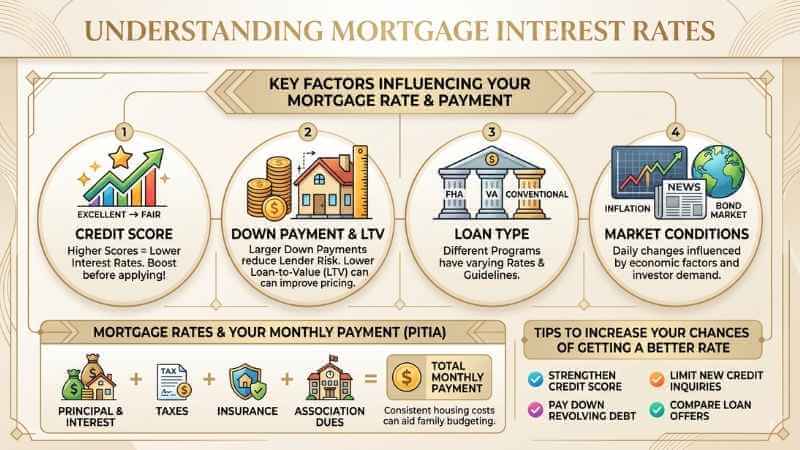
Mortgage interest rates are based on more than credit scores alone. Lenders look at the full loan profile when setting rates, which is why two borrowers can get different quotes on the same day. The main factors that affect mortgage interest rates include credit score, down payment, loan-to-value ratio, loan type, occupancy type, property type, loan term, rate lock period, discount points, and market conditions.
Putting down a bigger deposit and having a lower loan-to-value ratio boost your chances of snagging better mortgage interest rates. This is because it makes lenders feel they’re taking less risk. Loan type also matters because conventional, FHA, VA, USDA, and jumbo loans are priced differently.
Occupancy and property type can also change pricing. Primary homes usually get better interest rates than second homes or investment properties. Single-family homes may also sell for better prices than condos, multi-unit properties, or manufactured homes. The loan term and rate lock period also affect pricing. A 15-year loan may have a different rate than a 30-year loan, and a longer lock period may cost more than a shorter lock. Borrowers can also pay discount points up front to lower their mortgage interest rates. Finally, market conditions influence mortgage interest rates every day. Inflation, bond market activity, and investor demand all influence how lenders price loans. That is why mortgage interest rates are never based on a single factor. Lenders look at the full picture when setting rates.
What Are Loan-Level Pricing Adjustments on Mortgage Rates?
Loan-level pricing adjustments, often called LLPAs, are extra pricing costs lenders apply based on risk. In simple terms, they help explain why one borrower may get a better mortgage rate than another. These pricing adjustments can be affected by factors such as credit score, down payment, loan-to-value ratio, property type, occupancy, cash-out refinance, and investment property risk. The more risk a lender sees, the more likely the loan will carry added pricing. For example, a borrower with a higher credit score, larger down payment, and primary residence may receive better mortgage pricing than a borrower with lower credit, less money down, or an investment property. Borrowers do not always see LLPAs listed in plain language, but they are built into how interest rates are priced. That is why two people applying for similar loans may still receive different rate quotes.
Mortgage Interest Rates Are The Biggest Factor on Monthly Housing Payment
When budgeting for a home loan, you must prepare to pay principal and interest, property taxes, homeowners insurance, and any homeowners association dues. These five areas of your total monthly mortgage payment are referred to as PITIA. A mortgage underwriter will calculate all of these areas as your total monthly mortgage payment.
Knowing your total monthly mortgage payment will help you budget accordingly.
When you are a renter, every year, your landlord has the ability to raise your housing payment. When you buy a house, you are usually locked into a 30-year fixed mortgage program. The only way your payment will change is if your taxes and insurance fluctuate. This will help you and your family have a more consistent budget surrounding housing costs.
Why Mortgage Interest Rates Change
Mortgage interest rates can fluctuate pretty much every day, depending on what’s happening in the market. Lenders adjust rates in response to inflation, bond market activity, economic reports, and investor demand for mortgage-backed securities. This is why interest rates may move even when a borrower’s credit score, income, and down payment stay the same. Some rate changes are driven by the market, while others are based on the borrower’s individual loan profile. For most readers, the key point is simple: mortgage interest rates are shaped by both personal financial factors and overall market conditions.
How Mortgage Interest Rates Affect Monthly Payments
 Mortgage interest rates really affect how much you’ll pay each month on your mortgage. In general, a lower rate means a lower monthly principal and interest payment, while a higher rate increases the monthly cost of borrowing. Even a small change in mortgage interest rates can make a noticeable difference over time. That is why borrowers should carefully compare loan offers and consider both the interest rate and the total cost of the loan. If you want to estimate your payment, use our mortgage calculator to see how different interest rates may affect monthly costs.
Factors That Determine My Monthly Mortgage Payment on a Home Purchase
There are simple input fields that will allow you to enter the price of the home, interest rate, down payment, annual property taxes, and annual homeowners insurance cost. If you are moving to a neighborhood with a homeowners association, there is also a field to enter that cost. After you enter this information, our calculator will show you your total monthly mortgage payment. This will help if you are searching for multiple homes or are out on the road looking at homes with your realtor. Many real estate professionals utilize our calculator to help their clients.
Final Thoughts on Mortgage Interest Rates
Mortgage interest rates are shaped by a mix of personal financial factors and overall market conditions. Lenders look at credit score, down payment, loan type, occupancy, property type, and other risk factors when pricing a loan. That is why interest rates can vary from one borrower to another and from one lender to the next.
For borrowers, the most important step is understanding what affects pricing before applying. Improving credit, reducing debt, comparing loan options, and reviewing offers carefully can all help you secure more competitive mortgage interest rates.
When you understand how mortgage interest rates work, you are in a better position to choose the right loan and plan for the long-term cost of homeownership.
Frequently Asked Questions About Mortgage Interest Rates
What Affects Mortgage Interest Rates the Most?
The biggest factors that affect mortgage interest rates are credit score, down payment, loan-to-value ratio, loan type, occupancy, property type, loan term, discount points, and market conditions. Lenders also adjust pricing in response to broader forces such as inflation, bond markets, and investor demand.
Why are Mortgage Interest Rates Different for Each Borrower?
Mortgage interest rates are different because lenders price each loan based on risk. Two borrowers applying on the same day may receive different rates because of differences in credit, down payment, property type, occupancy, or refinance structure.
Do Higher Credit Scores Help You Get Lower Mortgage Interest Rates?
In general, yes. If you’ve got a good credit score, you’re likely to snag lower interest rates since lenders see you as less of a risk. Lower scores can lead to higher pricing or fewer loan options.
Can I Lock My Mortgage Interest Rate?
Yes. Most lenders offer a rate lock for a set period before closing, often for 15 to 60 days. A rate lock helps protect you if market rates rise before your loan closes, though longer lock periods may cost more.
Why are Online Mortgage Interest Rates Sometimes Lower Than the Rate I was Quoted?
Online interest rates are often based on ideal borrower profiles. They may not include all pricing variables tied to your credit score, down payment, property type, fees, or lock period. Your actual quote depends on your full loan scenario.
What is the Difference Between the Interest Rate and APR on a Mortgage?
The interest rate is the cost of borrowing the loan amount. The APR, or annual percentage rate, includes the interest rate plus certain lender fees and finance charges, giving a broader view of the loan’s total cost.
This article about “How Do Lenders Price Mortgage Interest Rates on Home Loans?” was updated on April 17th, 2026.
