State NMLS MLO Remote Work and Branch Licensing Requirements
In this guide, we will cover the state NMLS MLO work and branch licensing requirements.
Explore how distant mortgage branches and remote work policies, coupled with state fees, DBA filings, and NMLS sponsorship, affect multi-state MLO teams.
State NMLS MLO Remote Work and Branch Licensing Requirements
If your mortgage firm has loan officers working across several states, it is essential to grasp the differences between individual MLO licenses, company sponsorship, remote work approval, and licensed mortgage branches. Getting licensed in a state does not always mean an MLO can work from home or another remote place. In some states, the home office must be near a branch, linked to a licensed branch, or covered by an approved remote work policy.
This summary is based on a mortgage licensing meeting on July 9, 2026, and a state review starting January 1, 2025. It serves only as a training resource and preliminary planning tool; it is not legal advice.
State mortgage laws, regulatory interpretations, and rules on remote work, fees, and branch licensing can change. Before allowing an MLO to work remotely or submitting a license application, consult current state requirements and seek guidance from the appropriate regulator or licensing expert. ranch license authorizes a company to conduct licensed activities at a designated business location.
NMLS Branch License vs NMLS MLO License
The branch is typically linked to the company’s NMLS record via an MU3 filing. A branch license differs from a loan originator’s license. Even if a loan originator is licensed, both the company and the branch must comply with the regulations of the state where the branch operates. NMLS is the official system for state agencies, their companies, and employees to submit applications to, and modify, renew, or withdraw license requests..
Does Remote Work Eliminate the Need for a Licensed Branch?
Often, remote work does not remove the need for a licensed branch. Some states permit an MLO to work from home if the mortgage company maintains a licensed branch, has an approved remote work policy, and ensures ongoing supervision, information security, recordkeeping, advertising compliance, and consumer protection.
Other states may restrict how far an MLO may reside or work from a licensed branch. Some may also require the MLO’s home address to meet specific criteria or be licensed as a branch.
Companies need to review each state’s rules about where MLOs can work, what counts as a home address, how branches are affiliated, and what supervision is required.
Preliminary States With Distance-to-Branch or Remote Work Concerns.
A preliminary list from a mortgage licensing consultant identified these states as potentially having distance-to-branch restrictions, remote-work limits, or unclear remote-work requirements.
Alabama Mortgage Broker Licensing
Preliminary guidance indicated that MLOs must be within 60 miles of the licensed branch unless the company qualifies under an approved remote work policy. The specific rule may depend on the company’s license type, supervisory structure, and written remote work procedures.
Alaska Mortgage Licensing
Alaska was identified as a state where remote work may have been temporarily permitted; however, this status was not verified in the source email. Companies should obtain current information before assigning an Alaska-licensed MLO to a remote work location.
Connecticut Mortgage Licensing
The preliminary distance for Connecticut was approximately 100 miles. The email also inquired whether any temporary remote work allowance remained in effect. Because the status was unknown, Connecticut should be reviewed before relying on this estimate or any prior temporary policy.
Kentucky Mortgage Licensing
Kentucky was listed as having an approximate distance requirement of 60 miles. Companies planning to establish a branch in Kentucky should verify the state’s method for assessing distance and whether an approved remote work policy would impact this requirement. Louisiana was listed with a possible 120-mile distance requirement. The licensing consultant awaited confirmation of the current rule. Mortgage companies should not rely on this preliminary distance until they receive an updated response.
Maine Mortgage Licensing
Maine was listed as allowing certain remote work policies to be in effect through December 31, 2022. Since Maine’s temporary remote work program has expired, companies should determine whether remote work has become permanent or if prior branch work requirements have been reinstated.
Mississippi Mortgage Licensing
Mississippi has a distance requirement of approximately 125 miles. The company should determine The company should determine if the requirement applies to the MLO’s residence, principal work location, supervising office, or licensed branch. Nebraska has remote work regulations that may exclude persons with certain health restrictions. Mortgage companies should never assume remote work rules apply automatically. Always check with regulators for details, and consider how travel time, traffic, distance, remote setups, office location, or supervision might affect compliance.
New Mexico Mortgage Licensing
New Mexico has an approximate 75-mile distance requirement. The email inquired whether temporary remote work was still allowed. The current regulation should be consulted to determine an MLO’s assigned work location.
New York Mortgage Licensing
New York may have a distance limit of about 50 miles or a travel time limit of 2 hours to the branch. The email also asked if temporary remote work was allowed. New York licensing and branch work requirement regulations should be carefully reviewed, as they may vary based on the company’s license, location, regulatory status, recordkeeping, supervision, and authorized activities.
South Carolina Mortgage Licensing
Both South Carolina BFI and South Carolina DCA licensing were found to require a distance of approximately 75 miles. A temporary South Carolina DCA remote-work arrangement may have lasted only until December 31, 2022. Companies should determine which South Carolina regulators and license types apply to their activities.
South Dakota Mortgage Licensing
South Dakota was found to have temporarily allowed remote work until December 31, 2021. The initial fee discussion indicated a separate branch license might not be required. This should be verified based on the company’s license type.
Vermont Mortgage Licensing
According to the consultant’s email, Vermont will likely permit broader remote work in the future, but it did not specify whether a final rule has been adopted. Before setting up a residential work option in Vermont, companies should review the latest state rules.
Wisconsin Mortgage Licensing
Wisconsin has an approximate 100-mile distance requirement. A mortgage company operating in multiple states should verify whether the MLO’s Wisconsin residence is sufficiently close to the licensed branch. If not, a separate Wisconsin branch license or approved remote work arrangement will be required.
Wyoming Mortgage Licensing
Wyoming was also found to have an approximate 100-mile distance requirement. The company should assess the current rule and determine how the MLO will be supervised from the licensed branch.
Preliminary Mortgage Branch Licensing Fees
A third-party professional licensing consultant provides estimated state branch costs for preliminary planning. These figures are not final or comprehensive.
Estimated Fees Are:
- Alabama $620
- Alaska $520
- Connecticut $1,020
- Kentucky $420
- Louisiana $120
- New Jersey $1,020
- New Mexico $520
- South Carolina $170
A separate South Dakota branch license may not be needed. The fees for Maine, Mississippi, Nebraska, New York, Vermont, Wisconsin, and Wyoming are still under confirmation. These estimates may exclude NMLS processing fees, surety bond adjustments, background checks, fingerprinting, credit reports, registered agent fees, qualifying individual fees, secretary of state registration, local business occupancy, or professional licensing services.
Know When a Licensed Branch May Be Required
An MLO license alone may not authorize work from every location. Get a checklist to understand when a home office, branch office, or state approval may be needed.
NMLS has a License Requirements and Fees Chart
NMLS has a license requirements and fees chart and a state checklist compiler for viewing current state requirements. NMLS has a central fee chart that cannot possibly cover every additional or separate processing or state-related fee. The current NMLS standard processing fee for a branch application or an annual branch renewal is in addition to fees charged by the applicable state agency.
Why the Cheapest Branch Is Not Always the Best Branch
Do not choose a branch location just because the state application fee is low. Consider where your MLOs are located, which states generate the most loans, whether the branch location complies with state distance rules, who will manage the branch, and whether the location fits your growth strategy. A strategically located branch may serve multiple MLOs in different states. However, physical branch, office, or supervision requirements may prevent one branch from meeting regulatory obligations in every state.
The relationship among the mortgage company, corporate office, and assigned branch must be authorized by the state regulator.
An MLO may have operational relationships with both the corporate office and a company branch, but not all states allow two separate sponsorships or loan origination at both locations. The company will decide the office that supervises the MLO, the office that will appear in promotional materials and disclosures, the office that will house records, and the branch that will receive production.
Can a Mortgage Loan Officer Do Their Job Remotely?
Mortgage loan officers may work from home if both the officer and the employing company comply with the state’s remote work policies. This includes having a remote work policy, secure work tools, remote supervision, approved marketing, and safeguards for borrower information.
Some states may also impose a limit on how far the mortgage loan officer may reside from the branch. a mortgage branch license required for a mortgage loan officer’s residence?
Not necessarily. Some states may allow a mortgage loan officer to work from home without requiring a branch license for the residence, provided other specific criteria are met. In other states, the home may be considered a business location, or the mortgage loan officer may be required to work from a branch within a certain distance. This depends on state laws and the company’s license type.
Managing Own Mortgage Brokerage vs Mortgage Net Branch
Mortgage Loan Orignators who want to be independent and run their own team, or mortgage company can compare and contrast on either becoming your own NMLS Licensed Mortgage Broker or join a larger national mortgage company and become a mortgage net branch. The ideal staff and structure can differ from state to state. Review the branch licensing rules before making any changes to sponsorships.
If a state does not require branch sponsorship and the MLO meets all other state requirements, the MLO may maintain an approved but inactive status.
Typically, an inactive license does not permit the MLO to take loan applications, negotiate terms, offer mortgage products, or perform other loan origination activities. The MLO should ensure their license is active and properly sponsored before engaging in any loan origination, as rules and consequences vary by state.
Using a DBA for a Mortgage Company or Branch
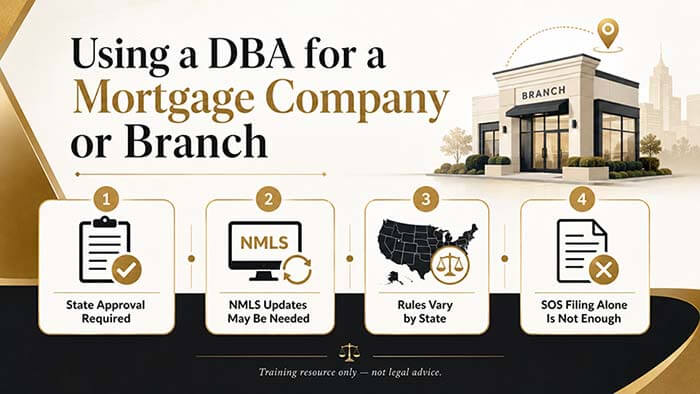 A mortgage company seeking to operate under a trade name such as Gustan Cho Associates must obtain DBA approval from state regulators, the NMLS, the Secretary of State, or another government body.
Registering a trade name with the Secretary of State does not automatically authorize a mortgage company to use that name for mortgage activities.
Regulatory approval for DBAs, assumed-name registrations, and advertising may differ from state to state, as will branch record keeping and NMLS modification requirements. The source email referenced a DBA cost spreadsheet, which was not included in the materials for this training summary. As a result, estimated DBA filing fees are not provided.
How Mortgage Companies Should Plan a Multistate Branch
The company must identify all states where its MLOs live and the states in which MLOs will be originating loans. Next, the company should determine the proximity of MLOs to the corporate or licensed branch. Priority should be given to states with unclear distance requirements, remote work policies, or office requirements, as these states often have stricter regulations. The company should review the NMLS checklists for itself, its branches, and its MLOs.
The Mortgage Company needs to consider the costs of setting up a branch, including state filings, NMLS fees, surety bonds, office and staff expenses, and the cost of a qualified individual and their oversight.
Before filing, companies should obtain written confirmation regarding any unclear remote work or distance rules. While verbal answers may be helpful, written responses are preferable for compliance records. Companies should implement remote work policies that address supervision, cybersecurity, consumer privacy, secure document handling, business communications, advertising, record access, complaint management, and prohibited activities at an employee’s home.
Mortgage Branch Licensing Rules Vary Widely from State to State
You should consider the MLO’s license, company sponsorship, assigned branch, work location, remote work policy, and state distance rules collectively. Possessing a state-approved license does not always permit an MLO to work from a home office, even with restrictions.
The state distance rules and branch fees in this training are early estimates meant for an introduction to licensing. They are not formal requirements or legal advice.
Before opening a branch, assigning an MLO to remote work, changing sponsorship, using a DBA, or implementing a remote work policy, review the latest NMLS requirements and obtain confirmation from the appropriate state regulator or mortgage compliance expert.
FAQs on Mortgage Branch Licensing and Remote Work
What is the Distance Requirement for a Mortgage Loan Officer to Live from the Branch?
There is no uniform distance requirement nationwide. Some states may impose a distance limit, a travel time limit, or a supervisory requirement. Where such requirements exist, the range is typically between 50 and 100 miles.
How Much Money is Needed to Open a Mortgage Branch?
The cost varies by state and company license type. Opening a mortgage branch may require a state application fee, NMLS processing fee, surety bond adjustment, registered agent appointment, secretary of state registration, qualifying individual, office lease, local business license, and annual renewal fee. Companies should estimate both first-year and ongoing costs before applying.
Can an MLO Have Two Sponsorships?
Holding sponsorships with two companies is not permitted in all situations. This depends on state laws, employment relationships, NMLS settings, and company affiliations. An MLO should not originate loans for two companies unless the arrangement has been reviewed and approved.
Can an MLO Have a Corporate Relationship and Be assigned to a Branch?
Yes, an MLO may have a corporate relationship and be operationally assigned to a licensed branch. The company must determine which location is responsible for oversight, operational control, recordkeeping, production, and regulatory compliance. The NMLS record and company structure must support the approved operational control.
What is the Meaning of Having an Approved-Inactive MLO License?
An approved-inactive license means an individual has met the state’s active licensing requirements but does not have a sponsor company for mortgage origination. The MLO should not assume that an inactive license permits them to take mortgage applications or negotiate mortgage terms.
Does a Mortgage Company Need State Approval to Use a DBA?
Yes, in many states, a mortgage company may require regulatory approval to use a trade name in advertising, disclosures, websites, social media, and loan documents. A general business name registration may not meet all requirements. The DBA should also be reported in the NMLS, where applicable.
Where Can a Company Verify Current Mortgage Branch Requirements?
Companies should begin with the following:
- NMLS State Resource Center.
- The License Requirements and Fees Chart
- The state licensing checklist compiler.
- They should also review the applicable regulator’s website and request written clarification when remote work or distance requirements are unclear.
- NMLS Consumer Access is a public resource for reviewing information about licensed companies, branches, and individuals. (Nationwide Licensing System)
Compliance Disclaimer:
This post is for mortgage training and education. It is not intended to provide legal advice or a definitive licensing determination. State requirements, regulatory guidance, fees, temporary permissions, and NMLS practices may change. All mortgage companies and MLOs must assess the status of all requirements prior to conducting any licensed activity.
Ready to Keep Your Mortgage Branch Compliant?
Send your states, branch locations, and MLO remote work setup. We’ll help you organize the requirements and next steps for a cleaner compliance process.