In this blog, we will discuss and cover FHA reverse mortgages for senior homeowners. Homeowners who are 62 years old or older can qualify for FHA Reverse Mortgages. Reverse Mortgages are ideal for retired homeowners with limited fixed income such as pension or social security income. John Strange, a senior mortgage loan originator at Gustan Cho Associates says the following about FHA Reverse Mortgages for senior homeowners.
Seniors with not enough income to qualify for a traditional cash-out FHA or Conventional Loan, then FHA Reverse Mortgages may be the perfect loan program for them.
The only requirement is that homeowners have enough equity in their homes. The higher the equity in home the more cash-out refinance proceeds homeowners can get. The older the homeowner is the higher the loan to value cap. In this article, we will discuss and cover mortgage guidelines on reverse mortgages. In the following paragraphs, we will cover FHA reverse mortgages for senior homeowners.
What Are FHA Reverse Mortgages?
FHA Reverse Mortgages is also called a home equity conversion mortgage (HECM). FHA Reverse Mortgages are special types of refinance mortgage loans. Allows homeowners age 62 or older possible to tap the equity in their homes.
This detailed guide will show you how FHA Reverse Mortgages allow senior homeowners to access the equity in their home for added financial flexibility.
There are various options of distribution plans on reverse mortgages offered to borrowers. Disbursements from reverse mortgages can be disbursed in two ways. It may be a lump sum that they can take out at once and use it for any reason. It may be a stream of regular payments paid over the life of the homeowner.
No Monthly Payments Required on FHA Reverse Mortgages
FHA Reverse Mortgages are an excellent opportunity to access home equity for senior homeowners. Unlike a traditional mortgage, there are no monthly payments required. This guide will help you understand the intricacies, the benefits, the eligibilities, and the application process.
Also known as Home Equity… Conversion Mortgages, they allow homeowners (62 and older) to turn a part of their home equity into liquid cash for many purposes, such as, daily living expenses, medical bills, or home renovations.
FHA Reverse Mortgages are a federally insured reverse mortgage with the FHA. Unlike traditional home equity loans, there are no monthly payment requirements on FHA reverse mortgages. Homeowners do not have to pay a single mortgage payment as long as they occupy the home. The home to be eligible for FHA reverse mortgages need to be an owner-occupant home.
Reverse Mortgage Guidelines
FHA Reverse Mortgages have many benefits, one of the most prominent being the flexible options available to clients. Depending on a customer’s financial situation, the customer can choose to receive their funds in a lump sum, monthly payments, or they can choose to have a line of credit. Furthermore, there are no monthly payments on the loan and the loan holder keeps ownership of the property. The home remains the borrowers for as long as they continue to live in the home. The loan comes due when the borrower leaves the home, they sell the home, or the borrower passes away.
Reverse mortgage borrowers must have to reside in the home they are taking out the reverse mortgage from. They need to stay current on their property taxes and insurance.
Disbursements may be used to supplement social security, meet unexpected medical expenses, make home improvements, and more. The equity built up over years of home mortgage payments can be paid to the reverse mortgage borrower. But unlike a traditional home equity loan or second mortgage, no repayment is required until you no longer use the home as their principal residence or you decide to sell their home
What Are FHA Reverse Mortgages Eligibility Requirements
There are certain eligibility requirements that must be met in order to qualify for an FHA sponsored reverse mortgage. First, borrowers must be a minimum of 62 years of age. Homeowners must have enough equity in their home to meet the requirements for a reverse mortgage as well as own the home as their primary residence. The property must meet and pass the FHA requirements and must not have any liens placed on it.
Reverse mortgage borrowers and any co-borrowers must be at least 62 years old to qualify. Here are the basic requirements:
- Reverse borrowers need to own their home free and clear or have a very low mortgage balance
- The home must be the principal residence
- May be a single-family or 2 to 4 unit dwelling
- Condominiums and Planned Unit Developments (PUDs) may be eligible if they are in HUD-approved developments
- Borrowers do not need a job to qualify for reverse mortgages
- Borrowers are required to attend and complete a Federally required housing counseling course
There are a number of steps in the application process for an FHA reverse mortgage loan. The first step is for the borrower to meet with an authorized FHA approved mortgage counselor for a one-on-one session. The purpose of this meeting is for the mortgage counselor to provide an overview of the loan and answer any questions the borrower might have regarding the loan terms. After the borrower has participated in the counseling session, they can begin the application process. The application process involves submitting financial documents and an appraisal of the property must be completed. Unlike ordinary loans, a reverse mortgage does not require repayment as long as homeowners live in their homes. Principal, plus interest is recovered when the home is sold. The remaining value of the home goes to you or your survivors.
What Are The Maximum Loan Amounts For FHA Reverse Mortgages
The costs associated with FHA loans do not just include interest. Also needed is origination fees, costs related to mortgage insurance, and for closing and settlement as well. It is important for any FHA loan mortgage borrower to come to completion on an amortization schedule and determine the total loan costs. An advantage is that a borrower can finance the fees into the loan, meaning out-of-pocket costs can be mitigated.
The maximum amount of a reverse mortgage varies by geographic area and changes frequently.
- Normally the maximum value of the subject property cannot exceed $650,000
- If it does, they will not go beyond the $650,000 value
- The amount borrowers can borrow (LTV) depends on their age
- The older a borrower is, the more they can borrow
Please contact us at Gustan Cho Associates Mortgage for the maximum mortgage amount for your area.
How Are Cash Disbursements Made on Reverse Mortgages
There are five options borrowers can choose from for receiving cash disbursements. They are not limited to a single option. As their needs changes, reverse mortgage borrowers may change from among the following reverse mortgage disbursement options:
- Tenure – equal monthly payments as long as at least one borrower lives and continues to occupy the property as a principal residence
- Term – equal monthly payments for a fixed period of months selected
- Line of Credit – unscheduled payments or in installments, at times and in amounts of your choosing until the line of credit is exhausted
- Modified Tenure – the combination of a line of credit with monthly payments for as long as you remain in the home
- Modified Term – the combination of line of credit with monthly payments for a fixed period of months selected by borrowers
Remember that repayment of FHA reverse mortgages does not start until the homeowner no longer occupies the home as their principal residence. Homeowners of FHA reverse mortgages will be responsible for making insurance and property tax payments but payments on the reverse mortgage do not begin until they no longer occupy your home. It is mandatory that a reverse mortgage borrower seek professional credit counseling prior to closing on a reverse mortgage refinance loan.
Protect your spouse with the right setup
Non-borrowing spouse and occupancy rules explained in plain English
Comparing Reverse And Traditional Mortgages
FHA Reverse Mortgages is insured by the government, unlike other reverse mortgages. Standard reverse mortgages offer a higher risk which is a loss of your home while government insured mortgages can protect borrowers from equity loss.
- A reverse mortgage is best explained by comparing it to traditional or “forward” mortgage
- With government and conforming loans, mortgage lenders check the borrower’s income and credit history
- It also appraises the home with a home appraisal to ensure that its market value is sufficient to support the loan
- The mortgagor borrows money from the lender using the home as collateral
- The homeowner pays the lender each month an amount representing principal and interest
- As the debt is paid down, the borrower’s equity in the home grows
Homes can also increase in value with market appreciation.
How Does FHA Reverse Mortgages Work?
A reverse mortgage works in the opposite way.
- The homeowner receives money from the lender based on the home’s appraised value
- The loan’s collateral is the home’s equity or its appraised value
- The homeowner doesn’t make any monthly payments to the lender
- There are reverse mortgage programs where the lender makes payments to the homeowner each month (or in whatever way the terms of the reverse mortgage have been established)
- The term and conditions of reverse mortgages depend on the appraised value of the home
- There is no minimum amount of income to qualify for a reverse mortgage unlike traditional forward purchase home loans
Homeowners do not need any income to qualify for HUD Reverse Mortgages.
FHA Reverse Mortgages For Senior Homeowners
What are FHA Reverse Mortgages (HECM) for senior homeowners, and how do they work? Please find information on the cost, payment options, pros and cons, and frequently asked questions.
What is an FHA Reverse Mortgage?
An FHA Reverse Mortgage is a Home Equity Conversion Mortgage (HECM), a federally insured loan for senior homeowners aged 62 and older, that allows them to convert a portion of their home equity into cash. FHA Reverse Mortgages differ from traditional FHA loans in that you do not make monthly principal and interest payments. Instead, they do so when they sell the home, move out permanently, or the last borrower passes away. The insurance provided by the FHA adds a protection system that prevents the borrower from going into a deficit due to a negative equity situation.
FHA Reverse Mortgages Basics
How Do You Get Paid?
- When it comes to reverse mortgages, the home being remortgaged serves as collateral.
- Therefore, the home must meet certain primary requirements, such as being paid off and having no other liens, to qualify.
- Qualifying that is a primary residence that is a single-family home, an FHA-approved condominium, or a two to four-unit property that has one unit that is owner-occupied, or a manufactured home that meets the appropriate HUD standards.
Disbursement options are:
- Lump sum (generally has a specified interest rate with first-year draw limitations).
- Line of credit (grows over the draw period on the unused portion).
- Monthly payments (tenure for life in the home or for a specified term in years).
- A Combination of the above.
- Interest & MIP: Borrowed amounts will have interest accrue over the term.
- The FHA charges upfront and annual MIP.
- Repayment: No monthly principal and interest payments are required.
- The borrower is responsible for ensuring that property taxes, homeowners’ insurance, and maintenance are kept up-to-date.
- The loan ends when a maturity event occurs (the home is sold, there’s a permanent relocation, or the last borrower dies).
How Much You Can Receive
Your principal limit depends on:
- Age of the youngest borrower (or eligible non-borrowing spouse).
- Interest rate expected.
Value of the home (with a HUD maximum claim amount)
- The Assessment of finances (which may require a LESA—Life Expectancy Set-Aside—for taxes/insurance).
FHA Reverse Mortgages vs. Traditional Mortgages
- Payment Obligation: For inverted mortgages, the FHA does not require monthly payments (the other type of mortgage does require them).
- Cash Flow: HECM enhances retirement cash flow through draws or a line of credit, compared to other loan options.
- Equity Impact: HECM results in a reduction of equity over time due to the accumulation of interest and mortgage insurance, which are added to the balance. In contrast, a conventional mortgage allows equity to be built and increased through the repayment process.
- Qualification: HECM revolves around age, equity, and the capacity to pay the taxes and insurance, rather than just income and credit scores.
FHA Reverse Mortgage Qualification Guidelines
A difference must be noted in related to loans for home equity and for an FHA reverse mortgage. An FHA reverse mortgage does not require repayments, while loans for home equity do require monthly repayments.
It is possible to leave it to your heirs. Your heirs can either pay off the debt while retaining the home or choose to sell the home to get a settled debt.
If you move out of your home, the loan becomes due and you need to repay the loan balance that is still owing. This is required to be accomplished by selling the home or through some other means that can be negotiated by the parties.
Borrower Qualification Guidelines
- Age 62 or older (you or your spouse).
- You must occupy the property as your primary residence.
- You must have sufficient equity in your home to satisfy the principal limit and any existing lien payoffs.
- You must be able to financially manage the ongoing costs of tax, insurance, and maintenance.
- Must have counseling from an approved HUD provider before applying.
Property Qualification Guidelines
- Your home must comply with both FHA property standards and occupancy rules.
- Condominium properties must be on the FHA-approved list (or approved as a single unit, as applicable).
- The property may need repairs if the appraisal identifies any health and safety concerns.
FHA Reverse Mortgage Costs
While the FHA reverse mortgages are beneficial, there are also some risks to consider. These include, but aren’t limited to, the accumulation of interest that diminishes the equity in your home as time goes by and, the possibility of being in a situation where your outstanding debt is greater than the worth of your home.
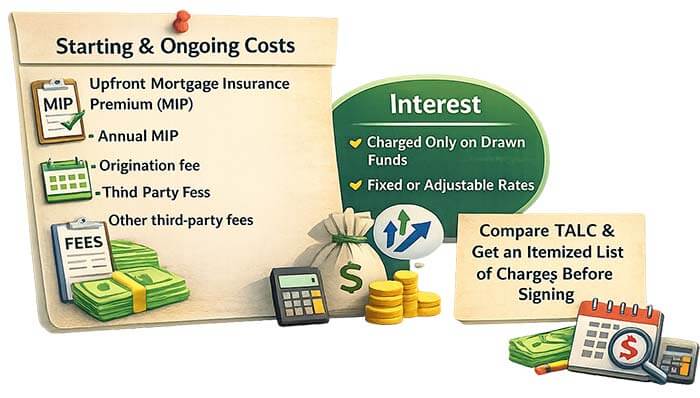
Starting and Ongoing Costs
- Upfront Mortgage Insurance Premium (MIP): Upfront MIP is typically financed into the loan.
- Annual MIP: Annual MIP is charged on the loan balance.
- Origination fee: The Origination fee is limited according to HUD schedules.
- Other third-party fees include appraisal, title, recording, and counseling fees.
- Interest: Interest is only charged on funds that have been drawn (plus financed fees).
- Interest can be fixed or adjustable.
- Because there can be substantial cost differences between lenders, we recommend considering the Total Annual Loan Costs (TALC) and requesting an itemized list of charges before signing any agreements.
HECM Line of Credit: A Retirement Buffer
- An advantage of FHA Reverse Mortgages is the growing line of credit.
- Due to the terms of the loan, the unused line will increase over time, which creates a flexible buffer for unexpected expenses, market downturns, or long-term care gaps.
- Many retirees utilize HECM lines as part of their investment strategy to avoid selling their assets when the market is down.
Protections for Borrowers and Heirs
Non-Recourse & Spousal Protection
- Non-Recourse: At the time of repayment for the loan, you or your heirs never owe more than the home’s value.
- Non-borrowing spouse: If properly documented and still residing in the home, and is eligible as a non-borrowing spouse, that spouse may continue to live in the home after the borrower dies (according to HUD regulations).
What Heirs Can Do
When an eminent domain mortgage loan matures, heirs can ..
- Sell the home and use the sales price to pay off the loan.
- Retain the home by paying the lesser of the loan balance or the current appraised value (this is pursuant to non-recourse conditions established by HUD).
- Deed-in-lieu options are available if the home has no equity, and negative equity makes it non-viable for the homeowner to remain in the property.
FHA Reverse Mortgages for Purchase (HECM for Purchase)
- HECM for Purchase allows you to buy a new primary residence.
- Rather than utilizing an all-cash purchase, one of the traditional mortgages, you are required to bring a required down payment (age and expected rate based) along with it. You can avoid monthly P&I payments indefinitely, as long as you remain current with the required taxes, insurance, and property maintenance (as these are necessary to keep the loan current).
- This can facilitate right-sizing your home without immobilizing all of your retirement finances.
Compare reverse vs. refinance vs. HELOC
Side-by-side costs, risks, and flexibility for informed decisions
Pros and Cons of FHA Reverse Mortgages
Advantages
- No monthly principal and interest payments, so you have more money every month.
- You can receive money in various ways, and you can choose the one that works best for you, such as through a line of credit, a lump sum, or regular monthly payments.
- Both you and your heirs are protected by non-recourse debt.
- The proceeds of the loan are typically tax-free. You should still consult a tax professional, however.
- The HECM for Purchase program can be very efficient.
Considerations of FHA Reverse Mortgages
- The upfront and ongoing costs, as well as the interest that continues to accrue, decrease the equity available in the house.
- You are still responsible for paying property taxes, insurance, HOA dues (if any), and for maintaining the house.
- If you move out or are away for an extended period, the loan will require immediate repayment.
- When balances continue to grow, it will mean heirs will get less equity upon your death.
When an FHA Reverse Mortgage Makes Sense
If you are house-rich, cash-flow constrained, and intend to age in place.
- Suppose you need an emergency line of credit that doesn’t require monthly payments. In that case, it gives you more flexibility with your finances and provides protection.
- To supplement your retirement income without having to sell your declining investments.
- If you intend to purchase a more suitable primary residence, and want a loan without monthly principal and interest payments.
Common Myths About FHA Reverse Mortgages
The bank takes your home. False. As long as you continue to meet the terms of the mortgage, such as maintaining the house, paying taxes, and keeping it insured, you keep the title.
My heirs will owe huge debts.
- False.
- The non-recourse rules mean that liability and debt are limited to the value of the home.
- Your options are estimated, along with other payout options, from which you can choose a lump sum payment.
- Only for those in need might seem to be true, but **FHA Reverse Mortgages serve as a planning tactic used by many smart retirees.
Getting an FHA Reverse Mortgage: A Guide
- HUD Counseling: First, there is counseling for reverse mortgages, which HUD requires.
- Application & Disclosures: This section enables you to review the TALC, estimates, and guides you on how to compare and contrast the programs.
- Appraisal & Underwriting: Now it’s time for the evaluation of the property and the financial review.
- Clear Conditions & Close: Now it’s time for you to sign the final documents, and you’ll also decide how to receive payment.
- Post-Closing Servicing: This step involves drawing the money according to your plan, but remember to keep your taxes and insurance up to date.
- Pro tip: Lenders are highly recommended to model multiple scenarios for you, which may include a line of credit and fewer monthly payments, as well as HECM for Purchase as opposed to refinance with or without LESA.
Things That are Alternatives to FHA Reverse Mortgages
- Get a Lower Payment Mortgage Refinance: Home Equity Line of Credit (HELOC) or a home equity loan.
- Downsizing when selling your current home and buying a new home with cash or a small loan.
- Sell & rent your home for less upkeep and more equity.
- A proprietary jumbo reverse mortgage is available if your home is worth than what the FHA covers.
Compliance, Taxes, and Estate Planning
- Occupancy: It is a requirement to live in the home as your primary residence.
- Taxes & Insurance: Failure to pay these can result in default.
- Tax treatment: Payments are considered loan advances, which are generally not taxable income.
- However, if interest is not repaid, it is typically considered non-deductible until it is repaid.
- Always consult a tax advisor.
- Estate planning: Coordination with your estate planning attorney is essential to explain to the heirs their alternatives and the time frames involved.
FAQs: FHA Reverse Mortgages
What is an FHA Reverse Mortgage?
- This is an FHA Reverse Mortgage known as a HECM loan, which permits individuals aged 62 and older to access the cash value in their homes (equity) with no monthly principal and interest payments, and is FHA-insured.
Who Qualifies For FHA Reverse Mortgages?
- FHA Reverse Mortgages are available to homeowners who are 62 or older and reside in the home as their primary residence.
- There is a financial assessment that needs to be passed, there is sufficient equity, and complete HUD counseling.
Do I Keep My Home Title?
- Absolutely.
- You cannot be forced out.
- With FHA Reverse Mortgages, you retain title and ownership as long as you comply with the program’s requirements.
How Do I Receive My Funds?
- You can have your funds in the form of a lump sum, credit line, monthly payments (in a tenure or term payment), or a combination of various payment methods.
What Costs Are Involved?
- You will have to pay an upfront MIP, a supplementary annual MIP, and there are costs for origination, third-party closing costs, and interest on amounts that are pulled forward.
- Be sure to request a comprehensive TALC to compare all costs systematically.
- No, your heirs will not be burdened, as the FHA Reverse Mortgages are non-recourse.
- Heirs can sell the house or keep it by paying the lesser of the remaining mortgage balance or the current appraised value of the home.
- Yes, provided the condo is FHA-approved (or eligible for single-unit approval as per current HUD guidelines.
Suppose You No Longer Occupy The Home As Your Primary Residence. In that case, The Loan Becomes Due and Payable After a Certain Amount of Time.
- No, usually it is not because the funds are loan proceeds.
- Consult your tax professional for the specifics.
- A Life Expectancy Set-Aside is a form of reserve account designated for required taxes and insurance.
- This improves overall sustainability and reduces the risk of default.
- Yes.
- The HECM for Purchase Program allows you to buy a primary residence with a required down payment and no monthly principal and interest (P&I) payments thereafter.
- Approval is based, in part, on your credit history and report to understand your willingness to meet the obligations of your loan.
- The focus is on ensuring you can sustain the home with taxes, insurance, and upkeep.
Summary of FHA Reverse Mortgages
- FHA Reverse Mortgages (Home Equity Conversion Mortgages) enable homeowners aged 62 years and older to instantly convert their home equity into cash without making monthly principal and interest payments.
- You need to continue living in the home, paying property taxes and insurance, and keeping the property in good condition.
- The loan is non-recourse, which means you and your heirs are protected from being liable for more than what the property is worth.
- If you are right-sizing, consider a line of credit and HECM for Purchase for flexible, growing access to funds.
- With an experienced lender, you should analyze costs and payout options and consider different scenarios. You should consult tax and estate advisors.
Are You Ready To Understand What You Can Do?
- Do you have questions regarding HECM and Reverse FHA Mortgages? You can obtain customized quotes, and we can create side-by-side scenarios tailored to your goals, property type, and ag
Equity Is Required To Qualify For Reverse Mortgage
With a reverse mortgage, the homeowner is increasing the debt on the home by taking the equity they have in their home in cash. No repayments are made until the home passes or sell the home. The result of a reverse mortgage is just the opposite of traditional forward home loans:
- mortgage loan balance increases every month
- debt increases and the home equity decreases
- The mortgage loan balance amount owed increases every year
- Homeowners who live over 100 years old still do not have to worry about making any payments on FHA Reverse Mortgages
FHA reverse mortgages allow older adults to have the flexibility and peace of mind from knowing that they have a way to utilize their home equity. Knowing the benefits, risks, and the eligibility criteria can help a senior homeowner decide if an FHA reverse mortgage is a good option for them. The loan does not have to be repaid until the owner dies, moves from the home sell the home, or fails to maintain it properly, keep it insured, or pay property taxes. The final payment to the lender is typically structured not to exceed the home’s selling price.
Talk to a reverse mortgage specialist today
One-on-one guidance from application to funding—clear, patient, and thorough