
Fannie Mae DTI Guidelines on Conventional Loans: Borrowers can calculate their debt-to-income ratio using the Conventional Loan DTI Mortgage Calculator powered by Gustan Cho Associates. Conventional loans are the most popular loan program for first-time homebuyers due to the low 3% down payment program.
- Conv
- FHA
- VA
- Jum/Non
- USDA
Debt to Income Calculator
Fannie Mae DTI guidelines has a debt-to-income ratio cap at 45% on conventional loans. The minimum credit score to qualify for a conventional loan under Freddie Mac and Fannie Mae guidelines is 620 FICO. However, borrowers with higher credit scores (generally 680 FICO or higher), Fannie Mae DTI guidelines can top at 50% DTI on conventional loans. Christy Hembree, a senior mortgage loan originator at Gustan Cho Associates says the following about Fannie Mae DTI guidelines on conventional loans:
To get an approve/eligible with lower credit scores, the debt-to-income ratio may be capped at 45%. Fannie Mae DTI Guidelines have a maximum debt to income ratio cap of 50% DTI on conventional loans.
Conventional loan debt-to-income ratio guidelines are different than any other mortgage loan program. There is no maximum front-end debt-to-income ratio on conventional loans. There is only one debt to income ratio on conforming loans which is the back end. In the following paragraphs, we will cover Fannie Mae DTI guidelines on conventional loans and how to get the most accurate number on the housing payment on conventional loans using conventional DTI mortgage calculator.
What are Conventional Loans

The distinction between government-backed and conforming loans means that conventional loans follow separate mortgage lending criteria and typically require higher credit scores than government-backed loans.
Among these criteria are the Fannie Mae DTI Guidelines, which set more favorable debt-to-income ratios for conventional loans than FHA loans. The most widely utilized loan options in the United States are FHA and conventional loans. This blog will explore and contrast these two main loan types.
Fannie Mae DTI Guidelines – By Conventional Loan DTI Mortgage Calculator
- Mastering The Conventional DTI Calculator and Mortgage Debt DTI for Conventional Loans.
- The Expectations and The Understanding of the Debt-to-Income DTI Ratio.
- The Expectations and The Understanding of Debt-to-Income DTI Ratio for Conventional Loans.
Front-End vs. Back-End DTI Explained
- Front-End DTI: It considers only the housing expenses (principal, interest, taxes, and insurance).
- Back-End DTI: It considers all debts and dues that must be paid monthly (housing, car loans, student loans, credit cards, etc.).
Fannie Mae DTI Guidelines for Conventional Loans
Maximum DTI Ratios Allowed by Fannie Mae
Fannie Mae Normally Accepts:
- Front-End DTI: Maximum of 36% for the majority of borrowers
- Back-End DTI: 45% to 50% varying by credit score, reserves, and other compensating factors.
DTI Limits for Automated versus Manual Underwriting
- Automated Underwriting (DU): Strong credit and reserves may allow higher DTI.
- Manual Underwriting: More conservative DTI limits, generally 43% or lower. Underwriter has a lot of discretion with compensating factors.
How to Use the Conventional DTI Calculator by Gustan Cho Associates
Step-By-Step Instructions for Adding Your DTI
- Input your total gross income received each month.
- Detail all debts paid each month (not including your light bill or groceries).
- Include the estimated mortgage payment that includes taxes, insurance, PMI, and HOA.
- Evaluate your DTI results for front-end and back-end.
What the Calculator Includes
- All monthly debt obligations
- HOA dues
- Private mortgage insurance (PMI)
- Homeowners insurance
- Property taxes
- Principal and interest
How DTI Affects Your Chances of Getting Approved for a Conventional Loan
Conventional Loan Eligibility Based on DTI
Lenders use DTI to measure risk. It also determines the borrower’s financial condition. A lower DTI value puts the borrower in a better position for approval.
Other Factors That Can Help to Offset a High DTI
- Top Tier Credit Score
- Significant Cash Reserve
- Consistent Work History
- High Debt Equity Ratio
In the modern world, mortgages and mortgages, the concept of mortgage has become a universal requirement. This concept of attaching oneself to a Conventional DTI Calculator for a loan and fulfilling those requisites is often dictated by the Fannie Mae DTI Guidelines. Contact us today to use our DTI calculator and find out how much house you can afford.
This guide contains intricate information on how to capture the magic of DTI, elevate the potential available to you concerning the elusive DTI, and use the calculator with utmost precision and logic to become successful in lowering the mortgage tower.
For lenders, DTI is an important ratio criterion for assessing the borrower’s mortgage repayment capacity. DTI correlates to the total monthly obligations and income. A DTI lower than 43% is generally considered a good DTI number. However, other factors may allow some borrowers to get by with a higher DTI.
How is DTI Calculated for Conventional Loans?
To determine the Debt-to-Income (DTI) ratio for conventional loans, dividing your total monthly debt payments by your gross monthly income is necessary. Here’s how you can compute it:
- Total Monthly Debt Payments: Sum up all your monthly debts, including mortgage, credit card payments, car loans, student loans, alimony, and child support.
- Gross Monthly Income: This is your total pre-tax income per month. It includes your salary, wages, bonuses, commissions, and other sources of income, such as rental or alimony, before any deductions like taxes or retirement contributions.
- Calculate DTI Ratio: Divide the total monthly debt payments by your gross monthly income. Multiply the result by 100 to get a percentage.
Use the conventional DTI calculator to help you determine the strategy to follow when negotiating your mortgage. A low DTI ratio means your debt is lower than your income. Keeping your debt-to-income ratio at 36% or lower is important to ensure your loan application is accepted.
What is the DTI for Conventional Manual Underwriting?
For the HomeReady mortgage program, which is aimed at low-to-moderate-income buyers and offered by Fannie Mae, the maximum Debt-to-Income (DTI) ratio typically accepted is up to 50%. This higher DTI limit is part of the program’s flexibility, designed to make it easier for individuals with modest incomes to qualify for home loans.
While the guideline allows a DTI ratio as high as 50%, the actual acceptance of such a high DTI can depend on various compensating factors, including credit scores, cash reserves, and the amount of down payment.
Lenders might require a lower DTI in the absence of strong compensating factors. It’s always a good idea to check directly with lenders or the official Fannie Mae guidelines for the most current information, as these policies can be updated.
Use Conventional DTI Calculator To Check If You Meet Fannie Mae DTI Guidelines
Debt to income ratios is what determine whether or not you qualify for a mortgage loan. Debt to income ratios is the sum of all of the monthly minimum payments, including proposed principal, interest, taxes, and insurance ( PITI ) divided by monthly gross income. Debt to income ratio requirements is different for the various mortgage loan programs.
Calculate your true Conventional DTI in minutes
Include PITI, PMI, HOA/condo fees, and all debts for an accurate back-end ratio.What is the DTI Ratio for Fannie Mae?
The Debt-to-Income (DTI) ratio guidelines for Fannie Mae in 2024 generally follow historical standards. Historically, Fannie Mae has preferred a DTI ratio of no higher than 36%. Still, they can allow up to 45% with strong compensating factors and, in some cases, even up to 50% if additional criteria are met. Knowing your DTI Ratio is very important when securing a conventional loan.
Thanks to the Gustan Cho Associates, you can use the Conventional DTI Calculator to manage your mortgage in accordance with Fannie Mae guidelines and use the Conventional DTI Calculator to guide you.
Whichever scenario pertains to you, purchase or refinance, the calculator and our specialists can help you and are always available. However, private mortgage insurance companies will normally not insure borrowers with 50% DTI unless they have at least a 680 credit score. Borrowers can calculate their debt-to-income ratio by using the Conventional DTI Mortgage Calculator powered by Gustan Cho Associates.
Government Debt-to-Income Ratio Guidelines versus Fannie Mae DTI Guidelines
FHA has a debt to income ratio capped at 46.9% front-end and 56.9% back-end debt to income ratio cap. USDA loan programs have a debt to income ratio cap of 29% front-end and 41% back-end. VA loans do not have debt to income ratio requirements.
VA Loans’ debt to income ratio is determined by Automated Underwriting System Findings. Jumbo mortgages have debt to income ratio caps depending on the particular lender.
Portfolio lenders often have debt to income ratio caps that are determined by the individual lender. Debt To Income Ratios On Conventional loans is capped at 50% to get an approve/eligible per AUS FINDINGS. In the following paragraphs, we will cover and discuss the debt-to-income ratio guidelines on conventional loans.
Fannie Mae Guidelines on Conventional Loans
The conventional minimum credit score requirement is 620 whereas the minimum credit score requirement for FHA loans is 580 FICO.
Conventional loans have different waiting period requirements after a bankruptcy, foreclosure, deed in lieu of foreclosure, and short sale than FHA loans.
There is a 7-year waiting period after foreclosure to qualify for a conventional loan after the recorded date of foreclosure. There is a three-year waiting period after foreclosure to qualify for an FHA loan.
Fannie Mae Guidelines After Bankruptcy and Foreclosure on Conventional Loans
There is a four-year waiting period after a deed in lieu of foreclosure or short sale to qualify for a conventional loan. There is a three-year waiting period after a deed-in-lieu of foreclosure or short sale to qualify for an FHA loan. There is a four-year mandatory waiting period to qualify for a conventional loan after a discharge date of bankruptcy. There is a two-year mandatory period after a bankruptcy discharge date to qualify for an FHA loan.
Without government backing, lenders assume greater risk, thus relying more heavily on DTI. Maximize approval odds by applying in a more relaxed and stabilized financial state.
The minimum down payment for a conventional loan is a 3% down payment for a first-time homebuyer. First Time Home Buyers are defined as someone who has not owned a home in the past three years. 5% down payment for seasoned home buyers. FHA requires a minimum 3.5% down payment on a home purchase.
No Front-End Ratios per Fannie Mae DTI Guidelines Debt-to-Income Ratios for Conventional Loans
Fannie Mae DTI Guidelines for conventional loans are capped at 50%. Per Fannie Mae DTI Guidelines, there are no front-end debt-to-income ratios for conventional loans. FHA loans, the maximum front end debt to income ratios are capped at 46.9% and the back end is capped at 56.9%. The front-end debt to income ratios is often referred to as housing ratios. Proposed principal, interest, taxes, and insurance are divided by the borrower’s monthly income. The back-end DTI is the sum of the PITI plus all monthly minimum payments divided by the borrower’s gross monthly income.
Comparing HUD DTI Cap on FHA Loans versus Fannie Mae DTI Guidelines on Conventional Loans
FHA loans have much more lenient mortgage lending guidelines than conventional loans. Debt to income ratios FHA guidelines are much more generous than conventional loans. FHA loans have much more lenient lending guidelines.
Waiting periods after bankruptcy, foreclosure, or deed in lieu of foreclosure, and a short sale are much shorter for FHA loans than conventional loans.
FHA loans also ignore unpaid collection accounts. Especially medical collection accounts where borrowers with unpaid collection accounts can qualify for a mortgage. FHA allows non-occupant co-borrowers to be added to the mortgage for those who cannot get income documentation and/or have no income.
What is the Max DTI for Conventional HomeReady?
For the HomeReady mortgage program, which is aimed at low-to-moderate-income buyers and offered by Fannie Mae, the maximum Debt-to-Income (DTI) ratio typically accepted is up to 50%.
This higher DTI limit is part of the program’s flexibility, designed to make it easier for individuals with modest incomes to qualify for home loans.
However, while the guideline allows a DTI ratio as high as 50%, the actual acceptance of such a high DTI can depend on various compensating factors, including credit scores, cash reserves, and the amount of down payment. Lenders might require a lower DTI in the absence of strong compensating factors.
Fannie Mae DTI Guidelines Compared to Debt-to-Income Ratio of Other Mortgage Programs
Every loan program has different debt-to-income ratio requirements. FHA is far the most generous when it comes to maximum debt to income ratios at 56.9%. USDA loans are capped with 41% DTI. VA loans do not have a maximum debt to income ratio cap.
Homebuyers or Homeowners who need to qualify for a mortgage loan with a mortgage advisor licensed in multiple states with wholesale mortgage lenders with no lender overlays can contact us at 800-900-8569.
The team at Gustan Cho Associates is available seven days a week, evenings, weekends, and holidays. Borrowers can call or text us for a faster response. Or email us at gcho@gustancho.com. We do not have any overlays Debt To Income Ratios On Conventional Loans. We are available 7 days a week, on evenings, weekends, and holidays.
Fannie Mae DTI Guidelines – Conventional Loan DTI Mortgage Calculator
- Fannie Mae DTI guidelines are very important for loans of this nature.
- Here at Gustan Cho Associates, we understand how these guidelines can be complex.
- We developed our Conventional DTI Calculator to help borrowers ease the process.
- This tool helps both home-buying novices and experienced home-buyers evaluate their DTI to ensure it meets Fannie Mae guidelines to qualify as approved.
- Our Conventional DTI Calculator helps borrowers trying to purchase or refinance a home receive a DTI estimate based on guidelines that have been adjusted for the year 2025.
- This way, borrowers will know the mortgage estimate they can afford without ambiguity.
- Gustan Cho Associates has a long and successful history in conventional lending, and we pride ourselves on offering our clients sound mortgage guidance that aligns with the latest information from Fannie Mae.
What Are Conventional Loans, and What Fannie Mae DTI Guidelines Apply to Them
- Conventional loans, also known as conforming loans, typically sit in the middle of the mortgage business with a ‘one-and-only’ set of rules that govern the approval of mortgage loans by Fannie Mae and Freddie Mac.
- Unlike government-backed options such as FHA or VA loans, conventional loans do not have any federal regulation, which drives the lenders to have stricter qualifying rules, such as a lower debt-to-income ratio.
- These borrowers are controlled by the Fannie Mae DTI guidelines, which theoretically determine the maximum DTI for the borrower based on how much mortgage the borrower can afford on their other monthly commitments.
- For homeowners, the Conventional Loan DTI calculator is a powerful tool.
The Meaning of Conventional Loans Under the Fannie Mae Guidelines
- The structure of the loan helps borrowers with favorable credit and income profiles.
- It tends to be more flexible with lending terms, such as a down payment as low as 3% for first-time buyers.
- These loans are tailored to the Fannie Mae guidelines about loan amounts, credit scores, and DTI ratios.
- These loans are perfect for those who do not qualify for government-sponsored programs.
- At Gustan Cho Associates, we have helped countless clients access these loans.
- First, we used the Conventional DTI Calculator to qualify for the loan.
- This process ensures your application meets the Fannie Mae DTI guidelines, emphasizing prudent lending with risk assessment over reckless high-risk loans.
The Importance of DTI in Getting a Conventional Loan
- Debt-to-income ratios, DTI, refer to a person’s monthly gross income used to repay some forms of debt, such as a mortgage.
- Fannie Mae DTI guidelines are more concerned with the back-end DTI than with a front-end ratio to some level of housing cost.
- Incorporating the Conventional DTI Calculator into your approach makes verifying whether your DTI is under 50% easier and sets up your finances to strengthen your application.
Step-by-Step Guide to Using the Conventional DTI Calculator for Fannie Mae Compliance
- Manually calculating DTI can be burdensome and tedious, so our Conventional DTI Calculator eases the pain of DTI calculations through Fannie Mae DTI Compliant user inputs.
- Collect all your gross monthly income from whatever sources, and then outline your monthly debt payments, such as your car, credit card, and student loans (leave out your utilities or any other variable payments to the best of your ability).
- Add these to the calculator with your housing expenses, such as Principal, Interest, taxes, Insurance, PMI, and any HOA dues that might be applicable.
- The calculator will give you an estimate of your back-end DTI and will analyze to see if you are within Fannie Mae’s guidelines to offer assistance on any DTI caps if you aren’t.
Important Inputs Needed for DTI Calculations
- To achieve precision with the Conventional DTI Calculator, remember to obtain stated income such as salaries, bonuses, and rent received, and include them in full.
- Debts must be minimally stated as the payments that are actually required, and the proposed mortgage must be realistic when compared to today’s market interest rates.
- Fannie Mae DTI guidelines are rigid and require solid proof throughout the underwriting process.
- The Gustan Cho Associates team can help you avoid the many DTI voids in Fannie Mae DTI loans by sharing our team’s common knowledge of processing conventional loans.
Analyzing Feedback about a Session with a Standard DTI Calculator
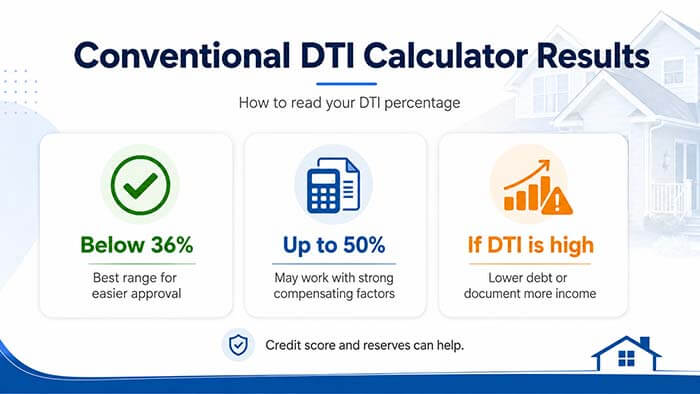
- After you put the data into the Conventional DTI calculator, you should concentrate on the returned number as a percentage.
- A DTI below 36% is optimal for easy approval.
- However, Fannie Mae DTI guidelines allow for 50% with strong compensating factors, such as a very high credit score or a substantial reserve.
- If your number is high, consider reducing debt or enhancing income documentation.
- At Gustan Cho Associates, we receive these daily and provide individualized game plans to meet Fannie Mae guidelines to maximize the likelihood of obtaining an “approve/eligible” finding on an automated underwriting system.
Most DTI Ratios Permitted by Fannie Mae to Be Used on Conventional Loans
- Regarding DTI, Mae has set a quite inelastic upper limit for Conventional Loans’ Debt To Income Ratios.
- Fannie Mae DTI guidelines often do not allow the back-end DTI to exceed 50%.
- There is room for some leniency, an advantage relative to other programs.
- However, there are tradeoffs, such as the caps becoming smaller as the credit score drops.
- For example, private mortgage insurance companies may be unwilling to insure loans with a DTI of 50% unless the borrower has a credit score of 680 or higher, indicating the need for a more comprehensive approach to their overall finances.
DTI Caps for Standard Conventional Loans and Exceptions
For conventional loans, Fannie Mae DTI guidelines prefer a ratio of 36% and allow for 45% if compensating factors are met and 50% in extraordinary circumstances.
The Conventional DTI Calculator considers ratio variables, allowing you to adjust for variables like responsible co-borrowers to find a more effective DTI.
At Gustan Cho Associates, we’ve noted that clients qualifying for higher ratio loans with more than 50% DTI were able to demonstrate cash reserves and job stability, once more showcasing our ability to help clients navigate these guidelines.
Special Considerations for High DTI Ratios in Conventional Lending
High DTI ratios in Fannie Mae guidelines often involve factors like residual income and more complicated manual underwriting. The Conventional DTI Calculator might help you glean these concerns in advance and understand more about them to construct a coherent case. People with DTI ratios near 50% should expect to come under a more rigid and critical case, but have Gustan Cho Associates ease the pain of the process so that the numbers and documentation reflect the reality with plausible and reachable expectations.
Analyzing Fannie Mae DTI Guidelines vs Other Loan Programs like FHA, VA, and USDA
Compared to Fannie Mae DTI guidelines, FHA loans are a lot lenient since they allow up to 46.9% and 56.9% front and back, respectively. With FHA loans, the DTI ratios are a lot more forgiving. VA loans are even more forgiving since they have automated systems and no fixed DTI caps. USDA is the most conservative, having 29% front and 41% back. The Conventional DTI Calculator works best for side-by-side comparisons, making the decision process easier for which plan works best for your needs.
FHA Loan DTI Requirements Vs Conventional DTI Standards
Fannie Mae DTI guidelines state that FHA has a higher DTI tolerance, but comes with mandatory mortgage insurance and lower credit thresholds. With the Conventional DTI Calculator, borrowers can estimate how much switching to FHA could relieve their debt burden. In most cases, a conventional mortgage would result in better terms. Because of our multi-state licensing, Gustan Cho Associates can efficiently conduct these analyses based on multiple case scenarios.
Comparison of VA and USDA DTI Guidelines to Fannie Mae Rules
Unlike USDA, which has comparatively lower DTI caps to help rural buyers, VA loans do not have DTI caps, which is very different from Fannie Mae’s approach. The Conventional DTI Calculator has all these comparisons so users can enter information for different programs. Our team’s expertise supports them with quality information and helps veterans and rural residents plan options for the new 2025 guidelines.
Fannie Mae DTI Approval Factors
Adding to the numbers, Fannie Mae DTI guidelines have credit score band, payment, and reserves compensating factors for your calculations. For example, if other factors come lower, a borrower with a 700 or above credit score can be qualified at 50% DTI. In contrast, some others have a 45% cap. The Conventional DTI Calculator is very helpful in estimating these values and offers a reliable DTI ratio that the lender will likely give for the other calculations based on the proven history of Gustan Cho Associates.
Strong Compensating Factors That Can Allow a Higher DTI Ratio
Confirming assets and strong compensating factors can allow DTI to be over-based more than the normal DTI. Guidelines set by Fannie Mae can be flexed in some areas, as can be explored from the Conventional DTI Calculator. Clients at Gustan Cho Associates have proven that with our help and calculations, there are many more ways to qualify than otherwise.
How Credit Scores Affect Fannie Mae DTI Limits
Credit scores determine DTI flexibility; restrictions could be set to 45% per Fannie Mae DTI rules if reduced. The Conventional DTI Calculator accounts for this and allows borrowers to increase their scores before application, to ensure the best results.
Fannie Mae DTI Guidelines, Waiting Periods, and Credit Requirements
Fannie Mae assigns waiting periods after significant credit events: 7 years after a foreclosure, 4 years after a short sale, or a bankruptcy. The minimum credit score is 620, more stringent than the FHA’s 580. The Conventional DTI Calculator helps by ensuring that DTI and credit focus are balanced.
Waiting Periods after Foreclosure and Bankruptcy for Conventional Loans
After bankruptcy, you must wait 4 years; foreclosure requires 7 years. These are in line with Fannie Mae DTI guidelines, which are designed to assist borrowers in gaining financial footing. Our calculator helps them determine the timeframe for becoming eligible.
Minimum Credit Score Requirements for Meeting Fannie Mae DTI Standards
- The minimum is set at 620.
- However, the DTI has more favorable terms for higher credit scores.
- The Conventional DTI Calculator is designed to show the influence of credit on overall qualification.
How to Practically See How The Conventional DTI Calculator Works To See if An Individual Is Fannie Mae Eligible
- The Conventional DTI Calculator is the first tool an individual can use to see if they meet the Fannie Mae DTI guidelines.
- Users can enter the relevant fields, see the information, then contact Gustavo Cho Associates at 800-900-8569 or email us at gcho@gustancho.com for an expert to look for the answer.
- The team at Gustan Cho Associates is available seven days a week,, evenings, weekends, and holidays.
More Advantages of Conventional Loans That Fall Under Fannie Mae DTI Guidelines
Conventional loans do not have upfront mortgage insurance premiums required by the FHA, and the PMI can be canceled as soon as the equity is at 20%. The Conventional DTI Calculator shows the lower monthly payments, as the DTI Calculation showed, so the payments are lower.
Down Payment Options and DTI
- 3% for first-time purchasers is a great offer.
- Lower payments then improve DTI. Fannie Mae’s rules set an upper limit of 3%.
The Process of Refinancing
- Under Fannie Mae, DTI limits do not change much.
- Use the calculator to see if the refinancing lowers the ratio to improve.
FAQs About Conventional DTI Calculator For Fannie Mae DTI Guidelines
How Does The Conventional DTI Calculator Help Meet Fannie Mae Guidelines?
It gives real-time DTI estimates that comply with Fannie Mae guidelines.
What is The Maximum DTI For Fannie Mae’s HomeReady Program Using The Conventional DTI Calculator?
Up to 50%, with mitigative factors.
Do Credit Scores Impact The Allowable DTI Under Fannie Mae Guidelines?
Yes, 45% is the maximum for lower scores in some cases.
What Are The Waiting Periods After Foreclosure For Conventional Loans For Fannie Mae?
7 years from the recorded date.
How Do Unpaid Collections Affect DTI For Conventional Loans?
They are treated more severely than FHA and may lead to denial.
Is There a Front-End DTI Ratio Requirement in Fannie Mae Guidelines?
No, only the back-end is considered.
What Compensating Factors Help Qualify for a Higher DTI on Conventional Loans?
High credit, reserves, or significant cash deposits.
How Frequently Must I Use The Conventional DTI Calculator When Preparing For a Mortgage?
Often, particularly after significant changes.
Does The Calculator Include Property Taxes And Insurance
All housing expenses are included in the Conventional DTI Calculator to ensure accurate calculations.
Is It Possible To Obtain A Conventional Loan When You Have A High DTI
Yes, if you have strong compensating factors such as excellent credit or large reserves.
How is The DTI Calculated For Conventional Loans?
Understanding your Debt-to-Income ratio is crucial for financial stability. It’s calculated by dividing your total monthly debt payments by your gross monthly income. To manage your budget, list your essential expenses, calculate your net income, and review regularly.
What Are the Credit Requirements on FHA versus Conventional Loans?
The credit score requirement for conventional loans is typically 620, while FHA loans require a minimum score of 580. This makes conventional loans stricter in terms of credit qualifications.
Can I Use a DTI Calculator To Determine if I Meet Fannie Mae DTI Guidelines?
Yes, borrowers can use the Conventional DTI Mortgage Calculator provided by Gustan Cho Associates to estimate their debt-to-income ratio and check if it aligns with Fannie Mae DTI guidelines for conventional loans.
When Comparing FHA and Conventional Loans, How Are These Two Mortgage Loan Types Differ on Unpaid Outstanding Collection Accounts?
FHA loans are more lenient towards borrowers with unpaid collection accounts, including ignoring unpaid non-medical collection and charged-off accounts.
Conventional loans, however, typically scrutinize all unpaid collections more closely, which could impact an approval/eligibility per the automated underwriting system.
This Guide About Conventional DTI Calculator For Fannie Mae DTI Guidelines Was Updated on July 8, 2026.
