
Quick Answer: Credit Report for a Mortgage (What to Know)
Mortgage lenders don’t use a screenshot of your credit app—they typically pull a tri-merge credit report (Equifax, Experian, TransUnion) through their system to verify your scores, accounts, payment history, and debt-to-income ratio.
Before You Apply, Do This:
- Check your credit reports first so you can spot errors early (your reports may not include the same scores your lender uses).
- Avoid new credit (new cards, car loans, “buy now pay later,” furniture financing) right before and during underwriting.
- Rate shop within a short window, so multiple mortgage inquiries usually count as a single inquiry for scoring.
- If you find errors, fix them before underwriting whenever possible—new disputes can delay approval.
Bottom Line: The best time to review your credit is before pre-approval, so you have time to address issues without delaying your closing date.
Ready For A Lender Pull? We can order your mortgage credit report and review it line by line with you.
Credit Reports in Mortgage Process
A mortgage credit report determines the qualifying criteria, interest, and loan terms. Gustan Cho Associates understands the importance of ordering a credit report and getting it in the hands of the borrower during the home loan application for increased efficiency. The score could improve if a credit report gets ordered and issues are within the timeframe of dealing with them. This guide focuses on people who want to learn the credit report process and are looking for “what credit report to send with a mortgage application.”
What is a Credit Report, and why is a Mortgage Essential?
Bureaus such as Equifax, Experian, and TransUnion compile and collect a credit report that a lender requires to determine a person’s creditworthiness. This report is broad and includes an individual’s payment history, debts, and other public records.
Important Factors in a Credit Report
- Payment History: Records timely payments with 35% weightage on your FICO score.
- Amounts Owed: Your credit utilization ratio affects 30% of your score.
- Length of Credit History: Older accounts positively strengthen reliability.
- New Credit and Inquiries: Newly submitted applications can, though temporarily, lower scores.
- Types of Credit: Varied debts demonstrate a combination of revolving and installment accounts.
In the underwriting world, the fine points go well beyond the score summary. Gustan has covered this in our credit report analysis guide Credit Report Anaylysis by Mortgage Underwriters.
Credit Reports’ Influence on the Loan Approval Process
Your report’s content can turn on or off certain aspects of the approval. If it’s in good standing, you can access better terms. Otherwise, mistakes or negative standing can increase charges or even denial. As Gustan Cho Associates points out, you must prepare and review the report well in advance to avoid unpleasant surprises.
When You Should Check Your Reports (Weeks/Months Before)
Check your credit before you apply, not after you’re already under contract. A good timeline:
- 90+ days before pre-approval: Best if you suspect errors, old collections, or identity issues—this gives you time to correct problems without delaying closing.
- 45–60 days before pre-approval: Ideal for most borrowers. You can clean up small items (addresses, duplicate accounts, reporting errors) and plan paydowns.
- 2–4 weeks before pre-approval: Last call for quick fixes (balance paydowns, documentation, removing obvious errors). Big disputes this late can create underwriting delays.
What To Check: Your credit reports (accounts, balances, payment history, addresses), not just a “credit score” app. AnnualCreditReport.com provides free reports (generally without scores), which is enough to spot many errors early.
When Lenders Pull Credit (Pre-Approval and/or Underwriting)
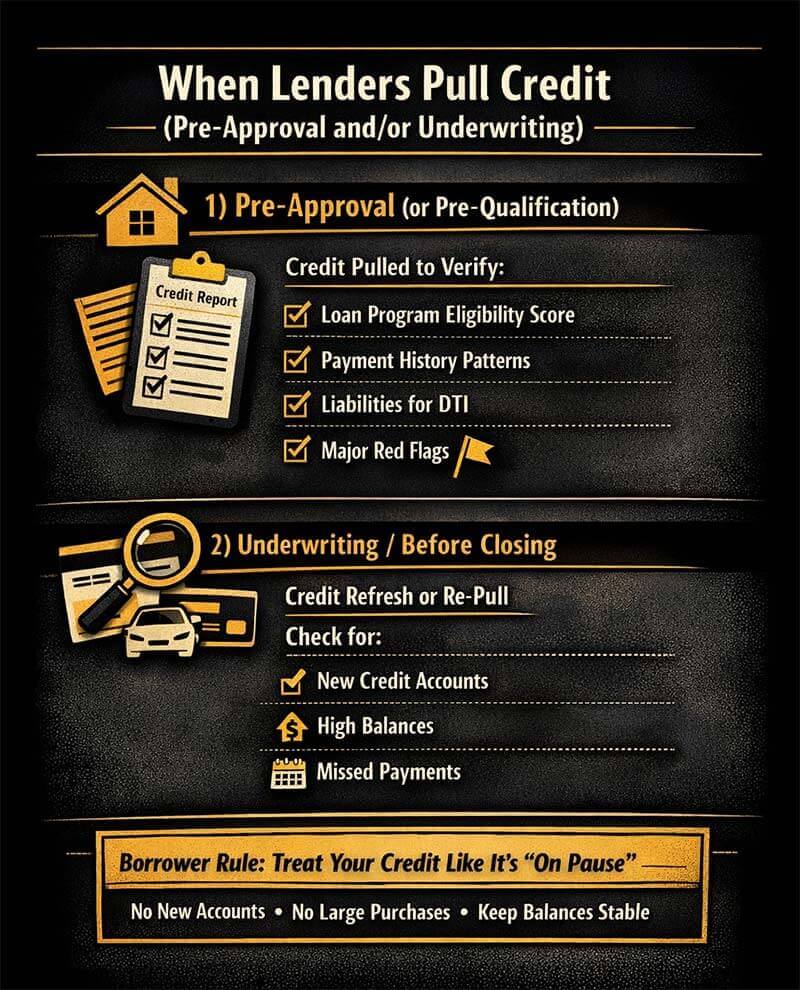
Most mortgage lenders pull credit at two common points:
1) Pre-Approval (or Pre-Qualification at Some Lenders)
This is when the lender typically pulls a mortgage credit report (often a tri-merge) to verify:
- score eligibility for the loan program
- payment history patterns
- liabilities for DTI (debt-to-income)
- major red flags (late payments, charge-offs, collections, public records)
2) Underwriting / Before Closing (Credit Refresh or Re-Pull)
Many lenders run a credit refresh (or sometimes a re-pull) later in the process—often closer to closing—to confirm you haven’t:
- opened new credit (cards, auto loans, “buy now pay later”)
- increased balances significantly
- missed payments
Borrower Rule During This Window: treat your credit like it’s “on pause.” No new accounts, no new financed purchases, and keep balances stable.
Rate Shopping Window (45 Days)
Mortgage rate shopping is expected, and credit scoring models generally try not to “punish” you for comparing lenders—as long as you shop within a short window.
- The CFPB explains that multiple mortgage credit checks within a 45-day window are typically treated like a single inquiry for scoring purposes.
- FICO also describes rate-shopping logic and notes that newer FICO versions use a 45-day window. In contrast, some older scoring approaches may use a shorter window. So it’s smart to compress your shopping timeline.
Best Practice: do all your mortgage shopping in 14 days if possible (ultra-safe), and no longer than 45 days (common guidance).
How to Order a Credit Report for a Mortgage Application

The process is simple and either free or low-cost. Gustan Cho Associates advises using official sources first to ensure reliability and precision.
Step-by-Step Ordering Process
- Go to AnnualCreditReport.com: This is the only site sanctioned by the Federal Government for free weekly reports (the number has increased from once a year due to new legislation).
- Proceed With The Identification Process: Provide personal information that will help in the verification process.
- Choose Bureau: Pull out from one or all three.
- For mortgages, we need all.
- Examine and Download: Expect to gain access to the site if the site is the right one with the required requirements.
- Distribute to the Lenders: Lenders are asked to integrate the information quickly.
Pricing/Free Methods
- Mentally: Booking Checked by AnnualCreditReport.com.
- Mentally: $15-30 per Bureau for desk requirements.
- Directly From Lenders: Sometimes included with the application fees.
- Pro Tip: Use services like VantageScore for preliminary reviews without a hard pull.
Examining and Contesting Errors on Your Credit Report
Some reports contain errors that appear in only 25% of reports. So, examine them closely to safeguard your mortgage chances.
Identifying Frequent Errors
- Missing or wrong personal details (e.g., new address).
- Accounts that are the same and have been opened more than once.
- Negative records that are older than 7 years.
- Credit reports are fraudulently obtained (e.g., records closed by mistake).
Disputation Process: Deadlines and Guidelines
Every Bureau must be contacted, and disputes must be filed within 30 days of the paperwork being sent to the individual. Offer evidence to support your case, as resolving the issue will take 30 days. Be aware of active disputes during the underwriting period; the loan being applied for may be frozen, so it must be addressed as soon as possible. Gustan Cho Associates strongly recommends against disputes being filed during the process, as it causes delays.
What the Change in Mortgage Will Do
If positive mortgage changes are made, the mortgage about to be underwritten as a new loan may have an increased score of 50. Our guide on Changes in Credit Report During Mortgage Process makes tracking your score simple.
Monitoring Credit Reports During the Underwriting Process
The underwriters focus not only on the scores but also on the patterns shown in the detailed report.
FICO or VantageScore: Does One Matter More than the Other?
TSF will use FICO 2, 4, or 5 models. The score requirements are 620 for conventional and 500 for FHA under flexible programs with Gustan Cho Associates.
In Depth Underwriting
The payment channels and public records are examined alongside the DTI ratios, which are highly public. If you want further information, you can check our underwriting insights.
Fix Small Issues Before They Cost You
Dispute strategy, rapid rescore, and re-pull timing explained.
Preparing for the Mortgage Application Process: Steps to Optimize the Credit Report
Enhance the profile for more favorable offers.
Quick Wins for Score Improvement
- Reduce balances on revolving debt to below 30%.
- Don’t apply for other accounts 3 to 6 months before the approval.
- Address disputes regarding inaccuracies.
Long-Term Strategies
Build history with secured cards if that is the only option. Gustan Cho Associates provides customized credit coaching to even the most non-traditional borrowers.
How to Optimize Credit Reports for Mortgages. Common Mistakes.
- Soft pulls tend to get ignored.
- They have no harm but do provide information.
- Hard pulls in numbers.
- When looking for rates, do it within 45 days to count as one.
- Not reactivating the authorized user status.
- Remove accounts that can be considered high-risk.
What Makes Gustan Cho Associates Stand Out for Mortgage Credit Assignments?
With over 20 years in non-QM and FHA lending, Gustan Cho Associates offers simplified credit reviews in 15 days. There are no credit overlays—approval is purely based on demonstrated potential. Visit Gustan Cho Associates for specialized guidance.
Questions Concerning Credit Reports During the Mortgage Application Process
What Credit Report Do Mortgage Lenders Use?
- Most mortgage lenders pull a tri-merge (three-bureau) credit report that combines data from Equifax, Experian, and TransUnion into one file for underwriting.
What Credit Scores Do Mortgage Lenders Use?
- Mortgage lenders typically rely on FICO® scores (not the score shown by many free apps), and the report often includes bureau-specific FICO scores used for mortgage decisions.
What is a Tri-Merge Credit Report?
- A tri-merge credit report is a single merged report that includes your credit file from all three bureaus, giving lenders a more complete view than any one bureau alone.
Can I Order My Own Tri-Merge Credit Report?
- Usually no, tri-merge reports are generally pulled through lender/industry systems.
- However, you can pull your individual bureau reports (which often contain most of the same tradeline details).
When Do Mortgage Lenders Pull Your Credit?
- Most lenders pull credit at pre-approval/application, and many also run a final check shortly before closing to confirm nothing major has changed.
How Many Times Will a Mortgage Lender Pull My Credit?
- It varies by lender and timeline. Many files involve an initial pull, followed by a later refresh/final check (especially if closing is delayed or the lender requires an update).
Does Shopping Around for a Mortgage Hurt Your Credit?
- Generally, no (or very little) if you shop within a 45-day window—multiple mortgage inquiries in that period are typically treated as a single inquiry for scoring.
Will Checking My Credit Report Hurt My Score?
- Checking your own reports is a soft inquiry and does not lower your score.
- A lender’s full mortgage credit pull is usually a hard inquiry, which can have a small, temporary impact.
How Do I Get My Credit Report for Free?
- Use AnnualCreditReport.com, the federally authorized site.
- It currently offers free weekly online credit reports from all three bureaus.
What Happens if My Credit Score Changes Before Closing?
- Lenders may re-check credit before closing; if your score drops or new debt appears, it can change your approval, pricing, or conditions.
- The safest approach is to avoid new credit, keep balances steady, and don’t finance big purchases during underwriting.
This article about “How to Order and Review Credit Report For a Mortgage” was updated on January 21st, 2026.
Order Your Mortgage Credit Report
Pull the correct tri-merge report lenders use—fast and secure.
