
Use this Virginia mortgage calculator to estimate your full monthly housing payment before speaking with a lender. It can calculate principal and interest, estimated Virginia property taxes, homeowners’ insurance, conventional private mortgage insurance, government-loan mortgage insurance, fees, and HOA dues. It can also estimate your front-end and back-end debt-to-income (DTI) ratios based on the income and monthly debts you enter. Results are estimates only and may change with actual rates, taxes, insurance, fees, and underwriting. This tool is not a mortgage approval, preapproval, loan offer, or official Loan Estimate from a lender.
- Conv
- FHA
- VA
- Jum/Non
- USDA
Debt to Income Calculator
How to Use the Virginia Mortgage Calculator
The Virginia mortgage calculator works best when you enter costs that reflect the home, location, and loan program you are considering. Follow these steps to estimate your monthly housing payment and debt-to-income ratios. Calculator results are estimates and do not guarantee loan approval, an interest rate, or final loan terms.
Enter the Home Price and Down Payment
Start with the home’s purchase price. Next, enter your down payment as a dollar amount or percentage. The calculator will subtract the down payment from the purchase price to estimate your base loan amount. The requirements for a down payment vary depending on the loan program and the borrower’s qualifications. For example, some conventional loans allow low down payments, FHA loans may require at least 3.5% for qualifying borrowers, and eligible VA or USDA borrowers may qualify for zero-down financing. A larger down payment may reduce the loan amount, monthly payment, and mortgage insurance cost.
Choose the Loan Program and Term
Select the loan program you want to estimate, such as conventional, FHA, VA, USDA, jumbo, or Non-QM. Each program handles down payments, mortgage insurance, and program fees differently. Then choose the loan term, such as 15 or 30 years, and enter an estimated interest rate. A shorter term normally results in a higher monthly payment but less total interest over the life of the loan. A longer term usually lowers the required monthly principal-and-interest payment. Use the note rate—not the annual percentage rate, or APR—in the interest-rate field. The APR includes certain loan costs and is not used to calculate the scheduled principal-and-interest payment.
Add Virginia Property Taxes and Insurance
Enter the property’s estimated annual real estate taxes. Virginia does not have one statewide real estate tax rate. Counties, cities, and some towns set local rates, so use the tax bill or assessment information for the specific property whenever possible. Next, enter the estimated annual homeowners’ insurance premium. Insurance costs depend on factors such as the home’s value, location, age, construction type, coverage amount, deductible, and the risk of weather-related or flood damage. A quote from an insurance agent will provide a better estimate than a general average. Divide annual taxes and insurance by 12 if the calculator requires monthly amounts. Flood insurance should be entered separately when it is required or desired.
Add PMI, MIP, HOA Dues, or USDA Fees
Include only the charges that apply to the loan and property:
- Conventional PMI: Private mortgage insurance may apply when the down payment is less than 20%. The cost depends on factors such as credit, loan-to-value ratio, occupancy, and loan type.
- FHA MIP: FHA loans generally include upfront and annual mortgage insurance premiums. If the upfront premium is financed, it increases the total loan amount. The yearly premium is included in the monthly mortgage payment.
- USDA fees: USDA loans generally include an upfront guarantee fee and an annual fee. A financed upfront fee increases the loan balance, while the annual fee is collected monthly.
- VA funding fee: Eligible VA borrowers do not pay a monthly PMI premium. However, a one-time VA funding fee may apply unless the borrower qualifies for an exemption.
- HOA or condominium dues: Enter the full monthly assessment. These dues are included in housing expenses for debt-to-income calculations, even when paid directly to the association.
Do not enter the same charge twice. For example, do not add FHA MIP to the conventional PMI field unless the calculator specifically uses that field for program-based mortgage insurance.
Review the Estimated Monthly Payment
Review each payment component rather than looking only at the final total. The estimate may include:
- Principal and interest
- Virginia property taxes
- Homeowners insurance
- Flood insurance, when entered
- PMI, FHA MIP, or the USDA annual fee
- HOA or condominium dues
Confirm that the displayed total equals the sum of the individual monthly charges. You can then adjust the purchase price, down payment, loan term, or interest rate to compare different scenarios. If you enter your gross monthly income and recurring debts, the calculator may also estimate your front-end and back-end debt-to-income ratios. These ratios are planning tools only. A licensed mortgage professional must review your income, credit, debts, assets, property, and loan-program rules to determine whether you qualify.
What Is Included in Your Virginia Mortgage Payment?
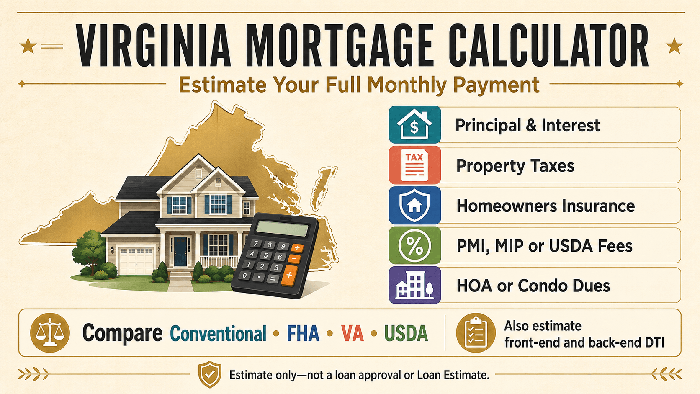
Your total monthly housing cost may exceed the amount used to repay your loan. A Virginia mortgage calculator should estimate principal, interest, property taxes, homeowners’ insurance, mortgage insurance, and any HOA or condominium dues. Some costs may be included in the payment sent to your loan servicer, while others may be paid separately.
Principal and Interest
Principal is the portion of your payment that reduces the loan balance. Interest is the cost of borrowing money. Together, principal and interest form the base monthly payment on most fixed-rate mortgages. The amount depends on:
- The total loan amount
- The interest rate
- The repayment term
- Whether the loan has a fixed or adjustable rate
With a fixed-rate mortgage, the scheduled principal-and-interest payment normally remains the same for the full loan term. However, your total monthly payment may still change if property taxes, insurance premiums, mortgage insurance, or association dues change.
Property Taxes
Virginia real estate taxes are set and collected locally. Counties, independent cities, and some towns establish their own tax rates. There is no single property tax rate that applies to every Virginia home. If your lender requires an escrow account, it will normally collect one-twelfth of the estimated annual property tax bill with each monthly payment. The loan servicer then uses the escrow funds to pay the tax bill when it becomes due. For a more useful estimate, enter the property’s current annual tax amount or obtain tax information from the local government. Do not rely on a general statewide average. The current owner’s tax bill may also differ from the amount charged after the sale due to reassessments, exemptions, or changes in the local tax rate.
Homeowners and Flood Insurance
Homeowners insurance protects against covered losses involving the home and personal property. It may also provide liability coverage. Mortgage lenders generally require enough insurance to protect the home securing the loan. The premium can vary based on the home’s:
- Location and replacement cost
- Age and condition
- Construction type
- Roof age
- Coverage limits and deductible
- Claims history
- Exposure to storms, wind, or other hazards
When insurance is escrowed, the lender normally collects one-twelfth of the estimated annual premium each month. Standard homeowners’ insurance does not cover flood damage. A lender may require separate flood insurance if the property is in a Special Flood Hazard Area. A buyer may also choose flood coverage when it is not required. Properties near the Chesapeake Bay, Atlantic coast, rivers, or other flood-prone areas may have different risks and insurance costs. Use an actual insurance quote and flood-zone determination whenever possible. Condominium buyers may need an individual HO-6 policy even when the condominium association maintains a master insurance policy.
PMI, FHA MIP, and USDA Annual Fees
The type of mortgage insurance or program fee depends on the loan selected.
Conventional private mortgage insurance: PMI may be required when a conventional borrower makes a down payment of less than 20%. Its cost can depend on the credit score, loan-to-value ratio, occupancy, loan term, and mortgage type. PMI may be eligible for cancellation when applicable federal and loan-servicing requirements are met.
FHA mortgage insurance premium: FHA loans require an upfront mortgage insurance premium and an annual premium paid monthly. The upfront premium can be added to the loan amount. Unlike conventional loans, FHA mortgage insurance does not end automatically at 20% equity; its duration depends on the original loan-to-value ratio and FHA regulations.
USDA guarantee fees: USDA loans generally have an upfront guarantee fee and an annual fee. The upfront fee may be added to the loan balance. The annual fee is calculated under current USDA rules and collected as part of the monthly payment. Eligible VA borrowers do not pay monthly PMI. However, a one-time VA funding fee may apply unless the borrower qualifies for an exemption. If the fee is financed, it increases the loan balance and affects the principal-and-interest payment.
HOA or Condominium Dues
Some Virginia homes are located in communities governed by a homeowners’ or condominium association. The association may charge monthly, quarterly, or annual dues to maintain shared property.
How Virginia Property Taxes Affect Your Payment
Virginia local governments assess and collect real estate taxes. Each county, city, or town may use a different tax rate, so there is no single statewide property tax rate that applies to every Virginia home. Review the Virginia Department of Taxation’s local tax information and confirm the current amount with the locality where the property is located. To estimate property taxes with the Virginia mortgage calculator, use the home’s latest annual tax bill whenever possible. If only the assessed value and local rate are available, use this formula:
Assessed value ÷ 100 × local tax rate = estimated annual property tax
If a property is assessed at $350,000 with a local tax rate of $1.00 per $100, the annual tax would be $3,500, or roughly $291.67 per month. This is only an illustration—not a statewide rate in Virginia. The current owner’s tax bill may not equal what a new buyer will pay. The amount can change because of:
- A new property assessment
- A change in the local tax rate
- City, town, or special-district levies
- Renovations or new construction
- Tax relief or exemptions are available to the current owner
- Changes in the property’s classification or use
If taxes are escrowed, the mortgage servicer generally collects one-twelfth of the estimated annual bill with each monthly payment. The servicer pays the local tax authority when the bill becomes due. An annual escrow analysis may increase or decrease the required payment if the tax estimate changes. Before making an offer, ask for the latest tax bill and verify the assessed value with the county or city. Enter the actual annual tax amount into the calculator instead of relying on a statewide average. A lender may use a different figure when preparing the Loan Estimate or qualifying you for financing.
Virginia Mortgage Payment Example
The following Virginia mortgage calculator example shows how a buyer’s complete estimated monthly housing payment and debt-to-income ratios are calculated. It uses a hypothetical conventional loan with a 10% down payment.
Purchase and Loan Details
- Purchase price: $400,000
- Down payment: $40,000, or 10%
- Base loan amount: $360,000
- Financed program fee: $0; conventional loans do not have a standard financed upfront program fee
- Total loan amount: $360,000
- Interest rate: 6.50% fixed
- Loan term: 30 years, or 360 monthly payments
- Monthly principal and interest: $2,275.44
The principal-and-interest payment is calculated using the $360,000 loan amount, 6.50% interest rate, and 30-year repayment term.
Taxes, Insurance, PMI, and HOA Dues
Assume the property’s local Virginia tax records, insurance quote, and association documents show the following expenses:
- Annual property taxes: $4,800
- Monthly property taxes: $4,800 ÷ 12 = $400
- Annual homeowners insurance: $1,800
- Monthly homeowners insurance: $1,800 ÷ 12 = $150
- Estimated annual conventional PMI: $1,800
- Monthly PMI: $1,800 ÷ 12 = $150
- Monthly HOA dues: $75
Virginia real estate taxes are local. The $4,800 annual amount in this example is not a statewide tax estimate.
Final Estimated Monthly Housing Payment
The complete estimated payment is: **$2,275.44 principal and interest
- $400 property taxes
- $150 homeowners insurance
- $150 PMI
- $75 HOA dues
- = $3,050.44 total monthly housing expense**
The mortgage servicer may collect principal, interest, taxes, insurance, and PMI through the monthly mortgage payment. HOA dues are generally paid directly to the association, but lenders normally include them when calculating the borrower’s housing expense.
Front-End and Back-End DTI
Assume the borrower has:
- Gross monthly income: $10,000
- Other recurring monthly debts: $750
- Total monthly housing expense: $3,050.44
The front-end DTI measures the monthly housing expense against gross monthly income:
$3,050.44 ÷ $10,000 = 30.50% front-end DTI
The back-end DTI includes the housing expense plus recurring monthly debts:
($3,050.44 + $750) ÷ $10,000 = 38.00% back-end DTI
These ratios do not determine approval on their own. The lender must also review the borrower’s credit, verified income, assets, employment, property, automated or manual underwriting findings, and applicable loan-program requirements. The interest rate, property taxes, homeowners’ insurance, PMI pricing, HOA dues, and income figures are examples only. Actual costs and qualification results will vary by borrower, property, locality, insurer, lender, and market conditions. This estimate does not include closing costs, prepaid expenses, discount points, maintenance, utilities, or future payment increases.
Compare Conventional, FHA, VA, and USDA Payments
Use the Virginia mortgage calculator to compare the full payment—not just principal and interest. Down payment requirements and mortgage insurance differ by program:
- Conventional loans: Some programs permit as little as 3% down. Private mortgage insurance (PMI) is generally required when the down payment is less than 20%, but it may be canceled once the borrower meets applicable equity and payment-history requirements.
- FHA loans: Qualified borrowers may purchase with 3.5% down. FHA loans generally require both an upfront mortgage insurance premium and annual MIP paid monthly. Financing the upfront premium increases the loan balance.
- VA loans: The VA generally does not require a down payment or monthly PMI for eligible borrowers. A one-time funding fee may apply and can increase the payment if the payment is financed. Certain veterans and surviving spouses are exempt. Review current requirements through the U.S. Department of Veterans Affairs.
- USDA loans: Eligible borrowers purchasing qualifying rural properties may receive 100% financing. Instead of the conventional PMI, USDA’s published program materials list a 1% upfront guarantee fee and a 0.35% annual fee. The upfront fee may be financed, while the annual fee is usually collected monthly. See USDA Rural Development.
The lowest down payment does not always produce the lowest total cost. Compare the loan amount, interest rate, mortgage insurance or program fees, cash needed at closing, and complete monthly payment. Confirm current fees and terms on each lender’s official Loan Estimate.
How to Estimate Your Debt-to-Income Ratio
The Virginia mortgage calculator can estimate your front-end and back-end debt-to-income ratios, or DTI. Begin by calculating gross monthly income before taxes and deductions: Annual gross income ÷ 12 = gross monthly income Next, use these formulas: Front-end DTI = total monthly housing expense ÷ gross monthly income × 100 The housing expense generally includes principal, interest, property taxes, homeowners’ insurance, mortgage insurance, and HOA or condominium dues. Back-end DTI = total monthly housing expense + recurring monthly debts ÷ gross monthly income × 100 Recurring debts may include car payments, student loans, minimum credit card payments, personal loans, and court-ordered support obligations. For example, a $3,000 housing expense, $600 in other monthly debts, and $9,000 gross monthly income would produce:
- Front-end DTI: $3,000 ÷ $9,000 = 33.33%
- Back-end DTI: ($3,000 + $600) ÷ $9,000 = 40%
These results are estimates—not an underwriting approval. A lender calculates DTI using verified qualifying income and debts based on the selected loan program, credit report, supporting documents, and underwriting findings. Income may be averaged or excluded, while certain debts may be calculated differently. There is no single DTI limit that guarantees mortgage approval.
Costs the Calculator Does Not Include
The Virginia mortgage calculator estimates a monthly housing payment, but it does not include all the upfront or ongoing costs of buying and owning a home. Budget separately for:
- Closing costs: Lender, title, settlement, recording, and other transaction charges.
- Prepaid expenses: Property taxes, homeowners’ insurance premiums, prepaid interest, and initial escrow deposits due at closing.
- Discount points: Optional fees paid to obtain a lower interest rate.
- Inspection and appraisal fees: Charges for evaluating the home’s condition and value.
- Repairs and maintenance: Routine upkeep, major replacements, and unexpected repairs.
- Utilities: Electricity, water, gas, internet, trash collection, and other services.
- Moving expenses: Movers, storage, supplies, travel, and utility setup costs.
- Optional flood insurance: Coverage purchased when the lender does not require it, unless entered separately in the calculator.
- Future increases: Property taxes, insurance premiums, HOA dues, and condominium assessments may rise after closing.
Ask the lender for an official Loan Estimate that shows projected loan costs and the cash needed at closing. Also consider keeping an emergency fund for repairs and payment increases that the calculator cannot predict.
Virginia Homebuyer Assistance Resources
Qualified borrowers may be able to combine an eligible mortgage with a Virginia Housing loan or homebuyer assistance program. Options may include down payment assistance, closing cost assistance, or a second mortgage, depending on the borrower, property, income limits, and first-mortgage program. Review the official Virginia Housing loan and grant directory for current options and eligibility information. These programs are not available to every borrower, property, or loan type, and not every mortgage lender participates. A participating Virginia Housing lender must confirm eligibility and explain how any assistance affects the monthly payment and cash needed at closing. When using the Virginia mortgage calculator, include any required payment for an assistance loan if the calculator does not add it automatically.
Final Thoughts About the Virginia Mortgage Calculator
A Virginia mortgage calculator can help you estimate the full cost of a home before you apply for financing or make an offer. For a more useful estimate, enter the property’s actual local taxes, a current insurance quote, applicable mortgage insurance or program fees, and any HOA dues.
Remember that calculator results are only a starting point. Your final payment, closing costs, interest rate, and qualification will depend on the property, loan program, and verified financial information.
When you are ready, speak with a licensed mortgage professional to compare conventional, FHA, VA, USDA, jumbo, and Non-QM options. Review the complete Loan Estimate—not just the advertised rate—to understand the monthly payment, cash needed at closing, and total borrowing costs.
Frequently Asked Questions About the Virginia Mortgage Calculator
How is Mortgage Interest Calculated Each Month?
In a fixed-rate mortgage, the monthly interest charge is calculated using the remaining principal balance and the loan’s interest rate. Early payments contain more interest because the balance is higher. As the balance falls, more of each scheduled payment goes toward principal.
How Much Can One Extra Mortgage Payment Save?
One additional principal payment each year may shorten the loan term and reduce total interest. The exact savings depend on the balance, interest rate, remaining term, and the timing of the extra payment. Confirm that the servicer will apply the additional amount directly to principal.
Do Biweekly Mortgage Payments Pay Off a Loan Faster?
A biweekly plan collects half the monthly payment every two weeks. That produces 26 half-payments—or 13 full payments—each year. This may reduce the repayment period when the extra amount is applied to the principal. Check for program fees and confirm how the servicer processes partial payments.
How does a 2-1 Buydown Affect the Estimated Payment?
A 2-1 buydown temporarily reduces the borrower’s effective payment rate, generally by two percentage points during the first year and one point during the second year. The payment then increases to the full note-rate payment in year three. Calculate each period separately, and remember that lenders generally qualify borrowers using the full note rate—not the temporarily reduced rate.
Can Seller Credits Reduce the Monthly Mortgage Payment?
Seller credits usually reduce eligible closing costs rather than the loan balance. However, they may indirectly lower the payment if permitted funds are used for discount points or an approved interest-rate buydown. Program limits apply, and unused credits are typically not redeemable for cash.
When is the First Mortgage Payment Due After Closing?
The first payment is typically due on the first day of the month following a full calendar month. For example, a buyer who closes on April 15 may make the first payment on June 1. Interest from the closing date through the end of April is generally collected at closing as prepaid interest. The exact date appears on the closing documents.
Can a Mortgage Calculator Estimate Refinancing Savings?
Yes, but compare more than the new payment. Enter the current balance, proposed rate, new term, closing costs, and expected time in the home. Dividing total refinancing costs by the estimated monthly savings provides a basic break-even period. Extending the repayment term could lower the payment while increasing the total interest.
What is a Mortgage Recast, and Will it Lower the Payment?
A mortgage recast recalculates the monthly principal-and-interest payment after the borrower makes a substantial principal reduction. The interest rate and remaining loan term normally stay the same. Not every mortgage is eligible, and the servicer may require a minimum lump-sum payment and charge a fee. Contact the servicer before sending money for a proposed recast.
This article about “Virginia Mortgage Calculator: Estimate Your Full Payment” was updated on August 6th, 2026.
