


What People Mean Today When They Search for No Doc Loans
True no doc loans are rare today. Most borrowers searching for no doc loans are really looking for low-doc or alternative-documentation mortgage options such as bank statement loans, DSCR loans, and asset depletion loans.
These programs are for people who struggle to get approved using regular income documents like W-2s, pay stubs, or tax returns. They are often used by self-employed borrowers, real estate investors, commission-based earners, freelancers, and high-asset clients with non-traditional income patterns.
Before the 2008 housing crisis, some lenders offered loans with little or no income verification. That market changed significantly after new lending rules and ability-to-repay standards. Today, most legitimate no doc style mortgage programs still require some documentation, but they may use alternative ways to evaluate income, cash flow, or assets.
In this guide, we explain what no doc loans mean today, how they differ from low doc mortgages, who they may help, and the most common options available in today’s market.
No-Doc Loans Compared to Low Doc Loans: What is the Difference?
True no doc loans originally referred to mortgage products that required little to no income verification. In the years before the 2008 housing crisis, some lenders allowed borrowers to qualify without providing traditional documentation such as tax returns, W-2s, or pay stubs. Those types of consumer mortgage programs are now largely gone.
Today, most borrowers searching for no doc loans are actually looking for low-doc or alternative-documentation mortgage options. These programs still require some documentation, but they use more flexible methods to evaluate income, cash flow, or assets. Common examples include bank statement loans for self-employed borrowers, DSCR loans for real estate investors, and asset-depletion loans for high-net-worth borrowers.
In simple terms, true no-doc consumer mortgages are mostly a thing of the past. At the same time, low doc loans remain available through specialized Non-QM and alternative lending programs.
Some Common Formats of the No-Doc Style
- No-ratio or asset-based mortgages, where qualification relies on assets and property values instead of income figures.
- Bank statement loans, where banks analyze the last 12 to 24 months of business or personal bank deposits to use as income.
- DSCR (Debt-service coverage ratio ) loans, where the investor qualifies based on rental income from the property instead of personal income.
Who No Doc and Low Doc Loans May Be Best For
No doc and low doc mortgage options are usually best for borrowers who can repay a loan but do not meet traditional income-documentation requirements. These programs are often used by people with strong cash flow, good assets, or non-traditional income patterns that are harder to show with standard tax returns, pay stubs, or W-2s.
Self-Employed Borrowers
Self-employed borrowers often have high income but report lower taxable income due to business deductions and write-offs. A bank statement loan or other alternative-doc program may work better than a traditional full-doc mortgage in these cases.
Real Estate Investors
Real estate investors often prefer loan options that focus on the property’s cash flow rather than personal income. DSCR loans are commonly used for this reason, especially when buying or refinancing rental properties.
Commission, Gig, and Seasonal Workers
Borrowers who earn income from commissions, freelance work, contract work, or seasonal jobs may have inconsistent monthly income that is harder to document through standard employment records. Low-doc programs can offer more flexibility for these income patterns.
High-Asset Borrowers
Some borrowers have substantial liquid assets, retirement funds, or investment accounts but do not want to qualify based on employment income. Asset depletion and other asset-based programs may help these borrowers qualify based on overall financial strength.
Borrowers With Complex Income
Some borrowers have multiple businesses, multiple properties, partnership income, or recent income changes that make traditional underwriting more difficult. In these cases, a low-doc mortgage may provide a more practical path than a standard full-documentation loan.
Self-Employed and Hate Paperwork? No-Doc Loans May Help
Reach out today and let us see if a no-doc or alternative-doc loan program can get you approved
Types of No-Doc and Low-Doc Loan Options
Most no-doc and low-doc products have higher interest rates and cost more than an equivalent full-doc loan. This is attributed to the lender taking on more risk. Although these borrowers must pay more for these loans, they benefit from being flexible and submitting less paperwork.
DSCR Loans (Debt Service Coverage Ratio) for Investors
DSCR loans are one of the few modern options similar to ‘no doc’ loans for real estate investors. Lenders don’t look at the borrower’s personal income. Instead, they review the property’s income and expenses to see if the rent covers the mortgage.
- Suitable for investors with multiple properties
- Applicable in long-term rentals and, in certain cases, short-term rentals
- Qualification mostly depends on the property’s cash flow.
- Best for real estate investors who aim to purchase or refinance rental properties and want to avoid traditional income documentation.
How No Doc and Low Doc Mortgage Loans Work Today
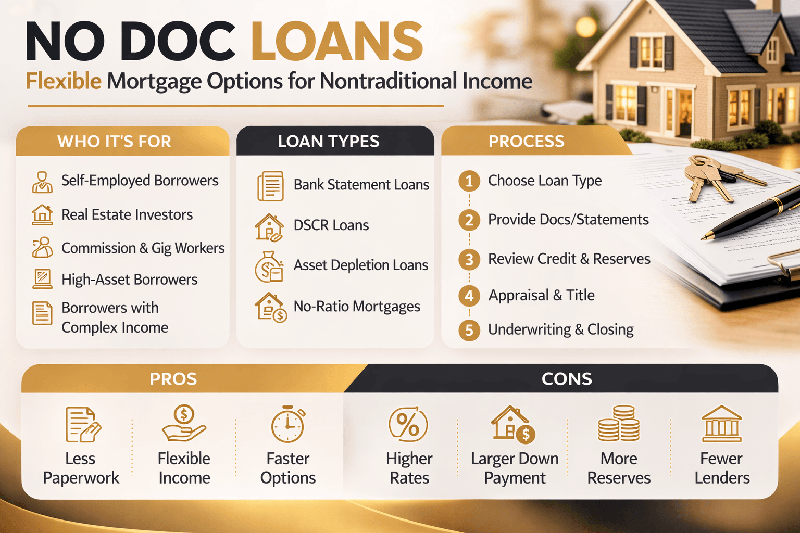
Modern no-doc style mortgages usually follow a similar process to traditional home loans, but the main difference is how lenders evaluate income. Instead of relying only on W-2s, pay stubs, or tax returns, the lender may use bank statements, rental income, liquid assets, or other alternative documentation to determine whether you qualify.
Choose the Right Loan Type
The first step is choosing the loan program that best matches your income situation and property type. For example, a self-employed borrower may be a better fit for a bank statement loan. At the same time, a real estate investor may qualify more easily with a DSCR loan. A high-net-worth borrower may be better suited to an asset-depletion program.
Provide Alternative Documentation
Once the loan type is selected, the borrower provides the documentation required for that program. Depending on the loan, this may include personal or business bank statements, proof of liquid assets, lease agreements, rent schedules, or other financial records. Even though these are called no-doc or low-doc loans, most modern programs still require some form of documentation.
Lender Reviews Credit, Down Payment, and Reserves
After receiving the file, the lender reviews the borrower’s credit profile, available down payment funds, cash reserves, and overall risk level. In many low-doc programs, these factors carry more weight because the loan is not being underwritten the same way as a traditional full-document mortgage.
Appraisal and Title Review
Like most mortgage loans, the property usually must go through an appraisal and title process. The lender wants to confirm the property’s value, marketability, and the legal condition of the title before the loan can proceed.
Underwriting and Closing
The final stage is underwriting, where the lender reviews the entire file, clears any conditions, and issues final approval if the borrower meets the program guidelines. Once underwriting is complete, the loan moves to closing, where final documents are signed, and the transaction is funded.
Pros and Cons of No Doc and Low Doc Mortgage Loans
No doc and low-doc mortgage programs can be helpful for borrowers who do not fit traditional underwriting rules, but they usually involve tradeoffs. The biggest advantage is flexibility. The biggest downside is cost.
Pros
These loans usually require less paperwork than a traditional full-document mortgage. They can also make it easier for self-employed borrowers, investors, freelancers, and high-asset clients to qualify when tax returns, W-2s, or pay stubs do not reflect their full financial picture. In many cases, they provide a practical path forward when a conventional lender says no.
Cons
These loans often come with higher interest rates than standard conventional or government-backed mortgages. Borrowers may also need a larger down payment, stronger reserves, and better overall credit. Program rules can vary widely from one lender to another, and there are usually fewer lenders offering these options compared with standard mortgage products.
Regulatory and Post-Crisis Landscape
- Following the 2008 financial crisis, low- and no-documentation loans were heavily scrutinized, resulting in new regulations and product restructuring.
- Today, most offerings focus on complying with current ability-to-repay policies while requiring less documentation.
- This regulatory backdrop shapes how no-doc loans are offered.
The Contemporary Safeguards Include:
- A much higher priority is placed on rigorous verification standards for consumer mortgages, with pure no-document loans generally restricted to business or investment transactions.
- Improved lender risk management strategies, especially with respect to more conservative credit overlays and continuous monitoring of their portfolios.
When a No-Doc Loan May Be Useful …
- No-doc loans cater to a specific market niche rather than the general public.
- It’s crucial to ensure the loan type matches each borrower’s needs and goals.
- Some illustrative circumstances are described below.
Examples of Circumstances Where They are Applicable Include …
- A seasoned investor who is competent, has the ability to secure rapid funding to make a strong down payment on a property opportunity, though lacks the conventional employment documentation.
- A self-employed borrower has strong bank deposits and asset strength, but their tax returns have been heavily optimized and do not accurately represent their cash flow.
- A business owner is in need of working capital and would prefer a quicker underwriting process that considers only revenue and time in business, rather than complete audited financial statements.
Fast, Flexible Financing When Traditional Loans Don’t Work
Call 800-900-8569 and let us design a no-doc or reduced-doc mortgage solution tailored to you
How to Strengthen a No-Doc Application
Since underwriting for no-doc loans depends on compensating factors, applicants should showcase their overall financial strength.
The Following Tips Can Help Strengthen a No-Doc Application.
Practical Preparation Tips
- Establish and maintain a good credit score by keeping revolving balances low, steering clear of late payments, and avoiding recent negative credit events.
- Adding to your liquidity and reserves, as a cushion of readily accessible savings, business cash, and investments, is beneficial.
- Be prepared with accurate information on properties, rental histories, or business cash flow metrics that demonstrate the ability to repay the loan.
Bank Statement Loans for Self-Employed Borrowers
A bank statement mortgage allows self-employed individuals to qualify for a loan using their bank deposits instead of tax returns.
You provide a predetermined number of months of:
- Personal bank statements, or
- Business bank statements
The lender calculates an income figure based on your deposits. However, if you use business statements, they usually apply an expense factor to adjust the amount. Free lancers, gig workers, and business owners with excellent cash flow and significant write-offs.
Asset Depletion Loans ( Asset-Based Income )
An asset depletion loan uses your liquid assets to figure out your monthly income. This can work even if you’re not working or don’t want to use income-based underwriting.
- Investment accounts (stocks, bonds, mutual funds)
- Retirement accounts (often with adjusted value)
- Best For retirees, entrepreneurs between ventures, and high-asset borrowers who want to qualify without submitting traditional income documents.
Interest-Only Non-QM Options (Where Available)
- Interest-only options can reduce your initial payments and, in some cases, make it easier to qualify investors, and high-income professionals with variable cash flow.
Foreign Nationals and Other Options
- Some borrowers seeking ‘no-doc’ loans are foreign nationals or residents with non-traditional documentation.
- In certain programs, having enough assets and a good down payment may be enough to qualify.
No Doc Loan Requirements: What Do Lenders Usually Look For
No-doc generally means no income documentation, while low-doc means that some minimal documentation, such as bank statements or debts, must be submitted. In reality, most products that exist today are low-doc products, aiming for a happy medium between the lender and the borrower.
Even with less paperwork, you still need to meet other standard requirements. These can vary by program, but usually include:
- Credit Score: Most low-doc programs require a specific credit score, which is often higher than that required for some FHA or VA loans. Better credit can also get you better rates and options.
- Down Payment: Low-doc loans typically require larger down payments than regular mortgages.
- Reserves: Many programs require cash reserves, sometimes enough to cover several months of mortgage payments, especially for investors or more complex situations.
- Property Type: Some programs may have restrictions on certain properties, condos, or types of occupancy.
- Loan-to-Value (LTV): Lower loan-to-value ratios can help with approval, pricing, and other factors.
- Each program sets a maximum LTV based on your credit and property type.
Pros and Cons of No-Doc Loans
While completely documentation-free loans are highly uncommon, today’s no-doc loans still do exist in the form of bank-statement, DSCR, and streamlined business loans, which are accessible from non-bank and specialized lenders. These products tend to require less documentation than typical bank loans, while still collecting sufficient data to assess risk responsibly.
Benefits of No-Doc and Low-Doc Loans
- Less paperwork than traditional mortgages
- Great for self-employed borrowers with write-offs
- Great for investors using the DSCR qualification
- Underwriting can be faster in many cases if your documents are organized.
- Alternative paths when banks say no
Potential Downsides
- Rates may be higher than standard conventional loans.
- Down payment requirements can be higher.
- Reserve requirements may apply.
- Program rules can be very different from one lender to another.
The important thing is to find the program that best fits your situation.
How to Choose the Right No Doc Mortgage Lender
At Gustan Cho Associates, we help borrowers who have been denied by other lenders find options like bank statement loans, DSCR investor loans, asset depletion loans, or other alternative documentation mortgages. Lenders offer no doc loans when applicants cannot provide conventional proof of income like W-2s, pay stubs, or tax returns.
Lenders of no doc loans weigh the applicant’s credit, down payment or equity, property value, and bank statements versus traditional qualified income as evidence of the ability to repay.
In this guide, we explain what a no-doc mortgage is today, how it works, its pros and cons, and how you can get one. In the following paragraphs, we will cover No Doc Loans: how no doc loans work today, who qualifies, and the best low doc mortgage options like DSCR, bank statement, and asset loans.
Common Myths About No-Doc Loans
Myth 1: “No Doc Loans Mean No Verification at All.”
- Modern loans still check if you can repay, but they use different types of documentation.
Myth 2: “No Doc Loans Are Easy Approvals.”
- They might be easier for some borrowers, but you still need strong assets, equity, or good credit.
Myth 3: “No Doc Loans Are Only For Investors.”
- Many self-employed and high-net-worth borrowers also use low-doc programs.
How the No Doc Loan Process Usually Works
Borrowers who explore no doc or low doc mortgage options usually go through a process similar to a traditional mortgage, but with different income documentation requirements. The key is choosing the right loan program and preparing the appropriate supporting documents from the start.
Step 1: Identify Your Goal
The first step is defining the purpose of the loan. Some borrowers are buying a primary residence, some are refinancing, and others are buying or refinancing an investment property. The right no doc or low doc option depends heavily on the property type and the borrower’s financial profile.
Step 2: Match the Loan Type to Your Income Situation
Once the goal is clear, the next step is choosing the loan type that best fits the borrower’s situation. A self-employed borrower may be a better fit for a bank statement loan. A real estate investor may be better suited for a DSCR loan. A high-asset borrower may benefit from asset depletion or other asset-based qualification methods.
Step 3: Gather the Required Alternative Documentation
Even low-doc loans usually require some documentation. Depending on the program, that may include bank statements, proof of liquid assets, lease agreements, rent schedules, or other records that help the lender evaluate repayment ability.
Step 4: Review Credit, Down Payment, Reserves, and Property Details
The lender then reviews the borrower’s credit profile, available down payment, cash reserves, and property details. In many cases, these factors carry more weight because the loan is not being qualified in the same way as a standard full-document mortgage.
Step 5: Complete Appraisal, Underwriting, and Closing
Like other mortgage loans, no doc and low doc loans usually require an appraisal, title work, and full underwriting review. Once conditions are satisfied and the file is approved, the loan moves to closing.
At Gustan Cho Associates, we help borrowers compare no doc and low doc mortgage options based on their income type, property goals, and overall financial profile.
No-Doc Loans FAQs:
Do No Doc Loans Still Exist Today?
- True no doc loans are rare today for consumer home loans. In most cases, borrowers searching for no doc loans are really looking for low-doc or alternative-documentation mortgage options such as bank statement loans, DSCR loans, or asset depletion loans. These programs still require some documentation, but they are more flexible than traditional full-doc mortgages.
What is the Difference Between a No Doc Loan and a Low Doc Mortgage?
- A true no doc loan historically meant little to no income verification. A low-doc mortgage, by contrast, still requires documentation, but it may rely on bank statements, rental income, liquid assets, or other alternative records instead of standard W-2s and tax returns. In today’s market, most so-called no doc loans are actually low doc mortgage programs.
Can Self-Employed Borrowers Get a Mortgage Without Tax Returns?
- Yes, some self-employed borrowers can qualify without using tax returns by applying for a bank statement loan. With this type of mortgage, lenders review recent personal or business bank statements to estimate income rather than relying only on W-2s, pay stubs, or filed tax returns. These loans are commonly used by self-employed borrowers with strong cash flow and significant write-offs.
Are DSCR Loans Considered No Doc Loans?
- DSCR loans are often described as a modern no doc or low doc option for real estate investors, although they are not truly documentation-free. Instead of focusing mainly on the borrower’s personal income, the lender considers the property’s rental income and whether it is sufficient to cover the housing payment. That is why DSCR loans are popular with investors buying or refinancing rental properties.
Do No Doc or Low Doc Loans have Higher Rates?
- Usually, yes. Low doc and alternative doc mortgage programs often have higher rates, stricter down payment requirements, or stronger reserve requirements than standard conventional or government-backed mortgages. That is one of the tradeoffs borrowers make in exchange for more flexible income documentation.
Can You Refinance with a No Doc or Low Doc Mortgage?
- In some cases, yes. Borrowers with non-traditional income may be able to refinance using bank statement loans, asset depletion programs, or other specialized alternatives, depending on the lender and property type. True no-income-verification refinance options are largely gone, but low-doc refinance options still exist for some borrowers.
No Doc Loan Quote/Pre Approval Through Gustan Cho Associates
If you are comparing bank statements, DSCR loans, or asset-depletion loans, focus on the program that aligns with your income style, property type, and long-term goals. True no doc loans are rare today, but many borrowers still have practical low doc options that can work when traditional income documentation does not fit their situation.
This article about “No Doc Loans: Easy Ways to Qualify With Less Paper” was updated on March 12th, 2026.
Start Your No-Doc / Alt-Doc Mortgage Pre-Approval Today
Apply online 24/7 with Gustan Cho Associates and see if you qualify for one of our no-doc or alternative documentation mortgage loans
