

How to Qualify for Small Business Loans: 2026 Guide for Entrepreneurs
Are you a small business owner looking for funding to grow your business? Getting approved for small business loans can help you move forward, whether you’re just starting or trying to expand. In this updated 2026 guide, we’ll break down the loan process in simple steps, explain your best options, and show you how to qualify—even if banks have turned you down.
At Gustan Cho Associates, we understand that every business has a unique story. That’s why we help small business owners nationwide get the funding they need, even when others say no.
If you want to start, stabilize, or grow a business, one of the most vital funding sources is a small business loan. Understanding how small business loans work can help you boost your chances of getting an approval and help you pick the right program. How small business loans work is the same in 2026 as it has always been. There are core questions that all lenders ask: What does the business need? What is the purpose of the money? How strong is the cash flow of the company? And is the repayment a strong possibility?
Process Of Small Business Loans
The best examples and strongest justification for financing are in revenue generation, efficiency improvement, and cost reduction. For example, a contractor could finance a piece of equipment that increases his ability to complete more jobs, a retailer could use a working capital loan to fund his business in anticipation of a seasonal increase in sales, and an owner-occupied business could utilize a 504 loan to buy a building and stop renting. In all 3 cases, the debt should finance a tangible business goal rather than simply fill an unending operational hole without a recovery plan. Because of this, lenders are so concerned about the ability to repay and the realistic use of the loan.
After receiving funds in a lump sum, as a line of credit, or through a structured financing package, the borrower is obligated to repay the debt in accordance with the repayment terms specified in the loan agreement.
While some programs are meant for flexible uses, such as working capital, refinancing business debt, purchasing furniture, fixtures, or equipment, or doing a partial acquisition of a business, others are more narrow in scope. For example, the SBA 504 loan programs target large, fixed assets like owner-occupied commercial real estate, long-term construction, and equipment, while SBA Microloans are aimed at smaller dollar amounts, usually for start-up or expansion purposes of $50,000 or less.
What are Small Business Loans and How Do They Work?
Very simply, a small business loan is a loan to a company that allows it to borrow money now and pay it back later, typically with interest and fees. The lender assesses the business and the owners, understands the financing purpose, evaluates the ability to repay, and decides whether to approve, deny, or counter the request with altered terms.
In SBA-guaranteed lending, the SBA does not usually lend to the business directly for 7(a) loans. In this case, the borrower interacts directly with one of the approved lenders, and the SBA provides a guaranty of a portion of the loan to reduce the lender’s risk. SBA-backed financing remains an option for qualified borrowers and is likely to be a major choice for SBA loans.
Your Top Priorities for a Small Business Loan
You should provide preeminent management, operations, and a management/ownership history. The SBA recommends that business owners draft their business plan and financial projections and prepare a summary of their expenses. Check your business and personal credit, gather your tax returns, and think like an underwriter before submission to lead to the best outcomes.
Select a funding purpose that aligns with a functioning need, and use an exact amount that you support with a calculation. Documents provide a strong rationale for the loan, a clear payment plan, and information about its use.
This may include a business plan, financial forecasts, historical financial statements when available, a narrative on ownership, and bank statements, and ensure your financials are reconciled. Be prepared to explain anything unusual, such as revenue declines, a one-time loss, slow-paying accounts receivable, or large recent deposits. Entrepreneurs frequently face denial, not because their business is impractical to finance, but because their file is incomplete, their financials are disorganized, or their loan purpose is vague. When a lender clearly understands the loan’s associated risks and the repayment plan, the likelihood of approval for a business loan increases.
Easy Steps On How To Get Small Business Loans
Getting a small business loan involves a process that starts with defining the loan’s purpose. Prior to applying, decide if the purpose is working capital, buying equipment, inventory financing, refinancing debt, business acquisition financing, or funding owner-occupied real estate. Once the purpose is identified, select the loan type that corresponds to it. With broad business needs, these usually fit under 7(a) loans, 504 loans are for fixed-asset projects, and Microloans are for small startup or expansion requests.
How To Prepare For Your Small Business Loans
The next step is to prepare your loan package. This includes a business plan, the last 3 years of your business’s financial statements and tax returns, financial projections, ownership information, a debt schedule, and documents that support the use of proceeds. SBA advises entrepreneurs to gather all documentation before approaching lenders, so you and lenders can evaluate the request.
Comparing Lenders On Your Small Business Loans
The last step is to compare lenders. You can reach out to banks and credit unions individually, or use Lender Match on the SBA website to reach participating SBA lenders. No entrepreneur will ever apply for loans directly through Lender Match. SBA does not guarantee that matching will offer any assistance. Lender Match can provide SBA customers with basic assistance in qualifying for specific loans, including contact information for lenders who can answer additional questions about interest rates, minimum credit scores, cash flow requirements, and whether there are prepayment penalties.
Underwriting Process Of Small Business Loans
Then comes underwriting. Here, the lender reviews the entire file and conducts a detailed analysis of cash flow and eligibility, including credit and the loan’s purpose, and may provide feedback on any clarifications or additional requirements. If the loan is approved, the lender will provide the specific loan terms and any closing requirements. The borrower will then be obligated to repay the loan in accordance with the terms of the loan, which may be a monthly payment of both principal and interest, or on another approved schedule associated with the product.
Types of Small Business Loans
7(a) Loans
Under 7(a), the SBA offers the most flexible small-business loans. Uses eligible for 7(a) loans include working capital, business debt refinancing, and the purchase of furniture, fixtures, supplies, equipment, and real estate, in addition to changes of ownership.
Most 7(a) loans, besides SBA Express, which has a smaller max, cap out at $5 million. Because of this flexibility, 7(a) loans tend to be the first program entrepreneurs harness to gain broad business-purpose financing.
SBA 504 Loans
Major fixed assets are eligible for SBA 504 loans. Loans of this type are used to purchase land, construct new facilities, make site improvements, and finance long-life machinery and equipment. They are not used for working capital and inventory. For businesses that need financing for real estate or equipment, 504 loans are among the most relevant small-business loans to consider.
SBA Microloans
SBA Microloans range from $2,000 to $50,000, with an average of about $13,000. These loans are issued by non-profit lenders and can be used only for daily business costs, supplies, furniture, equipment, and machines. You cannot use them to pay off old loans or buy real estate. For new businesses, Microloans can be a good way to get started.
Conventional Bank Small Business Loans
Conventional bank loans are not supported by the SBA and usually depend on the bank’s own rules for deciding who gets a loan.
Some borrowers prefer them if they have strong credit, strong business financials, ample collateral, or liquidity to qualify, without a government guaranty. Conventional bank small business loan types may suit even well-established businesses, but more stringent bank standards may lead some entrepreneurs to pivot towards SBA-backed small business loans. The SBA has noted that guaranteed financing may help when a bank considers the business too risky.
Who Can Qualify for Small Business Loans in 2026?
The lender, loan program, requested amount, and strength of the business file determine qualification for small business loans.
According to the SBA, businesses must be for-profit, operate legally, be located in the United States or its territories, be small under the SBA’s size standards, if applicable, and be able to repay the debt. For SBA 7(a) loans, eligible businesses must be operational, for-profit, located in the U.S., small under the SBA size standards, not fall into an ineligible business category, and be unable to secure the desired business credit on reasonable non-government terms, as well as be creditworthy.
SBA 504 Loans
SBA 504 loans require that businesses be for-profit, operate in the U.S. or its possessions, and have a tangible net worth under $20 million, as well as an average net income of less than $6.5 million (after federal taxes) in the 24 months preceding the application. Other requirements include adequate management, a workable business plan, good character, and the ability to repay. Microloan intermediaries set their own standards, but the SBA states that they typically require collateral and the owner’s personal guarantee.
A major change for 2026 is new citizenship rules for obtaining SBA-backed loans.
Updates On SBA Loans
The SBA announced changes that will go into effect on March 1, 2026, including updates to ownership, citizenship, and residency requirements for 7(a) and 504 Loans. On March 9, 2026, the Advisory Council on Underserved Communities stated that SBA loans will be available only to U.S. citizens or U.S. nationals whose principal residence is in the U.S. Policies implementing the referenced programs in the announcement will be published 30 days after publication. Because program notices can be technical, and implementation varies by product and effective date, borrowers with ownership or residency issues should check their eligibility with an SBA-participating lender before applying.
Are Small Business Loans Good for Startups?
Microloans, intended to help a specific demographic start or expand a business, are an exception to the general funding guidelines for startups. Small business loans may be document-heavy, and the owner’s personal credit, collateral, business planning, and experience will all be heavily considered.
SBA loans even state that some startup funding is available to people with poor credit. Because there is little operating history, more credible narratives and stronger projections are needed, which is why funding is generally more difficult for startups.
A startup owner should not assume that all small-business loans work the same way. Some lenders focus on businesses with established positive cash flow, while others are willing to consider a request from an earlier-stage business, especially for a smaller amount, provided a detailed plan is presented. This explains the importance of the business plan, financial numbers, the owner’s background, and the amount of capital the owner ‘injects’ during the underwriting process for a startup.
What Do Lenders Consider When You Request a Small Business Loan?
If you qualify, it will lower lenders’ risk and may increase your chances of obtaining financing that is harder to obtain with a regular bank loan. Small business loans are business-purpose funds that can be borrowed from banks, credit unions, online lenders, Community Development Financial Institutions, or lenders that participate in the SBA. That aid makes financing available to businesses that do not meet every traditional lending criterion but are otherwise reliable. Depending on the type of loan, repayment policies differ. Generally, 7(a) term loans are liquidated monthly from the enterprise’s cash flow. With fixed-rate loans, the payment is likely to remain constant for the duration of the loan, whereas with variable-rate loans, the payment may change depending on the interest rate at that time.
Cash Flow and Ability to Repay
The ability to repay a loan is the most important factor in the decision to issue a business loan. The lenders want to be sure the business can generate sufficient earnings to justify the new loan. Even when a business asset is offered in the loan application, cash flow is usually the determining factor. SBA eligibility requirements are very clear: the borrower must be able to repay and be creditworthy.
Credit Profile
Especially in banking and SBA loans, your credit history will be important in getting a small business loan. SBA’s Lender Match guidance instructs borrowers to inquire regarding minimum credit scores, cash flow, and other requirements. This suggests that there is no single universal cutoff for all lenders. However, poor credit history will influence approval, pricing, structures, and compensating factors. Lacking business credit history, newer businesses may face greater scrutiny, as lenders tend to rely more on the owner’s personal credit.
Use of Proceeds
The purpose of the loan must be clear to the lenders. It is more convincing if a business requests funds to purchase income-generating equipment or to refinance expensive debt into a fixed, stable debt structure, rather than a borrower requesting funds without a clear purpose. SBA program rules apply too. 7(a) has broad use of proceeds, while 504 is limited to certain fixed assets, and Microloans cannot be used for real estate or to refinance existing debt.
Ready to Grow Your Business? Get the Financing You Need with a Small Business Loan!
Contact us today to explore your loan options and get the funding you need.
Time in Business, Management Experience, and Business Plan
Not all lenders expect years of operating history, and files tend to be stronger when the business has a history, the management is experienced, and there are clear plans.
An SBA-specific loan application entails drafting numerous documents as part of the detailed planning process. Borrowers must provide a business plan, an expense sheet, and financial forecasts.
For established businesses, SBA expects income statements, balance sheets, and cash flow statements spanning three to five years.
Collateral and Personal Guarantee
Requirements for collateral will vary by business and will be detailed throughout business lending. The SBA Microloan intermediaries usually require at least one form of collateral, as well as the owner’s personal guarantee. Even outside of Microloans, as businesses remain young, the loan amounts increase, or cash flow is more questionable, lenders often want more collateral. Personal guarantees are common, as lenders want business owners to have a vested interest in the repayment outcome.
Business Lines of Credit and Short-Term Working Capital Financing
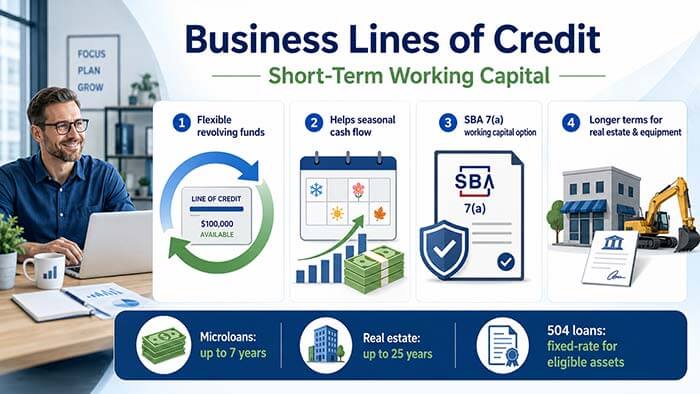
Certain small business loans are structured more like revolving lines of credit than one-time disbursements. Monitored credit lines are part of the SBA’s 7(a) Working Capital Pilot and are available for specific financing needs within the 7(a) program.
Numerous lenders outside the SBA also offer business lines of credit, which can be used to manage seasonal cash flow and operating cycles, or to cover gaps.
Borrowers also need to put together a solid repayment plan and maintain credit discipline. There is a wide range of terms on SBA 7(a) loans, but there are also policies that grant shorter terms for working capital and that allow longer-term financing for the acquisition of real estate or equipment, with certain terms associated with real estate extending repayment periods to as long as 25 years. Microloans have terms of up to 7 years, and 504 loans offer longer-term, fixed-rate financing for eligible fixed assets.
Importance of Small Business Loans for Entrepreneurs in 2026
Most entrepreneurs will not fail due to a poor idea. They will fail due to poor funding. Small business loans can help complete that equation. Small business loans can provide the working capital needed to cover payroll, seasonal inventory, gaps in receivables, the purchase of equipment, improvements to a business location, the expansion of the business to a second location, or the acquisition of a business with a history of generating revenue.
Who Benefits Most From Small Business Loans
SBA points out that if a bank views a business as too risky for a usual loan, the SBA guaranty may make that lender more likely to provide financing. This especially applies to 2026, as entrepreneurs are having to make more stringent capital decisions. Borrowing without a clear purpose can be detrimental.
When it comes to small business loans from the [SBA], the financing structure can work for service businesses, retail, contracting, manufacturing, restaurants, medical, logistics, and professional services.
Borrowing with a strategy can keep control, preserve ownership, support growth, and establish commercial credit. For founders who want to maintain control by avoiding equity investors, debt financing can be a viable option as long as the repayment plan aligns with the business model and the debt’s purpose is clear. The SBA encourages borrowers to create a business plan, an expense sheet, and a five-year projection report. This will make the loan proposal more succinct and improve the presentation.
Why Small Business Loans Matter in 2026
Small business loans assist entrepreneurs with an explicit business purpose and an achievable repayment plan. A startup may benefit from a smaller loan to cover start-up expenses, initial inventory, or working capital. An established business may finance operational expansion, refinance more expensive business debt, purchase machinery, acquire commercial real estate, or buy other companies.
Small businesses make up more than 60% of the U.S. workforce. They’re the heart of the local economy and a big part of what keeps communities alive.
Running a business takes money—for inventory, equipment, payroll, or just staying afloat during slow seasons. Small business loans are important for helping owners reach their goals. These loans offer financial support for starting a business, buying equipment, or expanding operations. They cover daily expenses and can help you hire new staff for growth. If you want to take your business to the next level or need help recovering from challenges, small business loans can give you the push you need to succeed.
Top Small Business Loan Options in 2026
SBA Loans
- SBA loans are backed by the U.S. government, which means they have lower interest rates and longer repayment periods for borrowers.
- The most popular types are SBA 7(a), SBA Express, and CDC/504 loans, with interest rates usually between 7% and 10%.
- These loans are great for business owners with good credit and a solid business plan.
Business Lines of Credit
- A business line of credit lets you borrow what you need, when you need it.
- You only pay interest on what you use, with rates from 10% to 30%.
- It’s useful for seasonal businesses or those facing cash flow issues since it provides quick access to funds without the hassle of a regular loan.
Short-Term Loans
- Short-term loans provide quick funding that you can repay in 3 to 18 months.
- The interest rates range from 8% to 20%.
- Short-term loans are ideal for emergencies, buying inventory, or taking advantage of time-sensitive chances.
Equipment Loans
- Equipment loans help businesses secure costly items like vehicles and machinery without draining cash reserves, benefiting industries like construction, transportation, and manufacturing by enabling essential tools for operations while fostering growth.
Invoice Financing
- Invoice financing helps small businesses quickly obtain cash for unpaid invoices.
- Instead of traditional interest rates, monthly fees range from 1% to 5%.
- This option benefits businesses dealing with other businesses that often experience payment delays, improving cash flow and ensuring smooth operations without waiting for payments.
How to Qualify for Small Business Loans
Getting approved starts with knowing what lenders look for. Here are the most important things they’ll check:
Credit Score
- Your personal and business credit scores are important when seeking small business loans.
- Lenders typically examine your personal credit, making it essential to maintain a strong score.
- For traditional loans, a score of at least 650 is recommended.
- However, some alternative lenders may approve scores as low as 500, giving chances to businesses with complex credit histories.
Time in Business
- Lenders generally prefer companies that have been operating for 6 months to 2 years because it shows stability.
- However, startups can still get funding by providing collateral or applying for programs for new businesses.
Revenue
- Lenders usually want to see a steady minimum revenue, like around $10,000 a month, to make sure you can handle repayments.
- But if your income is all over the place, regular loans might not be the best fit.
- In those cases, options like bank statement loans or lines of credit can be more flexible and work better with your varying earnings.
Business Plan
You need a clear and simple business plan to apply for SBA or startup loans. Start by explaining what you sell. Next, describe how you will use the loan money. Finally, share how you plan to pay back the loan. A well-organized plan shows lenders that you are ready and responsible.
Collateral (for some loans)
- When you’re looking to get small business loans, using collateral helps.
- Equipment or vehicles can back up your loan, making it easier to get the money and lowering the lender’s risk.
- While some small business loans are unsecured and don’t need any collateral, they usually come with higher interest rates because they’re riskier for the lender.
- Business owners need to get a good grip on the differences between collateral and unsecured loans to make better financing decisions.
Step By Step On How to Apply for Small Business Loans
Here’s a step-by-step look at the application process:
Know How Much You Need
- Are you covering payroll? Buying equipment? Opening a second location?
Pick the Right Loan Type
- Term loan for long-term growth
- Line of credit for everyday expenses
- SBA loan for lower rates
Check Your Credit
- Pull both your personal and business credit reports
Gather Your Documents
- Tax returns, bank statements, profit & loss statements, business plan
Apply With a Lender That Fits You
- Gustan Cho Associates can match you with lenders who understand small business challenges
Tips to Boost Your Approval Odds
Want to improve your chances of getting small business loans? Try these:
- Improve your personal credit score
- Separate business and personal finances
- Show steady cash flow in your bank statements
- Keep your debt-to-income (DTI) ratio low
- Have a clear use for the funds
Can You Get a Business Loan if Your Credit is Bad?
- Yes. While some lenders need good credit, others—especially non-bank and private lenders—work with as low as 500 credit scores.
- At Gustan Cho Associates, we specialize in helping business owners who have been turned down elsewhere.
- We look at the whole story, not just your credit score.
Looking to Expand Your Business? Small Business Loans Can Help!
Contact us today to explore our loan programs and find the right option for your business.
Typical Reasons for Denial of Small Business Loans
In most small business loan applications, there are a few reasons the loan may have been denied. The first is the overall ability to repay the loan. If there is no cash flow to support the debt, then no lender will approve the business loan, no matter how good the business idea.
The second is insufficient documentation. If there are missing documents, inconsistent financial statements, issues with the use of proceeds, or revenue forecasts, the application’s fundamentals will be weakened.
The third is meeting the criteria. Before beginning deeper underwriting, businesses that do not satisfy the SBA size or purpose criteria, fall into ineligible categories, or do not satisfy the current ownership rules may be screened out.
Selecting The Right Type Of Business Loan
Another frequent issue is selecting the incorrect loan type. Program criteria will not be satisfied by requesting a 504 loan for working capital or by attempting to use a Microloan for real estate purchases. Many business owners simplify the process by aligning the request to the appropriate program, resulting in a more organized, well-documented loan request.
Why Choose Gustan Cho Associates for Small Business Loans?
Many lenders have strict rules or overlays that make it hard to get approved. At Gustan Cho Associates:
- We work with over 280 private and alternative lenders
- We have no lender overlays on many programs
- We can offer fast approvals and flexible requirements
If your bank says no, we may say YES.
Selecting the Best Small Business Loan
The best loan is determined by the problem you are solving. For instance, if you need a loan for working capital, refinancing, expansion, or business acquisition, a 7(a) loan will be the best option.
On the other hand, if you need that loan to purchase or make improvements on owner-occupied commercial real estate (i.e., real estate that the owner is using for their own business) or to buy some long-term equipment, then you should consider the 504 loan.
If you need a much smaller amount to start or expand the business, you should consider Microloans. The mistake many borrowers make is thinking that the only important thing is approval. Rather than thinking about whether they will get the money, it is more important to think about whether the business will be able to operate at that level without too much strain.
Examining Small Business Loan Qualification for 2026
Completing an application for a small business loan in 2026 involves many steps. One of the most important steps is to construct a clear and credible repayment plan and story.
Entrepreneurs who understand what business loans entail, the process that follows. The benefits one can obtain are in a better position than those who choose an informal, liberal approach.
Usually, the most favorable outcome occurs when the loan program is customized and paired with the business need, a comprehensive and detailed documentation is provided, solid and conclusive financials are submitted,.
Finally, when the lender is approached with the intention of providing a detailed, concrete plan rather than a dollar amount for the big picture request.
Frequently Asked Questions About Small Business Loans
What Are Small Business Loans?
- Small business loans are a type of financing to acquire working capital, business equipment, inventory, or commercial real estate.
- They also include financing to acquire or refinance a business or commercial real estate.
- Funding sources can include banks, credit unions, online lenders, nonprofit intermediaries, and lenders participating with the Small Business Administration (SBA).
- The types of SBA-backed small business loans include the Microloans, and the 7(a) and 504 loan programs.
How Do Small Business Loans Work?
- Small business loans work by providing either a lump sum or a business line of credit, and the business must repay the loan within a certain period of time and under specific conditions.
- The lender looks at your eligibility, credit, cash flow, and the intended use of the loan.
- For SBA 7(a) loans, the borrower applies directly to the lender, not to the SBA, as the SBA only guarantees a portion of the loan.
Who Can Qualify For Small Business Loans?
- This depends on the lender and each loan program, but the SBA has said that to qualify, the business must be a legal, for-profit business based in the U.S. or its territories, and the owner must be creditworthy and able to repay the loan.
- For SBA 7(a) loans, the business must be considered small by SBA’s size standards and must not be in a disallowed category of business.
Can I Get A Small Business Loan if I Am A Startup?
- Most likely, yes! Just be ready to show a thorough business plan, operational forecast, and a detailed profile of the business owners.
- Your operating history is likely to be very limited, but as a startup, the business plan you submit, the operational forecast, and the owners’ profile will speak volumes.
- Some borrowers with weak credit histories may be eligible for startup financing.
- This is a point of consideration by the SBA.
What Is The Minimum Credit Score To Get A Small Business Loan?
- Unfortunately, the answer to your question may very likely be no.
- Minimum score requirements are not publicly shared by the SBA.
- The Lender Match tool provides general credit requirements for each loan, so be sure to check whether your score meets the minimum.
- Score requirements for loans can vary by lender and loan type.
What Paperwork Is Needed For A Small Business Loan?
- Different lenders may require different paperwork, but the SBA suggests you come prepared with your business plan, a record of expenses, and financial forecasts.
- According to the SBA, established businesses are expected to present a plan that includes financial forecasts, as well as historical documents for profit & loss statements, the balance sheet, and the cash flow statement for the past three to five years.
- All lenders are likely to ask for tax returns, ownership documents, and debt and bank statements that support those.
- To be thorough, have the records so that the funds can be tracked for the purpose for which they were intended.
What Are Small Business Loans Used For?
- SBA 7(a) business loans can be used for working capital, equipment, refinancing debt, or purchasing real estate, supplies, and/ or ownership changes.
- For major fixed assets like land, buildings, and long-life equipment, you can use an SBA 504 loan.
- For SBA Microloans, you can finance working capital, inventory purchases, and the purchase of supplies, furniture, fixtures, machinery, and equipment. Microloans cannot be used for real estate or to pay off existing debts.
Are Small Business Loans For Old Or New Businesses?
No. Some small business loans are available to new businesses and startups. Microloans can be used by newer businesses, and certain early-stage borrowers can access them through specific lenders or underwrite intermediaries. More options are available to established businesses because they can demonstrate an operating history and stronger cash flow, but newer businesses are not automatically excluded.
Can I Apply For SBA Small Business Loans If I Am Not A U.S. Citizen?
- Since the SBA made changes to citizenship and residency requirements
- in 2026, only U.S. citizens, U.S. nationals, and lawful permanent residents can obtain 7(a) and 504 loans.
- Because these rules changed recently, non-citizen owners should check with their SBA-participating lender to see if anything has changed.
How Long Does It Take To Get Approved For Small Business Loans?
- Since there are many types of small business loans, there is no single answer that fits all.
- The lender, the program, the size of the request, and the completeness of the request all affect how quickly the loan closes.
- Borrowers who organize their business plan and supporting financial documents ahead of time typically experience faster approvals.
What Are Small Business Loans Used For?
- Small business loans help business owners pay for equipment, payroll, inventory, or to grow their company.
- You can also use them to get through slow seasons.
Can I Get Small Business Loans If I Have Just Started?
- Yes.
- Some lenders offer small business loans to new businesses, especially if you have a good plan or offer collateral like equipment.
What Credit Score do I Need to Get Small Business Loans?
- Most lenders want at least a 650 credit score, but some may approve you with a score as low as 500.
How Much Money Can I Borrow with Small Business Loans?
- Loan amounts vary depending on your revenue and credit.
- Some small business loans go from $5,000 to over $5 million.
What Types of Small Business Loans are Available in 2026?
- Popular options include SBA loans, term loans, business lines of credit, equipment loans, and invoice financing.
How Fast Can I Get Approved For Small Business Loans?
- Some lenders approve loans in just 1–2 days. SBA loans can take a few weeks.
- Gustan Cho Associates offers fast approvals with flexible rules.
Do I Need a Business Plan to Get Small Business Loans?
- Yes, especially for SBA loans or if your business is new.
- A simple plan that explains what you do and how you’ll repay the loan can help a lot.
Do Small Business Loans Require Collateral?
- Not always. Some small business loans are unsecured, but loans with collateral often have lower interest rates.
Can I Get Small Business Loans with Bad Credit?
- Yes.
- Gustan Cho Associates works with lenders who approve small business loans for owners with credit scores as low as 500.
Why Choose Gustan Cho Associates for Small Business Loans?
- We work with over 280 lenders and have no extra rules or overlays.
- Even if a bank says no, we may say yes and help you get approved fast.
Get the Small Business Loan You Deserve
Don’t let tight bank rules or low credit hold you back. Small business loans are available in 2026 to help you grow, hire, and thrive. Whether you need working capital, equipment, or breathing room, we can help.
When offering a loan, there are various business activities that can be improved, such as the ability to expand, the ability for the business to be sustainable and remain in a solid position.
In some cases, the ability to transform a business that is classified as good into one that can be classified as great and is able to scale. Borrowing with a clear, defined purpose, supporting all plans and arguments with adequate documentation, and developing a financial plan and strategy that accurately reflects your business’s current status are essential to achieving your objectives.
Contact Gustan Cho Associates today to get pre-approved, explore your best loan options, and get funded fast. Contact us at 800-900-8569, text us for a faster response, or email us at gcho@gustancho.com. The team at Gustan Cho Associates is available 7 days a week, on evenings, weekends, and holidays.
This blog about “Best Small Business Loans for Low Credit Scores” was updated on March 10th, 2026.
Ready to Secure Funding for Your Business? Apply for a Small Business Loan Now!
Whether you need funds for equipment, working capital, or expansion, we have small business loan solutions to fit your needs. Contact us now to get started on your application.
