
Veterans may be eligible for a VA loan even if they have outstanding collections or charge-offs, as VA guidelines on charge-offs and collections do not always require them to be settled before closing. However, the final approval depends on the complete loan file. Lenders will assess your credit, income, monthly debts, residual income, and findings from the Automated Underwriting System (AUS). It’s not uncommon for some veterans to be denied by one VA lender but approved by another, often because of additional rules known as lender overlays. These overlays could impose more stringent standards, such as a higher credit score, a lower debt-to-income ratio, or the requirement to pay off older collections. Understanding whether the denial was due to VA guidelines, AUS findings, or lender overlays is crucial.
VA Lender Overlays

Not all VA lenders adhere to identical guidelines for VA loans, particularly concerning VA Guidelines on Charge-Offs and Collections. It’s important to note that a veteran borrower’s inability to qualify with one lender doesn’t preclude them from qualifying with another. The subsequent paragraph will outline common lender overlays on VA loans. Lender overlays are additional requirements individual lenders impose on top of VA guidelines, including those related to charge-offs and collections. These overlays may include stricter credit score requirements, lower debt-to-income ratios, or limitations on certain types of properties. Understanding these overlays is crucial for veterans seeking VA loans, as they can significantly impact their ability to secure financing. At Gustan Cho Associates, we specialize in helping veterans navigate these complexities and find lenders who offer terms aligned with VA guidelines, ensuring they have the best chance of obtaining the financing they need.
Most lenders have VA lender overlays on credit scores. Most lenders require a 620 credit score, but the VA does not require a minimum credit score.
Veterans seeking a loan should maintain a credit score of at least 580 to secure approval via the Automated Underwriting System. Findings as per VA Guidelines on Charge-Offs and Collections. At Gustan Cho Associates, we adhere strictly to VA guidelines and do not impose additional requirements or minimum credit scores. It’s worth noting that many lenders typically cap the debt-to-income ratio at 41% to 50% DTI.
VA Guidelines Versus VA Lender Overlays
Not all VA lenders adhere to the same criteria. A borrower might meet the VA guidelines on charge-offs and collections but still face denial due to additional lender requirements. VA guidelines are the basic rules for VA loans laid out by the Department of Veterans Affairs. AUS findings, which are the results from automated underwriting, assess the borrower’s credit, income, debts, assets, and overall risk. An approve/eligible finding from AUS can significantly enhance the chances of receiving approval. Lender overlays are additional stipulations imposed by the mortgage company; for instance, while the VA may not mandate a minimum credit score, a lender might require a minimum of 620. Similarly, the VA may not require repayment of old collections, but a lender may require payment before closing. Manual underwriting occurs when a file cannot be approved through automated means, necessitating an underwriter to hand-review the borrower’s complete file, including credit history, income, residual income, housing history, and compensating factors. This explains why one VA lender may decline a borrower while another may approve, often because of the lender’s overlays rather than the borrower’s adherence to VA guidelines.
VA Loan Credit Score Requirements
The VA does not establish a single universal minimum credit score for all VA loans; instead, individual mortgage lenders determine their own minimum credit score requirements. Many lenders typically require a credit score of 580, 600, or 620, influenced by the lender’s policies and the overall strength of the borrower’s profile. It’s also important to consider the VA guidelines on charge-offs and collections, as these factors can impact a borrower’s creditworthiness. Even when a lender does not have a strict minimum credit score, the borrower still needs one of the following:
- An acceptable AUS approval
- Or approval through manual underwriting
This means a veteran may still qualify for a VA loan with lower credit scores, but approval depends on the full file, not just the credit score. Lenders will review credit history, income, debt-to-income ratio, residual income, housing payment history, and overall repayment ability.
Collections Versus Charge-Offs On VA Loans
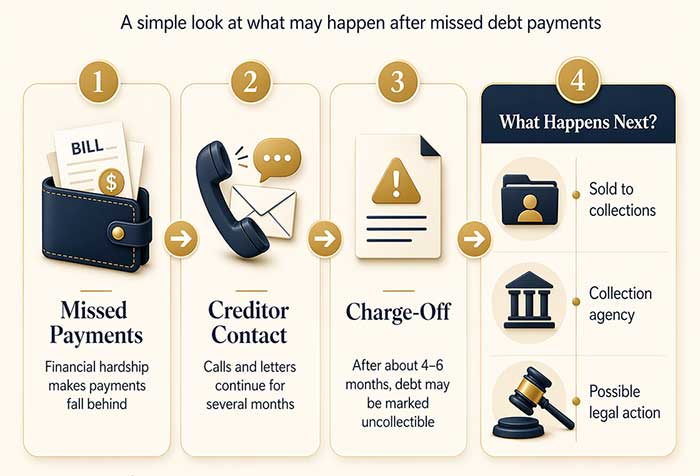 Collections and charge-offs are not the same. They are both negative credit items, but mortgage lenders may review them differently during the VA loan process.
A charge-off happens when the original creditor writes off the debt as a loss. This does not always mean the borrower no longer owes the money. In many cases, the creditor may still try to either collect the debt or sell it to a collection agency.
A collection account happens when an unpaid debt is sent or sold to a collection company. The collection agency may report the account on the borrower’s credit report and may try to collect the balance. A charged-off account sold to collections can create confusion, as the borrower may see both the original charge-off and the collection account on their credit report. The lender will review the account history, balance, dates, and whether the debt is still being collected. A medical collection may be treated differently than a non-medical collection, depending on the loan file, AUS findings, and lender requirements. A disputed account can complicate the mortgage process, particularly under VA guidelines on charge-offs and collections. Certain credit disputes may need to be resolved before the loan proceeds, especially if they affect the credit score or Automated Underwriting System (AUS) findings. Additionally, a judgment carries more weight than a standard collection account; if a collection escalates to a court judgment, the borrower may be required to pay it, reach a settlement, or arrange an approved payment plan before finalizing the closing.
How VA Guidelines on Charge-Offs and Collections Affect Credit
How do collections affect debt-to-income ratio on VA loans? VA loans can be more flexible than many other mortgage programs regarding debt-to-income ratios. However, this does not mean there is no review of the borrower’s debts or ability to repay.
When a borrower has collections or charge-offs, the lender will review the full file. This includes monthly debts, the new mortgage payment, income, credit history, residual income, AUS findings, and any lender overlays.
Residual income is very important for VA loans. Residual income is the money left over each month after paying the mortgage, debts, taxes, insurance, and other required obligations. Even if the debt-to-income ratio is higher, the borrower may still qualify if there is enough residual income and the overall file is strong. Collections can influence the debt-to-income ratio if a lender considers payments on the collection account. Some lenders might insist on a payment plan. In contrast, others may regard a portion of the unpaid collection balance as a monthly debt. Additionally, some lenders may adhere to the AUS findings and not require payment for the collection. This is why VA loan approval is not determined solely by the debt-to-income ratio. Instead, according to VA guidelines on charge-offs and collections, lenders evaluate the full picture, including credit history, residual income, compensating factors, AUS approval, and any additional overlay requirements.
Worried about charge-offs or collections?
VA guidelines can help you qualify—apply now and take the next step toward homeownership!How Collection Agencies Work
Collection agencies can reach out to people by phone, mail, email, or other allowed ways to collect unpaid debts. These debts usually show up on your credit report after the original lender has written them off or transferred them. Borrowers should not ignore collection notices. In some cases, an unpaid collection may remain only a credit reporting issue. In other cases, the creditor or collection agency may pursue legal action. If the debt becomes a judgment, it can create a more serious problem during the VA mortgage process. Veterans applying for a VA loan should review all collection accounts before starting the mortgage process. The lender will consider the account type, balance owed, last activity date, payment status, and whether the account affects AUS findings or manual underwriting. It’s important to know your rights when dealing with collection agencies. If a collection account is wrong, outdated, listed more than once, or isn’t yours, you may need to fix it before or during the mortgage process.
Do VA Lenders Count Collection Balances As Monthly Debt?
VA lenders do not always treat collection accounts the same way. Some lenders may count a percentage of unpaid collection balances as a monthly debt, especially if the borrower does not have a documented payment arrangement.
Other lenders may follow AUS findings and VA underwriting guidance more closely. If AUS does not require the collection to be paid, some lenders may not require a payoff before closing.
This is where lender overlays become important. A lender may require that old collections be paid, settled, or counted as a monthly debt, even when VA guidelines or AUS findings do not specifically require it. Borrowers should ask one important question:
Is this required by VA guidelines, AUS findings, or your lender overlay?
That answer can make a big difference. A borrower may be denied by one VA lender because of unpaid collections, but still qualify with another lender that follows VA guidelines without extra overlays.
Why AUS Findings Matter With VA Guidelines on Charge-Offs and Collections
AUS stands for Automated Underwriting System. It is the system lenders use to review a borrower’s credit, income, debts, assets, and overall risk.
Most VA loans are first run through AUS. The AUS result can play a major role in whether collections or charge-offs need to be paid before closing.
An approve/eligible finding means the borrower appears to meet the automated underwriting requirements for a VA loan. If the file receives approved/eligible findings, old collections or charge-offs may not need to be paid unless the AUS findings or lender require it. A refer/eligible finding means the file may need to be manually underwritten. This does not always mean the borrower is denied. It means a human underwriter must review the full file more closely. AUS may allow flexibility on unpaid collections and charge-offs, but lender overlays can still create problems. A lender may require collections to be paid, settled, or explained, even when the AUS does not require a payoff. This is why veterans should not give up after one VA loan denial. The issue may not be the VA guideline. It may be the AUS result, the file’s strength, or the lender’s overlays.
Can You Get A VA Loan With Collections Through Manual Underwriting?
Yes, manual underwriting may be possible if the borrower does not receive an AUS approve/eligible finding. A refer/eligible finding does not always mean denial. It means a human underwriter needs to review the full file.
The underwriter will check your credit history, income, debts, residual income, housing payment history, collections, charge-offs, and any positive factors. If you have recent late payments or large unpaid collections, it can be harder to get approved. But if you have paid your housing bills on time for the past year, it can help your case.
Manual underwriting may require the submission of extra documents, including letters that outline your circumstances, verification of rent payments, or bank statements. If you are a veteran dealing with collections or charge-offs, don’t automatically think you’ll be denied. According to VA guidelines on charge-offs and collections, you still have an opportunity if you can present strong documentation and demonstrate your ability to repay the loan.
Collections, Charge-Offs, Judgments, Tax Liens, And Federal Debt Are Not The Same
Not all unpaid debts are treated the same during the VA loan process. Collections and charge-offs may not always need to be paid before closing, depending on AUS findings, lender requirements, and the overall strength of the borrower’s file. A collection account is usually an unpaid debt that has been sent or sold to a collection agency. Some collections may not need to be paid, but the lender will review the balance, date, account type, and whether it affects the borrower’s ability to repay. A charge-off means the original creditor wrote the debt off as a loss. This does not always mean the borrower no longer owes the money, but charge-offs may not always need to be paid to qualify for a VA loan.
A judgment is more serious because it means a court has ruled against the borrower. Judgments usually need to be paid, settled, or placed on an acceptable payment plan before closing.
A tax lien may also need to be resolved before loan approval. The lender may require proof of payment, a payment plan, or documentation showing the lien is being handled properly. Delinquent federal debt can create serious problems with VA loan approval. This may include defaulted federal student loans, unpaid federal taxes, or other government debt. These issues should be reviewed early in the mortgage process. Borrowers should not assume all debts are treated the same. A collection, charge-off, judgment, tax lien, and federal debt can each affect VA underwriting differently.
More on Charge-Off Accounts in the Mortgage Process
Once a creditor charges off debt, that does not mean they have given up on collecting on the debt. This does not clear consumers from past debt obligations until the statute of limitations on debt expires. The creditor normally sells charge-offs to third-party debt collectors for pennies on the dollar. These debt collectors now own the paper, and the collection process repeats itself.
Documents Needed For A VA Guidelines on Charge-Offs and Collections
Borrowers with collections or charge-offs may need extra documents during the VA loan process. The exact documents depend on the AUS findings, lender requirements, and the type of credit issue.
Common documents may include a recent credit report, collection account statements, proof of payment arrangements, settlement letters, paid-in-full letters, or letters of explanation for major derogatory credit.
If the borrower is making payments on an old debt, the lender may ask for bank statements showing the payment history. If the debt is owed to an ex-spouse, a divorce decree or court order may be required. Borrowers with a prior bankruptcy may also need a bankruptcy discharge order and copies of the bankruptcy schedules. Having these documents ready early can help avoid delays during underwriting and make the VA mortgage process smoother.
Final Thoughts On VA Guidelines on Charge-Offs and Collections
A VA loan denial does not always mean the borrower failed VA guidelines. In many cases, the issue may be unpaid collections, charge-offs, recent late payments, AUS findings, lender overlays, or unresolved debts such as judgments, tax liens, or federal debt.
Veterans should ask why the loan was denied before giving up. The denial may have come from the lender’s internal rules, not the VA loan program itself.
If you were denied for a VA loan because of collections or charge-offs, Gustan Cho Associates can review your credit, AUS findings, income, residual income, and lender overlay issues to determine whether you may still qualify under VA mortgage guidelines.
FAQ: VA Guidelines on Charge-Offs and Collections on VA Loans
Can I Get A VA Loan With Unpaid Collections?
Yes, you may still qualify for a VA loan with unpaid collections. VA guidelines do not automatically require all collection accounts to be paid before closing. However, the lender will review the type of collection, balance, date, credit history, AUS findings, residual income, and whether the collection affects your ability to repay.
Do Charge-Offs Have To Be Paid To Qualify For A VA Loan?
Charge-offs do not always have to be paid to qualify for a VA loan. A charge-off means the original creditor wrote off the debt as a loss, but the borrower may still legally owe it. The lender may request an explanation, supporting documents, or proof that the account does not pose a current repayment risk.
Can A VA Lender Deny Me Because Of Collections Or Charge-offs?
Yes. Even if VA guidelines do not require payment of old collections or charge-offs, a lender may still deny the file due to lender overlays. Lender overlays are extra rules added by the mortgage company, such as minimum credit scores, lower DTI limits, or requirements to pay certain collection accounts before closing.
What Happens If My VA Loan Does Not Get AUS Approval?
If the file does not receive an AUS approve/eligible finding, it may receive a refer/eligible finding and need manual underwriting. Manual underwriting means a human underwriter reviews the full file, including credit history, housing payment history, income, debts, residual income, collections, charge-offs, and compensating factors.
This article about “VA Guidelines on Charge-Offs and Collections on VA Loans” was updated on May 19th, 2026.
