
Oklahoma mortgage loans include FHA, VA, USDA, conventional, jumbo, and Non-QM financing for eligible homebuyers and property investors. The right program depends on your credit, income, debts, down payment, military eligibility, property location, and intended occupancy. Oklahoma buyers may also qualify for assistance through OHFA, REI Oklahoma, or local programs. A mortgage preapproval can help determine which options fit your finances and planned home purchase.
How Mortgage Approval Works in Oklahoma
Approval for Oklahoma mortgage loans depends on the borrower, property, and selected loan program. The lender reviews income, employment, credit history, debt-to-income ratio, assets, down payment, occupancy, and the appraisal. The loan may be evaluated through an automated underwriting system or manual underwriting when permitted. FHA, VA, USDA, conventional, and Non-QM loans have different requirements. Buyers using OHFA or another assistance program must also meet that program’s separate income, credit, purchase-price, and property guidelines.
Oklahoma Mortgage Programs at a Glance
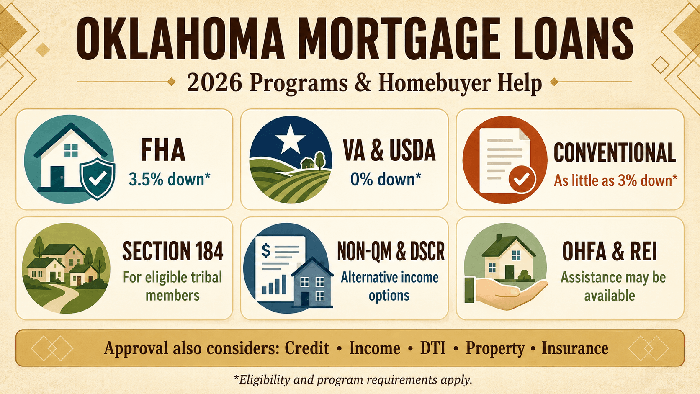
Buyers can choose from several Oklahoma mortgage loans, depending on their eligibility, finances, property, and intended occupancy.
- FHA loans: Low-down-payment financing with flexible credit guidelines.
- VA loans: No down payment for eligible service members, veterans, and qualifying surviving spouses.
- USDA loans: No-down-payment financing for eligible households purchasing qualifying rural properties.
- Conventional loans: Options for primary homes, second homes, and investment properties.
- Section 184 loans: Financing for eligible enrolled members of federally recognized tribes.
- Jumbo loans: Used when the loan exceeds the applicable conforming limit.
- Non-QM loans: Alternative documentation options for self-employed borrowers, investors, and others with non-traditional income.
FHA Loans in Oklahoma
FHA loans are a popular option for Oklahoma mortgage loans because they allow flexible credit guidelines and a relatively low down payment. Borrowers with a minimum decision credit score of 580 may qualify for a 3.5% down payment. Scores from 500 through 579 require at least 10% down under HUD guidelines, although approval is not guaranteed. The home must be an eligible one- to four-unit property used as the borrower’s principal residence. County loan limits, income, debts, payment history, assets, and findings from automated or manual underwriting also affect eligibility. FHA loans require upfront and annual mortgage insurance. Annual mortgage insurance generally lasts for the loan term when the original LTV exceeds 90% and for 11 years when the original LTV is 90% or lower.
VA Loans for Oklahoma Veterans
VA loans are available to eligible veterans, active-duty service members, certain National Guard and Reserve members, and qualifying surviving spouses. Qualified borrowers can use Oklahoma mortgage loans to purchase a primary home with no down payment and no monthly private mortgage insurance.
Borrowers must obtain a Certificate of Eligibility, but the certificate alone does not guarantee approval. Lenders still evaluate credit, income, debts, residual income, payment history, occupancy, and the property appraisal.
Most borrowers pay a VA funding fee, which may generally be financed. Veterans receiving qualifying service-connected disability compensation and certain other eligible borrowers may be exempt from the fee.
USDA Loans and Eligible Rural Areas
USDA guaranteed loans provide 100% financing to purchase a primary residence in a rural area for buyers in the low- and moderate-income categories. Much of rural Oklahoma, including many outlying towns, may qualify. Buyers must use the USDA’s eligibility map to check any properties of interest. The evaluation of an Oklahoma mortgage loan application considers the individual and household income and credit history, level of debt, and the property’s eligibility. USDA mortgage loan guarantees do not set a minimum credit score; individual lenders may set their own. The financing of the upfront guarantee fee and the collection of an annual fee through the monthly payment are features of USDA loans. While a “no down payment” loan means no cash at closing, the cost should not be expected to be completely zero.
Conventional and High-Balance Loans
Conventional loans generally follow Fannie Mae or Freddie Mac requirements and can finance primary residences, second homes, and investment properties. Some eligible buyers may qualify with as little as 3% down. Private mortgage insurance is usually required when the loan exceeds 80% of the property value.
For 2026, the baseline conforming limit for a one-unit property is $832,750. A high-balance conforming loan is available only when the property is in an FHFA-designated high-cost area with a higher county limit. A loan above the applicable county limit is generally considered jumbo.
Approval for these Oklahoma mortgage loans depends on credit, income, debts, assets, reserves, occupancy, property eligibility, and automated-underwriting findings.
Need Help With Down Payment or Closing Costs in Oklahoma?
Oklahoma buyers may have access to homebuyer assistance, grants, forgivable loans, seller credits, lender credits, or gift funds depending on eligibility and location.HUD Section 184 Loans in Oklahoma
HUD Section 184 loans provide home financing for eligible enrolled members of federally recognized tribes. These Oklahoma mortgage loans may be used to purchase, build, rehabilitate, or refinance an eligible one- to four-unit primary residence located in an approved area. Properties designated as second homes or for investment purposes are not qualified. Borrowers must document tribal enrollment and apply through an approved Section 184 lender. Approval also depends on income, credit history, debts, assets, repayment ability, and the property. Section 184 loans include a 1% upfront loan-guarantee fee that may generally be financed. HUD eliminated the annual loan-guarantee fee effective July 1, 2023.
Non-QM, Bank-Statement, and DSCR Loans
Non-QM Oklahoma mortgage loans may help borrowers who cannot document income under FHA, VA, USDA, or conventional guidelines. These programs still require underwriting but may use alternative documentation and investor-specific requirements.
Bank statement loans use eligible deposits to determine qualifying income, typically over a 12- or 24-month period. If business deposits are used, the lender may consider an expense factor.
With DSCR loans, qualifying rental income is evaluated to determine if the rental proceeds will cover the proposed housing expense. These loans are for investment properties, not for owner-occupied properties. The credit, down payment, reserves, interest rates, fees, and minimum DSCR vary by lender and the program.
OHFA Down Payment Assistance
 The Oklahoma Housing Finance Agency offers eligible homebuyers assistance of up to 3.5% of the total loan amount for down payment and closing costs. OHFA programs may be paired with FHA, VA, USDA, HUD Section 184, or conventional Oklahoma mortgage loans for qualifying primary residences. Basic eligibility generally includes a minimum credit score of 640, annual income not exceeding $150,000, and a debt-to-income ratio no higher than 45%. Additional income, purchase price, property, and first-time-buyer requirements vary between the Gold and Dream programs. OHFA assistance is a repayable, interest-free second lien—not a grant. It generally becomes due when the first mortgage is paid off, the home is refinanced or sold, or the borrower no longer occupies it as a primary residence. Buyers must apply through an OHFA-approved lender.
REI Oklahoma and Local Assistance Programs
REI Oklahoma offers down payment assistance, closing cost assistance, and up to 5% of the mortgage amount. Available structures may include gift funds that do not require repayment, a seven-year forgivable second mortgage, a repayable second mortgage, or a hybrid combining gift and repayable assistance.
Program eligibility may vary by loan type. REI assistance is offered in combination with eligible FHA, VA, USDA, HUD Section 184, Fannie Mae, and Freddie Mac mortgages. Requirements for the buyer and repayment terms will vary by program option.
Local assistance options may be available in some counties and cities, but the funding and eligibility may change. Buyers should check the housing departments serving the areas they are considering buying into to see whether assistance available in their area can be used in their financing plan.
Credit Scores, DTI, and Lender Overlays
Credit scores and debt-to-income ratios help lenders assess mortgage risk, but neither metric alone determines approval. DTI compares qualifying monthly obligations—including the proposed housing payment—with gross monthly income. Lenders also review payment history, income stability, assets, reserves, occupancy, and the overall loan profile. Approval for Oklahoma mortgage loans may depend on automated underwriting findings or manual underwriting when the program permits it. Meeting an agency’s minimum credit score or DTI guideline does not guarantee approval. Lenders may also impose overlays, which are additional requirements beyond the underlying program guidelines. An overlay could require a higher credit score, lower DTI, additional reserves, or stricter treatment of recent credit problems. This is why the same borrower may receive different decisions from different lenders.
Oklahoma Property and Insurance Considerations
Property taxes, homeowners’ insurance, flood insurance (if applicable), association fees, and mortgage insurance affect the qualifying payment for an Oklahoma mortgage loan. Buyers are advised to reach out for insurance quotes early, as premiums and wind/hail deductibles tend to vary greatly by location, property condition, roof age, and coverage.
The lender will not close the mortgage without confirming that the property has been insured. High insurance premiums can negatively affect debt-to-income ratios and put mortgage approval in jeopardy.
Additional review is often required for rural Oklahoma properties that include any combination of acreage, manufactured homes, private roads, wells, septic systems, barns, and multiple land parcels. The appraisal must confirm adequate residential use, value, and marketability, as well as accessibility and compliance with the selected loan program.
Steps to Get Preapproved
A mortgage preapproval helps determine which Oklahoma mortgage loans fit your finances before you begin making offers.
- Identify the property type, intended occupancy, price range, and estimated down payment.
- Provide identification, income, employment, assets, housing history, and credit information.
- Have the lender calculate qualifying income, debts, DTI, cash-to-close, and estimated housing payment.
- Compare FHA, VA, USDA, conventional, Section 184, and Non-QM options when applicable.
- Check eligibility for OHFA, REI Oklahoma, or local assistance programs.
- Obtain automated-underwriting findings or a manual-underwriting review when permitted.
- Review the preapproval conditions, maximum payment, available funds, and any remaining documents.
Avoid opening new credit, changing jobs, moving money without documentation, or making large purchases before closing.
Final Thoughts on Oklahoma Mortgage Loans
Oklahoma homebuyers have access to conventional financing, government-backed programs, Section 184 loans, alternative-documentation mortgages, and several down payment assistance options. The right choice depends on more than the interest rate or minimum down payment. Buyers should compare the total monthly payment, mortgage insurance or guarantee fees, cash-to-close, eligibility rules, and long-term costs. Because approval for Oklahoma mortgage loans depends on the complete borrower and property profile, getting preapproved before making an offer can prevent surprises. A thorough lender review can identify the programs you qualify for, determine whether assistance is available, and establish a realistic homebuying budget.
Frequently Asked Questions About Oklahoma Mortgage Loans
Do I Need to Live in Oklahoma Before Applying for a Mortgage?
No. You generally do not have to be a current Oklahoma resident to apply for financing on a property in the state. However, the lender must be authorized to conduct business in Oklahoma, and an owner-occupied loan requires a genuine intention to use the property as your primary residence within the program’s required timeframe.
Can Gift Funds Be Used for an Oklahoma Home Purchase?
Many mortgage programs allow eligible gift funds to cover some or all of the down payment or closing costs. The donor, permitted use, and required borrower contribution depend on the loan program and property. The lender typically requires a signed gift letter and documentation showing the transfer of funds.
Can the Seller Pay My Closing Costs?
Yes. A seller may contribute toward eligible closing costs and prepaid expenses, subject to the selected loan program’s limits. Seller contributions generally cannot be used to satisfy the borrower’s required down payment or to create cash back beyond documented allowable costs.
Can I Qualify for an Oklahoma Mortgage After Bankruptcy or Foreclosure?
Possibly. FHA, VA, USDA, conventional, and Non-QM programs have different waiting periods and exceptions. Eligibility may depend on the type of bankruptcy, discharge or dismissal date, foreclosure completion date, reestablished credit, extenuating circumstances, and whether manual underwriting is permitted.
How Long Does It Take to Close a Mortgage in Oklahoma?
Many purchase transactions are scheduled to close within approximately 30 to 45 days, but there is no universal timeline. Closing can take longer when the appraisal, title work, insurance, property repairs, assistance-program approval, or underwriting conditions are delayed.
What Happens If the Oklahoma Home Appraises Below the Purchase Price?
The lender generally bases financing on the lower of the purchase price or appraised value. The buyer may renegotiate the price, pay the difference with eligible funds, request a reconsideration of value when supported by additional evidence, or cancel if the purchase contract provides that right.
Can Mineral Rights or an Oil and Gas Lease Affect Mortgage Approval?
They can. Severed mineral rights do not automatically make a property ineligible, but an active lease, drilling operation, surface-use agreement, or related title exception may require additional review. The lender, title company, appraiser, and insurer may need to determine whether the arrangement affects the property’s safety, value, access, or marketability.
Is Homebuyer Education Required for Oklahoma Mortgage Loans?
Homebuyer education is not required for every mortgage or every first-time buyer. However, certain assistance and affordable lending programs may require a course or an informational video. Buyers using OHFA down payment assistance must complete OHFA’s required DPA video.
This article about “Oklahoma Mortgage Loans: Programs, Requirements, and Homebuyer Assistance” was updated on August 25th, 2026.
