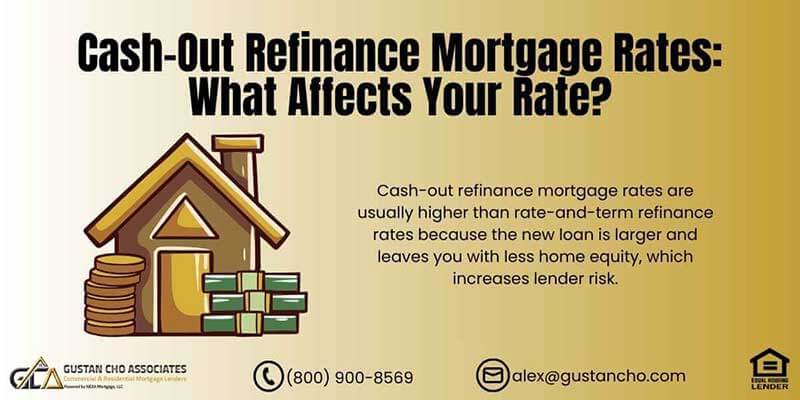
Cash-out refinance mortgage rates are usually higher than standard refinance rates because you are borrowing against your home equity and increasing the lender’s risk. The exact rate you get depends on several factors, including your credit score, loan-to-value ratio, occupancy type, property type, and current market conditions.
A cash-out refinance can be a handy option for homeowners looking to pull out some cash. It’s a great way to fund home upgrades, pay off debt, or handle big expenses. But the rate matters. Even a small difference can raise your monthly payment and increase your total borrowing cost over time.
In this guide, you will learn how cash-out refinance mortgage rates work, why they are often higher than rate-and-term refinance rates, what affects pricing, and how to compare offers more effectively before you tap into your home equity.
What Are Cash-Out Refinance Mortgage Rates?
Cash-out refinance mortgage rates are the interest rates lenders charge when you replace your current mortgage with a larger new loan and receive the difference in cash. Because the new loan balance is higher, lenders usually price these loans more cautiously than they do for a standard refinance.
In most cases, cash-out refinance mortgage rates are higher than those for rate-and-term refinances. That does not automatically mean a cash-out refinance is a bad idea. It means borrowers need to look closely at both the rate and the reason for taking cash out.
Why Cash-Out Refinance Mortgage Rates Are Higher
Lenders usually charge higher cash-out refinance mortgage rates because the borrower is taking on a larger loan amount and using more of the home’s available equity. When equity drops, lender risk rises. That added risk often leads to a higher interest rate than you would see on a refinance that only changes the rate, term, or both.
The difference may look small on paper, but over a 15-year or 30-year loan, even a modest rate increase can have a meaningful impact on payment and long-term interest costs.
What Affects Cash-Out Refinance Mortgage Rates?
Several key factors affect cash-out refinance mortgage rates. Borrowers with higher credit scores, stronger equity positions, and primary residences usually qualify for better pricing. On the other hand, lower credit scores, higher loan-to-value ratios, multi-unit properties, second homes, and investment properties often come with higher rates.
Lenders also look at the broader market, so cash-out refinance mortgage rates can move up or down even when your personal financial profile stays the same.
Is A Cash-Out Refinance Worth It?
A cash-out refinance may be worth it if the money serves a clear financial purpose and the new mortgage still fits your budget. Many homeowners use cash-out funds for home renovations, debt consolidation, or other large expenses that would otherwise carry higher interest rates.
Still, the decision should not be based solely on access to cash. You also need to weigh the new interest rate, closing costs, monthly payment, and how long you plan to keep the loan.
Cash-Out Refinance Mortgage Rates vs. Rate-and-Term Refinance Rates
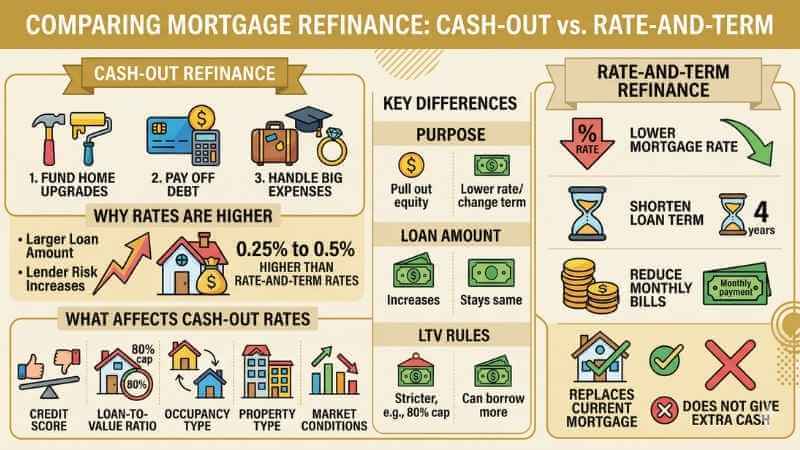
A rate-and-term refinance replaces your current mortgage without giving you extra cash back. Its main purpose is to lower your interest rate, change your loan term, or both. Because the loan balance does not increase the way it does with a cash-out refinance, rate-and-term refinance rates are usually lower.
Cash-out refinance mortgage rates are typically higher because the new loan is larger and uses more of your available home equity. If homeowners are looking for cash to spruce up their place, pay off some debts, or tackle big expenses, it is worth it to go for a loan with a slightly higher interest rate. But if your only goal is to lower your rate or payment, a rate-and-term refinance may be the better fit.
Cash-Out vs Rate-and-Term Refinance Explained
See which mortgage refinance saves you more and fits your goals.
Rate and Term Refinance vs. Cash-Out Refinance Rates
Why Cash-Out Rates Cost More
Lenders see cash-out refinances as riskier since the loan amount is higher. That’s why cash-out refinance rates often run 0.25% to 0.5% higher than rate and term refinances rates.
Loan-to-Value (LTV) Rules
Cash-out refinances usually have stricter LTV rules. If you want to take cash out, most lenders cap the loan at 80% of the home’s value. For a rate and term refinance, you may be able to borrow a higher percentage.
The Role of Credit Score
A higher credit score helps you lock in better rates for both refinance options. The gap between the cash-out and rate and term rates grows larger for borrowers with lower scores.
Why a Cash-Out Refinance Might Be Smart
- Quick Cash Access: Turn your home equity into cash for debt consolidation, home projects, or big purchases.
- Possible Tax Perks: The interest on the loan could still be tax deductible if you use it for home upgrades.
- Simple Monthly Bills: Combining debts into your mortgage means tracking only one monthly payment.
Why a Rate-and-Term Refinance is a Good Move
- Better Mortgage Rates: Usually, this option gives you the lowest rates lenders have.
- Shorter Loan Terms: Switch to a shorter term, like a 15-year mortgage, and you’ll pay much less interest overall.
- Lower Monthly Bills: If you need a smaller payment, you can stretch the loan term without taking out extra cash.
What to Watch Out For
Cash-Out Refinance Cautions
- Rates are often higher than for a plain rate-and-term refi.
- If you stretch the loan, you’ll be paying longer.
- A larger loan balance could mean more risk if you can’t pay.
Rate-and-Term Refinance Cautions
- No extra cash, only new terms and rates.
- Closing fees can still add thousands to your new balance.
- A longer term can lead to more total interest, even if monthly payments are smaller.
Which Option Is Best for You?
Deciding between cash-out refinance mortgage rates and rate-and-term refinance rates comes down to what you want to achieve. If you’re looking for cash to pay for big expenses or to combine debt, a cash-out refinance may be worth the extra rate. A rate-and-term refinance is probably your best bet to lower interest costs and reduce your monthly payment.
At Gustan Cho Associates, we guide borrowers through both loan types, ensuring they get the most competitive refinance program possible—with no lender overlays.
What Do People Spend The Proceeds From Cash-Out Refinance Mortgage
Tens of thousands of Americans are house rich and sitting on a lot of equity. A large percentage of Americans are dipping into their home equity to cash in and use the cash for multiplying their real estate portfolio. The nation’s housing shortage is making it lucrative for investors to invest in rental properties.
People can spend the proceeds from the cash-out refinance for investments, renovations, vacations, pay down debts, weddings, education, and dozens of other reasons.
Homeowners can use the proceeds from a cash-out refinance for any purpose they see fit. Cash-out refinance loans are tax-free. Homeowners do not pay a dime in taxes from the proceeds of a cash-out refinance.
Which Refinance Option Fits Your Goals?
Analyze cash-out and rate-and-term options to optimize your home loan.
Why Are Cash-Out Refinance Mortgage Rates Higher Than Rate and Term Rates?
The reason cash-out refinance mortgage rates are higher than rate and term rates are that lenders consider cash-out refinances higher risk than rate and term.
Loan level pricing adjustments, commonly referred to as LLPAs, are pricing hits or pricing adjustments for each layer of risk the lender considers.
Every homeowner is trying to strive for the best lenders with the best cash-out refinance mortgage rates. Many borrowers with lower credit scores and/or bad credit often feel grateful just being able to do a cash-out refinance loan because they need the money for one purpose or another.
How To Compare Cash-Out Refinance Mortgage Rates
Shopping for cash-out refinance mortgage rates is about more than finding the lowest number in an ad. The best loan deal is the one that offers a good interest rate, reasonable closing costs, and a monthly mortgage payment that fits your budget. Even a small rate difference can increase your payment and total interest cost over time, so it pays to compare lenders carefully.
Because cash-out refinances are considered riskier than standard rate-and-term refinances, pricing can vary from lender to lender. Your quote may change based on your credit score, home equity, occupancy, property type, and loan amount.
That is why homeowners should compare multiple offers on the same day and review both the interest rate and the annual percentage rate, or APR, to get a clearer picture of the total cost.
When comparing lenders, ask for a full Loan Estimate and look closely at discount points, lender fees, and total closing costs, not just the headline rate. A lender offering a slightly lower rate may charge a higher upfront fee, which can make the loan more expensive overall. The goal is not just to find the lowest advertised cash-out refinance mortgage rates, but to find the best overall value for your financial goals.
Why Cash-Out Refinance Mortgage Rates Are Usually Higher Than Rate-and-Term Refinance Rates
Cash-out refinance mortgage rates are usually higher than the rates you would see on a rate-and-term refinance. The main reason is risk. With a cash-out refinance, you replace your current mortgage with a larger loan and take some of your home equity in cash. Because the loan balance increases and your remaining equity decreases, lenders often charge a higher rate.
Several factors can push cash-out refinance mortgage rates higher, including lower credit scores, higher loan-to-value ratios, property type, occupancy, and loan size. In plain terms, borrowers with stronger credit and more equity usually qualify for better pricing, while borrowers with more layered risk may pay more.
That said, cash-out refinance mortgage rates can still be competitive depending on your financial profile and the reason for taking cash out. If you are using the funds for home improvements, debt consolidation, or another major expense, the loan may still make sense even at a slightly higher rate. By contrast, if your only goal is to lower your interest rate or monthly payment without pulling cash from your equity, a rate-and-term refinance will usually offer better pricing.
Homeowners Are Tapping Into Their Equity To Cash In For Renovations, Investments, Pay Debts In Hot Bull Housing Market

Home values have been skyrocketing throughout the U.S. This means many homeowners have equity in their homes. Homeowners need equity in their homes to do a cash-out refinance mortgage.
Cash-out refinance mortgage rates are higher than rate and term refinance rates. This is due to added layers of risk on cash-out mortgages.
Lenders will apply loan level pricing adjustments, also referred to as LLPA, on cash-out refinance mortgages. In this article, we will cover and discuss Cash-Out Refinance Mortgage Rates And Loan Level Pricing Adjustments.
Reasons Why Cash-Out Refinance Mortgage Rates Are Higher Than Rate And Term Refinances
There are many advantages of cash-out refinances. All proceeds from a cash-out refinance are tax-free. The proceeds from using the equity from your home are not taxable. In general, Cash-Out Refinance Mortgage Rates are higher than rate and term refinance rates. This is due to the lender taking on an additional layer of risk. For example, let’s assume market rates are 3.5% for prime borrowers.
Par rate of 3.5% is offered to prime borrowers with 740 FICO, 20% or more in equity, single-family homes, lower debt-to-income ratios, and other positive factors where it minimizes risks for borrowers.
The mortgage rate bar will start at 3.5% by lenders. Then loan level pricing adjustments are added for risk factors sustained by lenders. In the next paragraph, we will give our viewers examples of loan level pricing adjustments.
Why Some Borrowers Pay Higher Cash-Out Refinance Mortgage Rates
Many homeowners notice that their cash-out refinance rate comes in higher than the base or advertised rate. That usually happens because lenders adjust pricing based on risk. In mortgage lending, these are often called loan-level pricing adjustments, but most borrowers only need to know the practical takeaway: the more risk a lender sees, the higher the rate may be.
Cash-out refinance mortgage rates are often priced higher because the new loan uses more of your home equity and increases the lender’s exposure. If your credit score is lower, your loan-to-value ratio is higher, or the property is considered riskier, your rate may rise even more.
In many cases, that difference can be meaningful, which is why two borrowers may receive very different cash-out refinance mortgage rates even on the same day.
The key point is that higher cash-out refinance mortgage rates do not always mean a bad loan. They usually reflect how the lender views the overall risk of the file. Borrowers who want the best pricing should focus on improving their credit where possible, keeping as much equity in the home as possible, and comparing Loan Estimates from more than one lender.
Shopping For A Lender With The Best Cash-Out Refinance Mortgage Rates
All lenders will start out with a prime rate on conforming and/or other loan programs for prime borrowers which is the par rate. The par rate is the starting point when pricing out a mortgage loan. From the par rate comes in pricing hits, often referred to as loan level pricing adjustments (LLPAs). Dale Elenteny, a senior mortgage loan originator at Gustan Cho Associates said the following about shopping for a lender with the best cash-out refinance mortgage rates:
Pricing adjustments are pricing hits the borrower is charged due to each count of layered risk the lender takes. Not all lenders have the same pricing hits on risk factors.
Some lenders may charge higher pricing hits on certain factors while a different lender may not. Each lender has its own rules and pricing engines based on the borrower’s credit scores, credit profile, debt to income ratio, loan to value, mortgage rates, and loan level pricing adjustments. Rates and discount points charged can vary widely from lender to lender.
Cash-Out or Rate-and-Term? Make the Right Mortgage Choice
Avoid surprises and maximize your savings with the right refinance.
Comparing for The Best Cash-Out Refinance Mortgage Rates and Lowest Fees and Costs
Borrowers need to compare apples to apples and not just get the best rates but also the lowest possible fees and costs. This is why it is very important to shop for rates from several different lenders. All lenders will have pricing hits on cash-out refinances.
The key is how to shop for the best lender with the lowest rates on cash-out refinance based on your credit/income/risk profile.
Many homeowners with lower credit scores think that shopping for the best cash-out refinance mortgage rates is a waste of time and feel they have bad credit so they are just lucky to get a cash-out refinance loan. This is not right, not true, and not acceptable. Getting a slightly lower rate can save a homeowner tens of thousands of dollars over the term of the loan.
Cash-Out Refinance Mortgage Rates and Other Common LLPAs
Here are common loan level pricing adjustments charged by lenders:
- All mortgage lenders will have loan level pricing adjustments on cash-out refinances
- Each lender will have their own LLPAs based on credit criteria and the subject property
- It is best to shop for the best cash-out refinance mortgage rates by getting rate quotes from several different mortgage companies
We will show you later in this article how to shop for lenders with the best cash-out refinance mortgage rates. The team at Gustan Cho Associates always quotes our clients with the very best cash-out refinance mortgage rates available in the marketplace.
Shopping For The Types Of Lenders To Get The Best Cash-Out Refinance Mortgage Rates
We always recommend our borrowers to shop for rates and fees so they are well informed on cash-out refinance mortgage rates we are offering and what the competition has to offer. Yes, you can negotiate with lenders for the best cash-out refinance mortgages rates. Not all lenders have the same rates.
Every lender will charge pricing adjustments or loan level pricing adjustments (LLPA) based on layered risk factors. Borrowers have choices on types of lenders they can shop for the best cash-out refinance rates. We will discuss what type of lender to go to who has the best cash-out refinance mortgage rates.
You can always negotiate rates with any lender. Just because you have a lower credit score does not mean you cannot shop for the best cash-out mortgage rates. Whether you are shopping for a home purchase and/or refinance mortgage loan, whether you are shopping for a cash-out refinance mortgage or no-cash-out refinance loan, rates can always be negotiated. We will show you how.
How To Negotiate The Lowest Rate Possible On a Cash-Out Refinance Mortgage With A Mortgage Broker
If you want to offer a different rate to a particular individual borrower for one reason or another, you can change the comp plan from lender-paid to borrower-paid comp.
For example, if you have a 2.75% comp plan with ABC wholesale lender but you need to give a lower rate to Borrower A, the borrower can go borrower-paid comp. of maybe 1.50% borrower paid comp.
By doing so, the wholesale lender will discount the rate based on the 2.75% mortgage broker comp plan and charge the borrower a par rate with no commission which will be substantially lower.
What Affects Cash-Out Refinance Mortgage Rates?
Several factors affect cash-out refinance mortgage rates, and each one can change how lenders price your loan. The most important factors usually include your credit score, the amount of equity you have left in the home, the type of property, how you occupy the property, and the size of the new loan. In general, borrowers with stronger credit, lower loan-to-value ratios, and primary residences tend to qualify for better pricing.
Cash-out refinance mortgage rates are also influenced by the level of risk tied to the transaction itself. A cash-out refinance is often priced higher than a no-cash-out refinance because you are increasing your loan balance and using more of your available equity.
Lenders may also charge higher rates for condos, multi-unit homes, manufactured homes, second homes, and investment properties because those property types can carry more risk than a single-family primary residence.
Other factors can also affect pricing, including your debt-to-income ratio, loan program, loan term, lock period, and local market conditions. Even the same borrower may receive different quotes from different lenders because mortgage companies do not all price risk the same way. That is why comparing cash-out refinance mortgage rates from multiple lenders is one of the smartest steps a homeowner can take.
How Pricing Adjustments By Mortgage Companies Work
Many mortgage companies advertise at very low rates. Be very careful when shopping for rates. Not all borrowers have the luxury to shop for rates and terms due to lender overlays and having lower credit profiles.
Many high credit profile borrowers should shop for rates and terms. One lender may quote borrowers very low rates but they may have higher closing costs. Bait and switching borrowers from one loan program to another are very common.
Beware of False and Misleading Advertisements
Some mortgage companies may advertise rates as low as 2.875% when par rates are 3.5%. If you read the fine print on the ad, it may have conditions to get the 2.875% rates such as it only applies for 15-year versus 30-year loans, need to pay discount points, and closing costs may be extremely high.
Compare and contrast mortgage rates, closing costs, and pricing adjustments. Make sure to get all quotes on paper through a Loan Estimate.
You can wheel and deal to get the best mortgage rates. Lenders can get you a better rate with a competitor’s Loan Estimate. This is why getting Loan Estimates from various lenders is important.
Every Lender Has Different Ways Of Pricing Mortgage Rates
Never respond to mass mailers. Many scammers and unorthodox brokers use mailers to get leads. Always do your due diligence by checking and researching the loan officer and mortgage company.
Low rates may be important but make sure you read the fine print. Compare mortgage rates with closing costs. Get quotes from a few different lenders.
For homeowners with stellar credit and have no intentions of refinancing in the future may want to buy down rates with discount points. As mentioned in the earlier paragraph, make sure all quotes are in writing via the Loan Estimate.
Reasons To Take Advantage of Cash-Out Refinancing
Lenders will not monitor what you do with the proceeds from a cash-out refinance mortgage. Borrowers can use it for any purpose they deemed fit. They can use the proceeds to pay down credit cards, HELOCs, automobile loans, student loans, personal loans, or other debts. Or they can use it for investment purposes, pay for weddings, go on vacation, or buy a second home.
Smart Money Management Will Save You Thousands
According to the Federal Reserve, the average assessed interest on credit cards is 17.14%. The average consumer balance on a credit card is $31,170.60 in the second quarter of 2024.
Paying down high-interest credit cards and other higher interest debts is the best idea on proceeds from cash-out refinances.
Average car payments are normally high due to short amortization schedules. Paying off a car loan will greatly reduce your monthly payments since mortgages are amortized over 30 years versus 5 years on auto loans.
Fannie Mae And Freddie Mac Cash-Out Refinance Mortgage Rates and Guidelines
Fannie Mae and Freddie Mac set the guidelines on conventional loans. All borrowers need to go through the Automated Underwriting System (AUS) to determine their eligibility and maximum loan to value. Fannie Mae and Freddie Mac allow up to 80 LTV on cash-out refinancing on conventional loans on single-family homes. Non-QM Loans require a 10% to 30% down payment.
Bank Statement Mortgage Loans require a 10% to 20% down payment. Amount of down payment on non-QM loans, bank statement mortgages, and Jumbo Loans are dependent on borrowers’ credit scores.
The AUS will evaluate borrowers’ credit, income, and other factors within a matter of seconds and render an automated underwriting system approval.
Refinance Smarter: Cash-Out vs Rate-and-Term
Understand the rates, costs, and benefits before making a move.
Maximum Loan To Value On Cash-Out Refinance Mortgage Loans
Below is the maximum loan to value requirements on cash-out refinancing. HUD requires a maximum loan to value of up to 80% LTV on FHA loans. Fannie Mae and Freddie Mac allow up to 80% LTV on cash-out refinancing on single-family homes.
VA loans allow up to 100% LTV on cash-out refinance mortgages. Non-QM caps loan-to-value up to 80% or lower depending on the wholesale non-QM lender. Jumbo mortgages allow up to 70% to 80% LTV depending on the loan size and the jumbo mortgage lender.
What Type of Factors Are Taken Into Consideration by the Automated Underwriting System
The AUS will take the following into consideration when evaluating the automated underwriting system findings on cash-out refinance mortgage loan approvals:
- Borrowers credit scores, credit history, and payment history
- History derogatory events in the past
- Payment history in the past 24 months
- Housing lates in the past 24 months
- Credit tradelines, their history, and payment patterns
- Recent credit inquiries
- Debt to income ratio
- Assets
- Down payment
- Public records reporting on the credit report
- Employment history
- Gift versus own funds
- Co-borrowers
- Reserves
An approve/eligible per AUS is the golden ticket. FHA and VA allow manual underwriting.
Fannie Mae Maximum LTV on Non-Single Family Homes
Fannie Mae’s Maximum Standard Eligibility Requirements are determined by the Automated Underwriting System.
Here is the maximum loan to value guidelines on conventional loans:
- Single-family homes are capped at 80% LTV
- 2 to 4 unit multi-family properties limit the LTV to 75%
- Second-home cash-out guidelines cap LTV to 75%
- Investment homes are capped at 75% LTV for single-family homes and 70% LTV on 2 to 4 unit multi-family properties
Debt service coverage data can be calculated by dividing the total monthly rent by the P.I.T.I. on investment properties.
Freddie Mac Cash-Out Refinance Guidelines on LTV
Freddie Mac’s maximum LTV ratios are the same as Fannie Mae’s.
- For primary residence: 1 unit maximum LTV is 80%
- Maximum LTV on 2-4 unit multi-family homes is 75% LTV
- Maximum LTV on investment homes is 75% on single-family homes
- The LTV gets reduced to 70% LTV on 2 to 4 unit multi-family homes
- Second homes caps at 75% LTV
Cash-Out Refinance Mortgage Rates and Closing Costs
When comparing cash-out refinance mortgage rates, do not focus solely on the interest rate. Closing costs matter too. A loan with a slightly lower rate may come with higher upfront fees, discount points, or lender charges, making it more expensive overall. That is why borrowers should compare the full Loan Estimate, not just the headline rate.
Common closing costs on a cash-out refinance may include lender fees, appraisal fees, credit report fees, title charges, recording fees, and prepaid items such as homeowners’ insurance and property taxes.
Some of these costs are set by the lender or third parties, while others can vary depending on the property location and loan details. The exact total will depend on your loan amount, property type, and the home’s location.
The key is to compare cash-out refinance mortgage rates alongside total closing costs and monthly payments. A lower rate is not always the better deal if the fees are much higher. Reviewing multiple Loan Estimates side by side can help you see which loan offers the best overall value.
What Is The Maximum Amount A Home Seller Can Contribute Towards Buyer’s Closing Closing Costs
The maximum a home seller can contribute towards a homebuyer’s closing costs with a seller concession depends on the mortgage loan program:
- Maximum sellers concession home sellers can contribute buyers on FHA loans is 6%
- For conventional loans with a 35% down payment is 3%
- For conventional loans with 10% or more down payment the sellers’ concession allowed is 6%
- VA loans are 4%
- USDA loans are 6%, and for investment conventional properties is 2%
- If the whole sellers’ concession does not get used up by the home buyer, any excess in sellers concessions needs to be returned to the home seller
- The home buyer cannot pocket any excess sellers concession
- Non-QM Loans allow up to 6% seller concessions
For more information about this topic or any other mortgage-related questions, please contact us at Gustan Cho Associates at 800-900-8569 or text us for a faster response. Or email us at gcho@gustancho.com. We are available 7 days a week, evenings, weekends, and holidays.
Frequently Asked Questions About Cash-Out Refinance Mortgage Rates:
Are Cash-Out Refinance Mortgage Rates Higher Than Regular Refinance Rates?
Yes. Cash-out refinance mortgage rates are usually higher than rate-and-term refinance rates because the new loan is larger and leaves you with less home equity, which increases lender risk.
How Much Equity Do You Need for a Cash-Out Refinance?
In many cases, homeowners need to keep at least 20% equity in the home after the refinance, which means lenders often cap the new loan at around 80% loan-to-value. Some loan types may allow more, but the limit depends on the program and lender.
What Credit Score Do You Need for Cash-Out Refinance Mortgage Rates?
For many conventional cash-out refinance loans, a credit score of 620 is a common minimum. However, stronger scores usually get better pricing. FHA and VA options may allow more flexibility depending on the lender and the full loan profile.
Is a Cash-Out Refinance a Good Idea?
A cash-out refinance can be a good idea when the funds serve a clear purpose, such as home improvements or consolidating higher-interest debt, and the new payment still fits your budget. It may be less attractive if taking cash out pushes you into a meaningfully higher rate or a much higher long-term borrowing cost.
How Much Cash Can You Get From a Cash-Out Refinance?
The amount you can take out depends mainly on your home’s appraised value, your current mortgage balance, your loan program, and your lender’s loan-to-value limits. Many borrowers can access cash up to about 80% of the home’s value minus what they still owe, though some programs vary.
What is the Difference Between Cash-Out Refinance Mortgage Rates and a Home Equity Loan Rate?
A cash-out refinance means you’re getting a brand new mortgage to pay off your old one, while a home equity loan is like adding a second loan on top of what you already owe on your house. Cash-out refinance mortgage rates can be competitive, but they come with closing costs and reset your primary mortgage, while home equity loans may make more sense if you want to keep your current first-mortgage rate.
This article about “Cash-Out Refinance Mortgage Rates: What Affects Your Rate?” was updated on April 3rd, 2026.
Cash-Out vs Rate-and-Term Refinance: Which Saves You More?
Compare mortgage options to find the best fit for your home and finances.