

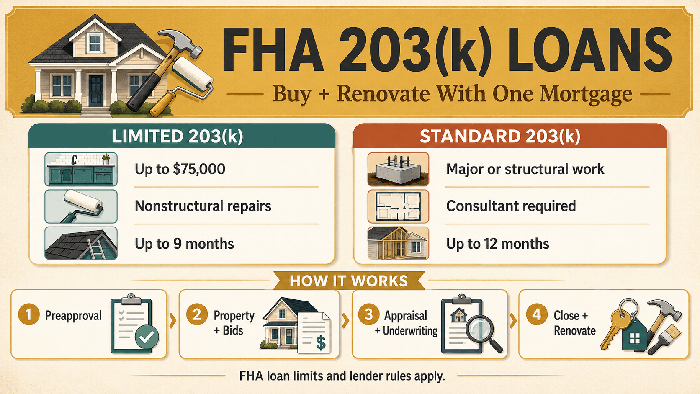
An FHA 203k loan can finance the purchase or refinancing of a home, as well as the cost of eligible repairs, through a single mortgage. The lender holds the renovation funds in an escrow account after closing and releases them as approved work is completed. The program has two options. A Limited 203k can cover up to $75,000 in minor, nonstructural work. A Standard 203(k) can finance larger or structural projects, subject to the FHA loan limit and other program rules. Borrowers must use the home as an eligible primary residence and qualify under FHA credit, income, appraisal, and property guidelines.
What Is an FHA 203k Loan?
An FHA 203k loan is an FHA-insured renovation mortgage offered through FHA-approved lenders. It combines the home and its eligible repair costs into a single loan, rather than requiring a separate mortgage and home-improvement loan. The program may be used to:
- Buy an eligible home that needs repairs
- Refinance an eligible home and include renovation costs
- Correct health, safety, structural, or property-condition problems
- Update kitchens, bathrooms, roofing, plumbing, electrical systems, HVAC, flooring, and other eligible items
- Improve accessibility, energy use, or resistance to certain natural hazards
FHA insures the mortgage, but a private lender approves and funds it. Not every FHA-approved lender offers 203(k) loans, and lenders may impose requirements stricter than HUD’s minimum rules. HUD explains that the program may be used for a purchase or refinance and that the renovation funds are placed in escrow for approved work.
Limited vs. Standard FHA 203k Loans
The right option depends on the type of repairs, the total rehabilitation cost, how long the work should take, and whether plans or structural work are required.
Limited 203k
The Limited 203k, formerly called the Streamline 203k, is for minor remodeling and nonstructural work. Current features include:
- Up to $75,000 in total rehabilitation costs
- No minimum repair amount
- An FHA-approved 203k consultant is optional
- Work must be scheduled for completion within nine months
- The project generally cannot keep the borrower from occupying the home for more than 30 days
- Up to four draw requests may be approved per contractor or for an approved borrower acting as the contractor
The $75,000 amount includes eligible rehabilitation costs and certain financeable fees. Energy Efficient Mortgage, weatherization, and eligible solar costs are handled separately under HUD’s calculation rules.
Standard 203k
The Standard 203k is for major rehabilitation, structural work, additions, or projects that cannot meet the Limited program’s rules. Current features include:
- At least $5,000 in eligible rehabilitation costs
- No separate FHA cap on the renovation budget, although the total mortgage remains subject to the property’s value, the FHA county loan limit, and maximum mortgage calculations
- A consultant from FHA’s active 203k Consultant Roster is required
- Work must be scheduled for completion within 12 months
- Up to five draw requests may be approved: four intermediate draws and one final draw
- A financeable mortgage-payment reserve may be available when the property cannot be occupied during the work, subject to HUD and lender requirements
HUD’s 203k consumer fact sheet summarizes the current differences between the Limited and Standard programs.
FHA 203k Loan Requirements for 2026
An FHA 203k loan includes the usual FHA borrower review, plus additional approvals for the property, repair plan, contractor, appraisal, and renovation budget.
Credit Score and Down Payment
FHA permits a maximum financing of 96.5% on an eligible purchase, commonly described as a 3.5% minimum down payment. FHA permits lower credit scores in some cases, but the basic framework is:
- A 580 or higher qualifying credit score may allow the 3.5% minimum investment
- A 500 to 579 qualifying score generally requires a 10% minimum investment
Many lenders set a higher minimum score for 203k loans because renovation files require more review. A lender’s score requirement is an overlay, not necessarily an FHA rule. The down payment is not based only on the home’s sales price. The lender uses HUD’s 203k mortgage calculation, which accounts for the purchase price, eligible rehabilitation costs, required adjustments, and the appraised after-improvement value.
Income, Employment, and Debt-to-Income Ratio
Borrowers must document enough stable and eligible income to repay the mortgage and other debts. The lender will also review employment, assets, credit history, and debt-to-income ratio. There is no single DTI number that guarantees approval or denial in every FHA file. The result may depend on FHA’s automated underwriting findings, manual underwriting rules when applicable, compensating factors, and the lender’s overlays. Ask the lender whether the file will be evaluated through automated underwriting, whether manual underwriting is available, and which requirements come from HUD versus the lender.
Occupancy and Eligible Properties
The borrower generally must occupy the property as a principal residence. Eligible property types may include:
- One-unit homes
- Two- to four-unit homes
- Townhomes
- Eligible condominium and site-condominium units, with work generally limited to the unit’s interior
- Eligible mixed-use properties that are primarily residential
- Certain manufactured homes titled as real estate when the rehabilitation does not affect structural components
- HUD homes and other eligible real-estate-owned properties
- Homes with an eligible accessory dwelling unit
The property generally must have been completed for at least one year. Special rules apply to conversions, reconstructions, condominiums, manufactured housing, mixed-use properties, and homes moved onto another foundation.
How the Maximum FHA 203k Loan Amount Is Calculated
The lender does not simply add any renovation budget to the sales price. It completes HUD’s 203(k) calculation and applies the correct loan-to-value factor. For a purchase, the calculation generally starts with the lesser of:
- The adjusted as-is value plus eligible rehabilitation costs and financeable items; or
- 110% of the appraised after-improved value, or 100% for an eligible condominium
The lender then applies the permitted loan-to-value factor and other adjustments. The final base loan also cannot exceed the FHA loan limit for the property’s county and number of units. For 2026, FHA’s one-unit national floor is $541,287, and its one-unit high-cost ceiling is $1,249,125. Limits for two- to four-unit properties are higher. The exact limit depends on the location. Borrowers should verify the property using HUD’s current FHA loan limit resources.
Repairs You Can Finance With an FHA 203k Loan
 Eligible improvements may include:
- Roofing, siding, gutters, windows, and exterior doors
- Plumbing, electrical, heating, cooling, and water-heater work
- Kitchen and bathroom remodeling
- Flooring, drywall, painting, and eligible appliances
- Foundation or other structural repairs under the Standard program
- Room additions and eligible accessory dwelling units under the Standard program
- Accessibility improvements such as ramps, wider doors, and accessible bathrooms
- Energy-efficiency and weatherization improvements
- Lead-based paint correction and other eligible health or safety work
- Septic, well, drainage, walkway, driveway, deck, patio, and porch work when eligible
- Repair or removal of an in-ground swimming pool
- Conversion of an eligible one-unit home to two to four units under the Standard program
All work must meet HUD’s minimum property requirements and applicable local building codes. Required permits must be obtained before the related work begins.
Work That Is Not Eligible
The program cannot finance improvements that are primarily recreational or luxurious and do not become a permanent part of the property. Examples may include:
- A new swimming pool
- Hot tubs or saunas
- Tennis courts
- Outdoor fireplaces or similar luxury features
- Improvements used only for commercial purposes
The Limited program also cannot finance structural work, major remodeling, projects requiring architectural plans, or work that falls outside its time, occupancy, or draw limits. Have the lender and, when applicable, the 203(k) consultant review the complete scope before the purchase contract and contractor schedule become final.
The Role of the 203k Consultant and Contractor
FHA-Approved 203k Consultant
A consultant is required for every Standard 203k. The lender must select an active FHA-approved consultant for the state where the property is located. The consultant inspects the property and prepares a work write-up and cost estimate. The consultant may also review progress, inspect completed work, help document change orders, and support draw requests. A consultant is optional for a Limited 203k, although the borrower or lender may choose to use one.
Contractor Review
The borrower chooses the contractor, but the lender must approve the contractor and the proposed work. Expect the lender to request an itemized bid, a cost breakdown, a schedule, references or experience, insurance, and any licenses required by state or local law. HUD does not maintain a list of “HUD-approved contractors.” That term should not be used. FHA maintains a roster of approved 203(k) consultants, while lenders review contractors under HUD policy and their own risk standards. A borrower may be permitted to perform certain work under a rehabilitation self-help agreement, but lender approval is required. The borrower must show the skills and time to complete the work. Rules for labor reimbursement and material payments apply, and many lenders do not permit self-help work.
Estimate Your Payment With Renovation Costs Included
Know your total monthly payment before you buy. We’ll estimate purchase price, renovation budget, FHA mortgage insurance, taxes, insurance, and cash-to-close.How FHA 203k Draw Payments Work
The renovation funds are not disbursed to the borrower as unrestricted cash at closing. The lender places the approved funds in a rehabilitation escrow account and releases money under the approved draw process. Under HUD Mortgagee Letter 2026-06:
- A Limited 203k may have up to four draw requests per contractor or for an approved borrower acting as the contractor. These may include an initial draw, up to two intermediate draws, and a final draw.
- A Standard 203k may have up to five draw requests: four intermediate draws and one final draw.
- Inspections and completion documents may be required before funds are released.
- Payment may be made to the contractor or jointly to the borrower and contractor, depending on the program and approved payment method.
The lender controls the escrow. Any unused funds are handled in accordance with HUD and lender rules; they do not become unrestricted cash for the borrower.
FHA 203(k) Process From Preapproval Through Completion
1. Confirm the Lender Offers the Right 203k Program
Ask whether the lender offers Limited, Standard, or both. Also ask about minimum credit scores, overlays, contractor rules, consultant requirements, and current processing capacity.
2. Get Preapproved
Provide income, asset, credit, employment, identification, and housing documents. The preapproval should account for both the home price and a realistic repair budget.
3. Find an Eligible Property
Work with a real estate agent who understands renovation financing. The purchase contract needs enough time for bids, appraisal, consultant work when required, underwriting, and closing.
4. Build the Repair Plan
Obtain detailed bids. For a Standard 203k, the FHA-approved consultant inspects the property and prepares the formal work write-up and cost estimate.
5. Complete the FHA Appraisal
The appraiser reviews the property and proposed work and develops the required value, including the after-improved value. The appraisal does not replace a full home inspection.
6. Complete Underwriting
The lender reviews the borrower, property, contractor, scope of work, costs, permits, appraisal, title, insurance, and required reserves. Missing or inconsistent documents can create new conditions.
7. Close the Loan
At closing, funds are used to complete the purchase or refinance. Approved renovation funds are placed in escrow. The rehabilitation loan agreement sets the terms for completing work and releasing funds.
8. Complete the Renovation
Work begins after closing and after the required permits are in place. Draws are requested as work reaches approved stages. Changes to the contractor, materials, cost, or scope may require written approval from the lender before the work is changed.
9. Verify Final Completion
Final work must be documented and inspected when required. A permit close-out or a certificate of occupancy may also be needed. The lender then closes the rehabilitation escrow in accordance with HUD requirements.
FHA 203k Costs, Fees, and Mortgage Insurance
An FHA 203k loan may cost more to complete than a regular FHA purchase because the lender must also review and manage the renovation. Costs may include:
- FHA upfront and annual mortgage insurance premiums
- An FHA appraisal and possible appraisal updates
- Consultant fees for a Standard 203(k) or an optional consultant on a Limited 203(k)
- Draw-inspection fees
- Title-update fees
- Permit fees
- Architectural or engineering fees when eligible under the Standard program
- A contingency reserve for unexpected project costs when required
- Supplemental origination charges permitted under FHA rules
- Standard title, settlement, insurance, prepaid, and closing costs
Do not rely on a generic online cost range. Ask for a written Loan Estimate and a separate explanation of all renovation-related charges. Compare the annual percentage rate, cash-to-close, lender credits, mortgage insurance, rate-lock terms, and the process for unused escrow funds.
How Long Does an FHA 203k Loan Take?
There is no universal FHA promise that a 203k purchase will close within a fixed number of days. Timing depends on how quickly the borrower, seller, contractor, consultant, appraiser, title company, and lender complete their work. The rehabilitation agreement may allow up to:
- Nine months for a Limited 203k
- 12 months for a Standard 203k
An extension may be considered when the delay is outside the borrower’s control, such as a documented property issue, a contractor problem, a disaster, or another acceptable cause. Approval is not automatic.
FHA 203k Approval Example
The following example is hypothetical and is not a promise of approval.
A buyer agrees to pay $260,000 for an eligible primary residence. The approved renovation plan totals $60,000. The home appraises for $340,000 after the proposed work is complete.
The combined purchase and renovation figure is $320,000. In this simplified example, 110% of the after-improvement value is $374,000, so the lower figure is $320,000 before the lender applies the FHA loan-to-value factor and all required adjustments. At 96.5%, that figure would produce a maximum base mortgage of about $308,800 and a minimum investment of about $11,200 before closing costs. The final result may change because of the adjusted as-is value, financeable fees, contingency reserves, appraisal findings, seller credits, gift funds, county loan limits, and other HUD calculator entries. The lender must complete the official 203k calculation.
Common Problems That Delay an FHA 203k Loan
Vague or Incomplete Contractor Bids
The bid should explain the labor, materials, quantities, costs, and work schedule. A one-line estimate often creates more questions for the lender and appraiser.
A Scope That Does Not Match the Program
Structural work cannot be placed in a Limited 203k. A project may need to move to the Standard program when it requires plans, a consultant’s work write-up, too many drawings, or more time than the Limited program permits.
Contractor Approval Problems
Missing insurance, required local licenses, references, signatures, cost details, or tax information may delay approval. A lender may also reject a contractor who does not meet its standards.
Unsupported After-Improved Value
The appraisal must support the proposed value after the work is completed. A larger renovation budget does not guarantee an equal rise in appraised value.
Late Changes
Changing the contractor, repair scope, materials, or price after approval may require new bids, a change order, consultant review, appraisal review, or underwriting approval.
Permit, Title, or Insurance Issues
Open permits, title problems, insurance restrictions, and local code requirements can delay closing or the first draw. These items should be investigated early.
FHA 203k vs. Other Renovation Loans
An FHA 203k may fit a borrower who wants FHA financing and plans to occupy the home. It includes FHA mortgage insurance and follows FHA property and borrower rules. A conventional renovation loan, such as Fannie Mae HomeStyle Renovation, follows conventional credit, loan-to-value, property, and mortgage-insurance rules. It may be a better fit for some borrowers or properties. A home equity loan or line of credit may work for a current owner with sufficient equity, but it is separate from the first mortgage. Personal loans and credit cards may have shorter terms or higher costs. Compare the complete financing package, not just the rate. Consider the down payment, mortgage insurance, cash needed before draws, contractor payment schedule, appraisal method, fees, completion deadline, and lender experience.
Questions to Ask an FHA 203k Lender
Before making an offer, ask:
- Do you offer both Limited and Standard FHA 203k loans?
- How many 203k loans has your team closed in the past year?
- What is your minimum credit score, and is that an FHA rule or a lender overlay?
- Is manual underwriting available?
- Who reviews and approves the contractor?
- How are draws requested, inspected, and released?
- Does the contractor receive an initial draw?
- How much cash might the contractor or borrower need before a draw is released?
- Which consultant, inspection, title update, or supplemental origination fees apply?
- What contingency reserve will be required?
- What happens if the appraisal does not support the planned budget?
- What happens to unused escrow funds?
- Is the proposed closing date realistic for this file?
Final Thoughts About FHA 203k Loans
An FHA 203k loan can make a home with repair needs financeable, but the loan works best when the scope, contractor, appraisal, and budget are organized early.
Before choosing a lender, compare the full Loan Estimate and the lender’s renovation process. Ask which rules come from HUD and which are lender overlays. A low quoted rate may not be the best value if the lender lacks 203k experience or cannot manage the contractor and draw process on time.
Borrowers who want to explore an FHA 203k loan can contact Gustan Cho Associates to review the property, proposed repairs, credit profile, and available program options. There is no obligation to proceed, and program availability depends on the borrower’s state and the lender’s current offerings.
Frequently Asked Questions About FHA 203k Loans
Can I Use Gift Funds with an FHA 203k Loan?
FHA may permit an eligible gift to help cover the minimum required investment or other allowed costs. The donor, transfer, and source of funds must comply with FHA documentation requirements. The lender may require a gift letter, proof of the donor’s ability to give the funds, and evidence of the transfer.
Can I Use Down Payment Assistance with an FHA 203k Loan?
It depends on the assistance program and lender. Some programs do not allow renovation loans or have rules that conflict with the 203k process. Confirm compatibility with both the assistance provider and the 203k lender before making an offer.
Can I Use an FHA 203k Loan on a Duplex and Rent Out the Other Unit?
An eligible two- to four-unit property may qualify when the borrower will occupy one unit as a principal residence. The lender must review the property, proposed repairs, and any eligible rental income under FHA guidelines.
Can an FHA 203k Loan Pay for Temporary Housing?
The loan does not directly reimburse ordinary rent or hotel costs. Under a Standard 203k, the lender may establish an eligible financeable mortgage-payment reserve for a period when the home cannot be occupied, subject to HUD limits and the approved work schedule.
Can I Buy a HUD-Owned home with an FHA 203k loan?
An eligible HUD-owned property may be purchased with 203k financing when the transaction, property, borrower, and repairs meet program requirements. Review the listing terms and repair process with the lender before bidding.
Can the seller make repairs before an FHA 203k closing?
The seller may complete agreed work before closing, but work funded by the 203k renovation escrow generally follows the approved post-closing process. Any pre-closing repair agreement should be reviewed by the lender, real estate agents, and settlement parties before work begins.
Can I refinance out of an FHA 203k loan after the repairs are done?
Completing the repairs does not automatically convert the loan into a different mortgage. A borrower may later refinance if they qualify and if the new loan provides an acceptable financial benefit after costs. Refinancing requires a new application and approval.
This article about “FHA 203k Loan Guide for 2026: Rules, Repairs, and Approval” was updated on August 4th, 2026.
