
Ohio mortgage loans include conventional, FHA, VA, USDA, jumbo, and non-QM programs. Eligible borrowers can get conventional financing with only 3% down or FHA financing with 3.5% down and a credit score of 580. VA and USDA loans may offer no-down-payment financing for qualified borrowers. However, USDA income and property-location limits apply.
The Ohio Housing Finance Agency may provide eligible buyers with down payment assistance equal to 3% of the loan amount on conventional loans or 3.5% on FHA, VA, and USDA loans. Credit, income, debt-to-income ratio, property, and lender requirements determine final approval. Because lenders may impose stricter overlays, a denial from one company does not always mean you cannot qualify elsewhere.
2026 Ohio Mortgage Requirements at a Glance
Ohio mortgage loans include government-backed and conventional programs for many types of borrowers. The right option depends on your credit, income, debt-to-income ratio, available funds, military eligibility, property location, and loan amount. Meeting an agency’s basic rules does not guarantee approval, as lenders may impose stricter requirements known as overlays.
FHA Loans
FHA loans may work well for buyers with lower credit scores or limited savings. Borrowers with a credit score of 580 or higher may qualify with 3.5% down. Scores from 500 to 579 require at least 10% down under FHA guidelines, although many lenders set higher minimum scores. FHA mortgage insurance applies, and the loan must remain within the FHA limit for the Ohio county where the property is located.
VA Loans
VA loans are available to eligible veterans, active-duty service members, and certain surviving spouses with a valid Certificate of Eligibility. The VA does not require a minimum credit score or down payment, but borrowers must have satisfactory credit, enough stable income, and adequate residual income. Lenders may set their own credit-score overlays. VA loans do not require monthly mortgage insurance, although a funding fee may apply unless the borrower qualifies for an exemption.
USDA Loans
USDA loans can provide 100% financing for eligible borrowers purchasing primary homes in approved rural or suburban areas. Both the property location and total household income must meet USDA rules. USDA does not establish a universal minimum credit score for every loan. However, scores below 640 generally require a more detailed credit review, and individual lenders may require higher scores.
Conventional Loans
Qualified borrowers may obtain a conventional loan with as little as 3% down through certain Fannie Mae or Freddie Mac programs. Private mortgage insurance is usually required when the down payment is below 20%. Conventional financing may favor borrowers with stronger credit, stable income, and manageable debt. The conforming loan limit for a single-unit residence in 2026 is set at $832,750.
Jumbo Loans
A mortgage exceeding the applicable conforming loan limit is generally considered a jumbo loan. Jumbo requirements are set by lenders or investors rather than by Fannie Mae or Freddie Mac. Borrowers commonly need stronger credit, more cash reserves, a larger down payment, and a well-documented ability to repay. The required credit score, debt-to-income ratio, and down payment can vary widely among jumbo lenders. An experienced loan officer should compare all available programs rather than choosing a loan based solely on its minimum down payment. The lowest-down-payment option may not offer the lowest monthly payment or the lowest overall borrowing cost.
FHA Loans in Ohio for Lower Credit Scores
FHA loans in Ohio may help buyers who have lower credit scores, limited savings, or past credit problems. The Federal Housing Administration insures these mortgages, but approved private lenders issue and underwrite them.
FHA Credit Score and Down Payment Requirements
Under FHA guidelines, borrowers with a minimum decision credit score of 580 or higher may be eligible for the maximum 96.5% loan-to-value ratio, which requires a down payment of at least 3.5%. Borrowers with scores from 500 to 579 are limited to 90% financing and must provide at least 10% down. These are FHA program thresholds—not guaranteed approval standards. Lenders may require a higher score or impose additional requirements called lender overlays. Approval also depends on the borrower’s income, employment, debt-to-income ratio, payment history, available funds, and property eligibility.
FHA Mortgage Insurance
FHA loans necessitate the payment of both an upfront mortgage insurance premium and ongoing annual premiums. The upfront mortgage insurance premium is generally 1.75% of the base loan amount. Most borrowers finance this charge into the mortgage rather than paying it in full at closing. The annual mortgage insurance premium is usually divided into 12 installments and included in the monthly payment. The rate and duration depend on the loan term, amount, and original loan-to-value ratio. On most FHA loans with less than 10% down payment, annual mortgage insurance premiums remain for the life of the loan. With at least 10% down, it generally ends after 11 years. Mortgage insurance protects the lender, not the homeowner.
2026 FHA Loan Limits in Ohio
FHA loan limits depend on the county and the number of residential units. For 2026, the national FHA floor for a one-unit property is $541,287. Certain higher-cost Ohio counties may have a larger limit. Buyers considering two- to four-unit properties may qualify for higher limits if they will occupy one unit as their primary residence. Borrowers should verify the limit for the property’s county using the official HUD FHA Mortgage Limits lookup. The down payment does not increase the county loan limit; the final FHA base loan amount must remain within the applicable limit.
Automated and Manual FHA Underwriting
Most FHA purchase applications are evaluated through an automated underwriting system using HUD’s FHA TOTAL Mortgage Scorecard. An automated approval means the file meets the system’s risk assessment, but the lender must still verify the borrower’s documents and confirm that all FHA requirements are satisfied. An application that does not receive automated approval may be eligible for manual underwriting. A human underwriter reviews the borrower’s complete credit profile, including housing-payment history, income stability, reserves, debt ratios, recent late payments, and compensating factors. Manual underwriting can help some borrowers with lower scores, limited credit, or past financial hardship, but it does not waive FHA requirements. When comparing Ohio mortgage loans, borrowers should ask whether the lender follows the FHA’s published guidelines or adds stricter credit score and debt-to-income overlays. A denial from one lender does not necessarily mean the borrower is ineligible for FHA financing.
VA Loans in Ohio With No Down Payment
VA loans in Ohio may allow eligible veterans, active-duty service members, National Guard members, reservists, and certain surviving spouses to purchase a primary residence without a down payment. VA financing also has no monthly private mortgage insurance. However, no down payment does not mean no closing costs, and approval still depends on income, credit, residual income, entitlement, the property appraisal, and the lender’s underwriting requirements.
Who Is Eligible for a VA Loan?
Borrowers must meet the applicable military-service requirements and obtain a valid Certificate of Eligibility. The COE confirms the borrower’s eligibility and shows how much VA entitlement is available. A lender can often request the certificate electronically. Eligible borrowers may include:
- Veterans who completed the required period of qualifying service
- Active-duty service members
- Qualifying National Guard and Reserve members
- Certain surviving spouses
- Borrowers discharged early under an eligible exception
The borrower must also plan to occupy the Ohio property as a primary residence and meet the VA’s and lender’s credit and income standards. A COE confirms benefit eligibility, but it does not guarantee mortgage approval.
VA Residual Income Requirements
VA underwriting places significant weight on residual income. Residual income is the money remaining each month after subtracting the proposed housing payment, monthly debts, income taxes, maintenance and utility costs, and certain other obligations from the borrower’s gross income. The required amount depends on:
- The loan amount
- The property’s geographic region
- The number of people in the household
- Whether qualifying for military benefits may reduce household expenses
Ohio is included in the VA’s Midwest region. A borrower can have a higher debt-to-income ratio and still receive approval when residual income is strong. The complete loan file demonstrates an ability to repay. Conversely, an acceptable debt-to-income ratio may not be enough when residual income falls below the applicable guideline.
How VA Entitlement Affects No-Down-Payment Financing
VA entitlement is the amount the Department of Veterans Affairs may guarantee for the lender. It is not a cash benefit or a limit on how much a veteran can borrow. Borrowers with full entitlement generally do not have a VA loan limit. They may be able to finance the full purchase price without a down payment if they qualify for the payment and the purchase price does not exceed the home’s VA-appraised value. The lender still reviews income, debts, assets, credit history, and residual income when determining the maximum loan amount. A borrower may have partial entitlement when another VA loan remains open, or entitlement has not been fully restored after a previous loan. In that situation, the applicable county loan limit and the remaining entitlement amount may affect how much the borrower can finance without a down payment. A down payment may be required if the remaining entitlement does not provide sufficient guarantee.
VA Funding Fees and Mortgage Insurance
VA loans do not require monthly mortgage insurance. Most nonexempt borrowers instead pay a one-time VA funding fee. For purchase loans with less than 5% down, the current fee is generally:
- 2.15% for first-time use of the VA loan benefit
- 3.3% for subsequent use
The fee decreases to 1.5% with at least 5% down and 1.25% with at least 10% down. Borrowers may pay the funding fee at closing or finance it into the loan. Certain borrowers are exempt, such as qualifying veterans with a service-connected disability, surviving spouses receiving Dependency and Indemnity Compensation, and active-duty Purple Heart recipients. The borrower’s COE and lender documentation should confirm the exemption before closing.
VA Guidelines Versus Lender Overlays
The VA does not establish a universal minimum credit score for VA-guaranteed mortgages. However, individual lenders may require a minimum score, cap the debt-to-income ratio, restrict manual underwriting, require reserves, or impose additional rules following bankruptcy, foreclosure, late payments, or other credit problems. These added requirements are called lender overlays. Because overlays differ, a borrower denied by one lender may still qualify with another lender that adheres more closely to the VA’s published guidelines. When comparing Ohio mortgage loans, eligible military borrowers should ask whether the lender imposes credit score, debt ratio, residual income, or manual underwriting overlays. VA financing can provide 100% financing, but it does not cover every expense. Buyers may still need funds for an earnest-money deposit, inspection, appraisal, prepaid taxes, homeowners’ insurance, and closing costs not covered by a seller credit or lender credit. Final approval depends on the complete application and an eligible property that meets VA requirements.
USDA Loans in Eligible Ohio Communities
USDA loans can offer full financing to eligible buyers acquiring a primary home in a qualifying community in Ohio. Although people often call them rural home loans, eligible areas can include small towns and communities outside major urban centers. Property location, household income, credit history, and repayment ability must all meet USDA and lender requirements.
USDA Property Eligibility in Ohio
The home must be located in an area USDA designates as eligible on the date of the eligibility determination. Buyers should check the exact property address using the USDA Property Eligibility Map. A rural mailing address or location outside a large city does not automatically make a property eligible, and eligibility boundaries can change. The property generally must:
- Serve as the borrower’s primary residence
- Be modest, safe, sanitary, and structurally sound
- Meet USDA appraisal and property requirements
- Be used mainly as a residence rather than an income-producing property
- Have an appraised value that supports the loan amount
USDA guaranteed loans may finance certain existing homes, new construction, manufactured homes, condominiums, and planned-unit developments when the property and transaction satisfy the applicable program rules.
USDA Household Income Limits
USDA eligibility is based on household income, not only the income of the people applying for the mortgage. Countable income from adult household members who will live in the home may need to be included even when someone is not listed as a borrower. For the guaranteed loan program, adjusted household income generally cannot exceed 115% of the applicable median household income. The actual limit varies by county or area and household size. USDA allows certain adjustments for eligible dependents, childcare expenses, disabilities, and elderly household members. Household income for program eligibility is different from the repayment income used to qualify for the mortgage. A lender must calculate both figures and document that the household remains within the applicable 2026 USDA income limit.
USDA Credit Review
USDA does not publish a universal minimum credit score that guarantees approval. Many lenders use a 640 score as a benchmark for automated underwriting through USDA’s Guaranteed Underwriting System. However, a score of 640 does not guarantee automatic approval, and lenders may set higher minimum scores. Borrowers with lower scores, limited traditional credit, or an automated underwriting result that requires further review may still be considered. The lender may need to examine:
- Rent or mortgage payment history
- Recent late payments and collections
- Bankruptcy or foreclosure history
- Federal debts and judgments
- Nontraditional credit references
- Explanations and documentation for past financial hardship
Manual underwriting may be possible when the complete file supports the borrower’s willingness and ability to repay. However, individual lenders may impose overlays that restrict lending to lower credit scores or require manual underwriting. USDA’s Guaranteed Loan Program requirements do not guarantee approval.
USDA Guarantee Fees
USDA guaranteed loans do not require conventional private mortgage insurance. Instead, the program currently charges two guarantee fees:
- A guarantee fee payable in advance, amounting to 1% of the total loan value.
- An annual fee equal to 0.35% of the scheduled average unpaid principal balance
The upfront fee can generally be financed into the mortgage. The annual fee is divided into monthly amounts and included in the borrower’s mortgage payment. The annual charge decreases over time as the scheduled loan balance falls, but it generally remains in place for the life of the loan. These fees help support the USDA loan guarantee and are subject to future program changes. Buyers should include the annual fee, property taxes, homeowners’ insurance, and any homeowners’ association dues when estimating the complete monthly payment. When comparing Ohio mortgage loans, buyers interested in USDA financing should verify the property address and household income before making an offer. Passing one eligibility test does not establish final approval; the borrower, property, and complete loan application must satisfy USDA requirements and the lender’s underwriting standards.
First-Time Homebuyer in Ohio? Start Here
Learn your down payment options, estimated monthly payment, closing costs, and possible low down payment programs before you start shopping for homes.Conventional and Jumbo Ohio Mortgage Loans
Conventional Ohio mortgage loans are not insured by the federal government. Conforming loans are those that meet Fannie Mae or Freddie Mac requirements and stay within the set loan limit. Buyers may qualify with a down payment as low as 3%, but the program requirements differ from standard 5%-down financing.
Conventional Loans With 3% Versus 5% Down
Certain conventional programs permit up to 97% financing, requiring only 3% down. Options may include Fannie Mae’s Conventional 97 or HomeReady and Freddie Mac’s Home Possible program. Depending on the program, borrowers may need to meet first-time homebuyer, income, property, occupancy, or homebuyer-education requirements. A 5% down payment provides 95% financing and is available to a wider range of qualified borrowers. It may be a better choice for repeat buyers or applicants who do not meet the rules of a 3%-down program. Putting 5% down also creates more initial equity and may reduce the monthly private mortgage insurance cost. The lowest down payment is not always the least expensive option. Borrowers should compare the interest rate, PMI, closing costs, monthly payment, and total five-year cost shown on each Loan Estimate.
Private Mortgage Insurance on Conventional Loans
Private mortgage insurance is usually needed if the borrower puts down less than 20%. PMI protects the lender—not the homeowner—if the loan defaults. Its cost can depend on the borrower’s:
- Credit score
- Loan-to-value ratio
- Loan term
- Property type
- Occupancy
- Number of borrowers
- Type of mortgage insurance coverage
PMI on many conventional loans can eventually be removed. Borrowers may request cancellation when the principal balance reaches 80% of the home’s original value if they satisfy the servicer’s requirements. PMI automatically ends when the loan balance is expected to reach 78% of the original amount, provided the loan remains current. Different rules may apply to high-risk loans and lender-paid mortgage insurance.
2026 Conforming Loan Limits in Ohio
The conforming loan limit for a one-unit property in 2026 is set at $832,750. The limit applies to the mortgage amount, not the home’s purchase price. Higher limits apply to eligible two- to four-unit properties. FHFA establishes conforming limits annually and publishes county-level information. Buyers should confirm the applicable limit for the county where the Ohio property is located. For example, on a $875,000 one-unit home in an area using the baseline limit:
- A 3% down payment would produce an $848,750 loan, exceeding the $832,750 conforming limit.
- A 5% down payment would produce an $831,250 loan, remaining within the baseline limit.
This means a slightly larger down payment could allow the buyer to use conforming financing instead of a jumbo loan.
When Does an Ohio Mortgage Become a Jumbo Loan?
A mortgage is classified as jumbo if its loan amount is above the conforming limit for the property’s county and number of units. Jumbo loans cannot be purchased by Fannie Mae or Freddie Mac, so eligibility rules vary among lenders and investors. Jumbo borrowers may need stronger credit, lower debt-to-income ratios, additional cash reserves, and more extensive income and asset documentation. Down payment requirements vary, and some jumbo programs permit less than 20% down. Jumbo interest rates are not always higher than conforming rates, so borrowers should compare same-day offers using the same loan amount, down payment, lock period, and discount-point assumptions. Meeting the minimum requirements for either conventional or jumbo financing does not guarantee approval. The lender must still verify the borrower’s ability to repay and confirm that the property meets all applicable guidelines.
Ohio Mortgage Loans With Bad Credit or High DTI
Borrowers with lower credit ratings, high debt-to-income ratios, or past financial problems may still have options for Ohio mortgage loans. A denial from one lender does not always mean the borrower is ineligible for a mortgage. The denial may result from that lender’s internal rules rather than the underlying FHA, VA, USDA, Fannie Mae, or Freddie Mac guidelines.
How Lender Overlays Affect Mortgage Approval
A lender overlay is an additional requirement imposed on top of the mortgage program’s published guidelines. For example, an agency may permit a particular credit profile, but a lender might still require:
- A higher minimum credit score
- A lower maximum debt-to-income ratio
- Additional cash reserves
- Longer waiting periods after bankruptcy or foreclosure
- No late payments during the previous 12 months
- Automated underwriting approval
- Payment or removal of certain collections
- Restrictions on manual underwriting
These overlays help lenders control risk, but they can also cause an otherwise eligible borrower to be denied. Two lenders reviewing the same borrower under the same loan program can reach different decisions because their overlays, investors, and risk limits are different. A key GCA differentiator is reviewing why a loan was denied and determining whether the issue stems from an agency rule, a lender overlay, or documentation that can be corrected. Gustan Cho Associates works with lending partners that offer different underwriting requirements, including programs that may not impose the same overlay that led to the original denial.
High DTI Does Not Always Mean Automatic Denial
The debt-to-income ratio compares a borrower’s monthly obligations with qualifying gross income. However, underwriters do not evaluate DTI in isolation. The permitted ratio depends on the loan program, automated underwriting findings, credit history, residual income, available reserves, and overall risk profile. For example, Fannie Mae allows Desktop Underwriter to evaluate case files with total DTI ratios up to 50%, whereas manually underwritten conventional loans generally have lower limits. VA underwriting gives substantial weight to residual income—the money remaining after monthly debts, taxes, housing expenses, and estimated maintenance and utility costs. A veteran with a higher DTI may still present an acceptable file when residual income is strong, and the overall application supports repayment ability. FHA manual underwriting generally starts with benchmark ratios of 31% for housing expenses and 43% for total monthly debt. Higher ratios may be considered when the borrower meets applicable credit-score requirements and has documented compensating factors. The highest permitted ratio is not available to every borrower, and individual lenders may impose lower limits.
When Manual Underwriting May Help
Most applications are first reviewed through an automated underwriting system, such as FHA TOTAL, Fannie Mae Desktop Underwriter, Freddie Mac Loan Product Advisor, or USDA’s Guaranteed Underwriting System. An automated approval can make processing easier, but an automated denial or referral does not always end the process. Manual underwriting allows a qualified underwriter to evaluate the entire loan file rather than relying solely on an automated risk assessment. It may help borrowers who have:
- Lower credit scores
- Limited traditional credit
- A high debt-to-income ratio
- Past bankruptcy or foreclosure
- Recent recovery from a documented financial hardship
- No automated underwriting approval
- Strong recent payment history despite older credit problems
Manual underwriting does not waive agency requirements. It typically requires more documentation, a closer review of the payment history, and evidence that the borrower can manage the proposed housing payment. Not every loan program or lender permits manual underwriting.
Compensating Factors That May Strengthen a File
Compensating factors are documented financial strengths that help offset a weakness, such as high DTI or limited credit. Depending on the loan program, acceptable factors may include:
- Verified cash reserves remaining after closing
- A proposed housing payment close to or below the borrower’s current verified payment
- A documented history of saving money
- Stable employment and dependable income
- Additional income that is verified but not used to qualify
- Limited discretionary debt
- A larger down payment
- Strong residual income
- A consistent record of on-time rent or mortgage payments
One factor does not automatically overcome serious credit or affordability problems. The underwriter must evaluate the complete combination of income, debts, assets, credit, housing history, and property information. Agency rules also define which compensating factors can be used for a particular program.
What to Do After a Mortgage Denial
Borrowers should ask the lender for the specific reason the application was denied. The next step depends on whether the problem involves an agency rule, lender overlay, inaccurate credit information, insufficient documentation, or an affordability concern. GCA may review the prior underwriting findings, recalculate qualifying income and debts, examine possible compensating factors, and compare programs with different lender requirements. Sometimes another lender can approve the file under the same agency guidelines. In other cases, the best solution is a mortgage-readiness plan addressing credit, debt, reserves, or payment history before applying again. Neither manual underwriting nor using a lender with fewer overlays guarantees approval. The borrower must still meet the applicable loan program requirements, demonstrate the ability to repay, and obtain approval for an eligible property. However, a carefully reviewed denial can reveal whether the borrower is truly ineligible or applied through a lender with more restrictive requirements.
Getting an Ohio Mortgage During or After Bankruptcy
 Bankruptcy does not permanently prevent someone from buying a home. Eligibility for Ohio mortgage loans depends on the bankruptcy chapter, discharge or dismissal date, payment history, loan program, and lender requirements. Chapter 7 and Chapter 13 have different rules, while non-QM loans may provide alternatives when an agency waiting period has not been met.
Ohio Mortgage Options After Chapter 7 Bankruptcy
Chapter 7 bankruptcy typically eliminates qualifying unsecured debts. Mortgage waiting periods are generally measured from the discharge date—not the filing date. FHA loans: FHA generally requires at least two years after a Chapter 7 discharge. During that time, the borrower must either reestablish satisfactory credit or avoid taking on new credit. A borrower may be considered after at least 12 months when documented extenuating circumstances caused the bankruptcy, and the borrower has since managed finances responsibly. Applications within two years of discharge require manual underwriting. HUD FHA Handbook 4000.1 VA loans: VA guidelines generally allow lenders to disregard a Chapter 7 bankruptcy discharge more than 2 years old. Approval may be possible one to two years after discharge when the borrower has reestablished credit and can document that circumstances beyond their control caused the bankruptcy. Approval within the first 12 months is generally difficult. The lender must evaluate the veteran’s complete credit history, income, residual income, and ability to repay. Conventional loans: Fannie Mae generally requires four years from the Chapter 7 discharge or dismissal date. The waiting period may be reduced to two years when the borrower documents qualifying extenuating circumstances. Freddie Mac has similar recovery periods. A borrower must also reestablish acceptable credit and receive the required automated underwriting result. USDA loans: A Chapter 7 bankruptcy discharged within the previous 36 months is considered significant adverse credit. Depending on the automated underwriting result, the lender may need to perform a more detailed credit review and document an acceptable exception. A credit score alone does not guarantee USDA approval. Meeting a waiting period does not create automatic eligibility. The lender will still review payment history after bankruptcy, new accounts, collections, judgments, federal debt, income stability, debt-to-income ratio, and available funds.
Buying a Home During Chapter 13 Bankruptcy
Chapter 13 establishes a court-approved repayment plan that usually lasts three to five years. Some borrowers do not have to wait for the bankruptcy to be discharged before applying for a mortgage. An FHA borrower may be considered while the Chapter 13 plan remains active when:
- At least 12 months of the repayment period have elapsed
- All required plan payments were made on time
- The borrower receives written permission from the bankruptcy court to enter into the mortgage transaction
- The borrower qualifies through manual underwriting
- The lender determines that the financial problems leading to bankruptcy are unlikely to recur
VA guidelines may also allow financing during Chapter 13 after at least 12 months of satisfactory plan payments. The trustee or bankruptcy judge must approve the new debt. The lender must still determine that the borrower has adequate residual income and represents an acceptable credit risk. USDA financing may be possible during an active Chapter 13 after at least 12 months of satisfactory payments, subject to written authorization and the lender’s credit review. Lender overlays may make this option more restrictive. Conventional financing generally requires the bankruptcy to be completed or dismissed before the applicable recovery period begins. Fannie Mae requires two years from a Chapter 13 discharge or four years from a dismissal. A two-year period following dismissal may apply when qualifying extenuating circumstances are documented.
Applying After a Chapter 13 Discharge or Dismissal
A discharge means the borrower completed the court-approved plan and received relief from eligible remaining debts. A dismissal means the case ended without completing the plan or receiving a discharge. Mortgage guidelines often treat these outcomes differently. FHA may permit financing without a separate waiting period after a Chapter 13 discharge, but a discharge occurring within the previous two years requires manual underwriting. The borrower must still demonstrate satisfactory payment history and meet all other FHA requirements. Fannie Mae requires:
- Two years after a Chapter 13 discharge
- Four years after a Chapter 13 dismissal
- Two years after dismissal, when documented extenuating circumstances meet its requirements
Borrowers with more than one bankruptcy filing during the previous seven years may face longer conventional waiting periods.
Non-QM Loans After Bankruptcy
Non-QM loans are not subject to the bankruptcy waiting periods of FHA, VA, USDA, Fannie Mae, or Freddie Mac. Each lender and investor establishes its own credit-event requirements. Some non-QM programs may allow financing immediately after a bankruptcy has been discharged or dismissed, while others require 12, 24, or more months of seasoning. Limited programs may consider a borrower during an active Chapter 13, but court or trustee authorization and acceptable plan-payment history may still be required. A shorter waiting period normally comes with stricter terms, which may include:
- A larger down payment
- A higher interest rate or additional points
- More cash reserves after closing
- A lower maximum loan-to-value ratio
- A documented record of on-time housing payments
- A detailed explanation of the bankruptcy
- Strong evidence that the borrower’s finances have recovered
Non-QM financing may also offer alternative income documentation, including bank statements, 1099 income, profit-and-loss statements, or asset-based qualification. Program availability and terms vary by lender, borrower, occupancy, and property type.
Documents Borrowers Should Prepare
Borrowers applying during or after bankruptcy may need:
- Bankruptcy petition and schedules
- Discharge or dismissal order
- Chapter 13 payment history
- Court or trustee authorization for new debt
- Written explanation of the events causing the bankruptcy
- Proof that the hardship has ended
- Current bank statements and reserve documentation
- Rental or mortgage payment history
- Documentation for debts that were not discharged
If a home or mortgage was included in the bankruptcy, the lender must also determine whether foreclosure, deed-in-lieu, short-sale, or mortgage-late-payment rules apply. Bankruptcy discharge alone may not resolve every housing-related credit event. Gustan Cho Associates can review the bankruptcy documents, payment history, and prior loan denial to determine whether the borrower meets an agency guideline or may need a non-QM alternative. Lender overlays and investor rules vary, so approval by one lender—or denial by another—does not establish how every lender will evaluate the same application. Final approval is never guaranteed.
Ready to Buy or Refinance in Ohio?
Complete a quick application or send your scenario. We’ll confirm the best loan program and guide you step-by-step from pre-approval to closing.OHFA Down Payment Assistance and First-Time Buyer Programs
The Ohio Housing Finance Agency (OHFA) offers 30-year, fixed-rate conventional, FHA, VA, and USDA loans through approved lenders. These programs can help eligible buyers reduce upfront costs, obtain a discounted interest rate, or receive a federal mortgage tax credit. For most OHFA first-time buyer programs, a borrower must not have owned a primary residence during the previous three years. OHFA may waive this rule for honorably discharged veterans and buyers purchasing in designated target areas. Income limits, purchase-price limits, credit requirements, debt-to-income limits, and homebuyer education may also apply. OHFA currently requires a minimum credit score of 640 for conventional, VA, and USDA loans and 650 for FHA loans. These OHFA requirements are stricter than the minimum guidelines permitted by some underlying mortgage programs. Achieving the minimum score does not ensure approval.
OHFA Down Payment Assistance
Eligible borrowers may receive assistance equal to:
- 3% of the purchase price with a conventional loan
- 3.5% of the purchase price with an FHA, VA, or USDA loan
The funds may be applied toward the down payment, closing costs, or other eligible pre-closing expenses. Standard OHFA Down Payment Assistance is forgiven after seven years. According to OHFA, borrowers who sell the home within that period must repay the assistance. The program can reduce the cash needed at closing, but buyers should compare the interest rate, monthly payment, closing costs, and repayment terms to those of a mortgage without assistance. The option requiring the least cash upfront may not always have the lowest long-term cost.
Ohio Heroes
The Ohio Heroes program offers a discounted mortgage interest rate to qualifying Ohio public-service professionals. Eligible occupations currently include:
- Veterans, active-duty military personnel, qualifying reserve members, and certain surviving spouses
- Police officers, firefighters, volunteer firefighters, EMTs, and paramedics
- Physicians, nurse practitioners, registered and licensed practical nurses, and state-tested nursing assistants
- Pre-K through grade 12 teachers, administrators, and counselors
Qualified borrowers may combine Ohio Heroes with OHFA Down Payment Assistance. Employment in an eligible profession does not eliminate the program’s income, purchase-price, credit, DTI, or mortgage-underwriting requirements.
Grants for Grads
Grants for Grads is designed to encourage recent college graduates to purchase a home and remain in Ohio. An eligible borrower must have earned an associate, bachelor’s, master’s, doctorate, or other postgraduate degree from an accredited college or university within the previous 18 months. The program provides a discounted mortgage rate and includes:
- 3% down payment assistance with a conventional loan
- 3.5% assistance with an FHA, VA, or USDA loan
The assistance is forgiven after five years if the borrower remains in Ohio. A borrower who sells the home and moves out of Ohio within five years may have to repay some or all of the assistance. Grants for Grads also requires the buyer to meet OHFA’s first-time buyer, income, purchase-price, credit, DTI, and education rules.
Next Home for Repeat Buyers
Not every OHFA option is limited to first-time buyers. The Next Home program provides 30-year, fixed-rate conventional, FHA, VA, and USDA loans to eligible repeat homebuyers. Next Home may be combined with OHFA Down Payment Assistance, although borrowers with sufficient funds are not required to accept assistance. The property must become the borrower’s primary residence, generally within 60 days after closing. Continuing to own another home may affect program-income calculations. Next Home can help repeat buyers who lack sufficient funds for their next purchase, but they must still meet the applicable credit, income, purchase price, DTI, occupancy, and loan program requirements.
Mortgage Tax Credit
OHFA’s Mortgage Tax Credit provides eligible buyers with a federal income-tax credit based on a portion of the mortgage interest paid each year. It is different from down payment assistance and does not provide cash at closing. The program currently offers two options:
- Mortgage Tax Credit Plus: Provides a credit equal to 40% of eligible annual mortgage interest, up to $2,000 per year. It must be used with an OHFA MTC Plus mortgage, which may carry a slightly higher interest rate. Buyers may combine it with OHFA Down Payment Assistance.
- Mortgage Tax Credit Basic: May be used with another eligible mortgage from the lender. The credit equals 20% of the mortgage interest for a property in an OHFA target area or 15% for a property outside a target area. OHFA states that MTC Basic does not have a credit-score requirement.
The credit is nonrefundable, so the homeowner must have sufficient federal income-tax liability to benefit from it. The amount available depends on the certificate percentage, qualified mortgage interest paid, and applicable tax rules. Buyers should consult a qualified tax professional about their individual eligibility and how the credit may affect the mortgage-interest deduction. When comparing Ohio mortgage loans, buyers should ask an OHFA-approved lender to evaluate every available combination. Assistance, discounted-rate programs, and tax credits have different benefits and conditions. Program availability and requirements can change, so borrowers should verify current terms with OHFA before applying.
Additional Costs Ohio Buyers Should Budget For
The down payment is only one part of the money needed to buy a home. Buyers comparing Ohio mortgage loans should also budget for closing costs, property taxes, homeowners’ insurance, appraisal and inspection fees, prepaid expenses, and possible reserve requirements. Your Loan Estimate will show the lender’s early estimate of these charges and the estimated cash needed to close. Review it carefully because closing costs and cash to close are not the same amount.
Mortgage Closing Costs
Closing costs are the charges required to complete the mortgage and transfer ownership. Depending on the transaction, they may include:
- Lender underwriting, processing, or origination charges
- Discount points used to reduce the interest rate
- Credit report and flood-certification fees
- Title search, settlement, and lender’s title-insurance charges
- Recording fees and other government charges
- Attorney or closing-agent fees
- Required mortgage insurance or guarantee fees
The actual amount depends on the loan program, purchase price, lender, title company, and property location. Buyers should not rely on a general percentage when planning their budget. The Loan Estimate provides a transaction-specific estimate. Seller concessions, lender credits, and eligible down payment assistance may reduce the amount paid at closing. However, lender credits commonly come with a higher interest rate, while seller concessions are limited by the loan program and cannot normally be received as cash back beyond eligible expenses.
Ohio Property Taxes
Ohio property taxes vary by county, municipality, school district, and local tax levies. Buyers can review a property’s assessed value and tax history through the applicable county auditor’s website. The seller’s current tax bill may not show what the buyer will pay in the future. A sale, a property-value update, an expiring exemption, or a change in local levies may affect later bills. Buyers should ask the lender or real estate professional to estimate taxes based on the expected ownership and purchase conditions. Depending on the closing date and local billing schedule, the buyer may receive a tax proration from the seller at closing. Borrowers with escrow accounts will also make a monthly property tax payment as part of their total mortgage payment.
Homeowners Insurance
Mortgage lenders normally require homeowners’ insurance before closing. The policy must meet the lender’s coverage requirements and be effective by the closing date. Premiums can vary based on:
- The home’s age and rebuilding cost
- Roof age and condition
- Property location
- Coverage limits and deductible
- Prior insurance claims
- Additional risks or optional coverage
- Available discounts
A standard homeowners policy does not cover every risk. Flood insurance requires separate coverage and may be mandatory if the property is in a designated special flood hazard area. Buyers should obtain insurance quotes early because a high premium can increase the total housing payment and affect qualification.
Appraisal and Home Inspection Costs
The appraisal and home inspection serve different purposes. The lender orders an appraisal to provide an independent opinion of the property’s value and identify concerns related to the loan program. The buyer commonly pays this fee before closing. If the purchase does not close, the appraisal fee may not be refundable because the service has already been completed. A home inspection is usually optional under mortgage guidelines, but it is strongly recommended. The inspector evaluates the home’s visible systems and condition for the buyer. Depending on the property, buyers may also consider separate inspections for:
- Radon
- Termites or other wood-destroying insects
- Sewer lines or septic systems
- Wells and water quality
- Mold
- Structural concerns
- Chimneys or fireplaces
An appraisal is not a substitute for an inspection. The appraiser protects the lender’s interest in the collateral, while the inspector helps the buyer understand the property’s condition.
Prepaid Expenses and Escrow Deposits
Prepaid expenses are amounts collected in advance rather than fees paid for a service at closing. They may include:
- Interest from the closing date through the end of that month
- The first year’s homeowners’ insurance premium
- Initial property-tax deposits
- Initial homeowners insurance escrow deposits
- Mortgage insurance or program-specific prepaid charges
The amount of prepaid interest depends partly on the closing date. Escrow deposits depend on when future tax and insurance bills are due. Therefore, two buyers with similar loan amounts may require different cash amounts to close. Prepaid expenses appear under “Other Costs” on the Loan Estimate. Buyers should not leave them out simply because they are not traditional lender fees.
Cash Reserves After Closing
Cash reserves are funds remaining after the purchase has closed. They are not normally spent at closing, but the lender may require proof that they are available. Reserve requirements may be more likely with:
- Jumbo loans
- Investment or multi-unit properties
- Manual underwriting
- Higher debt-to-income ratios
- Multiple financed properties
- Certain non-QM programs
- Risk factors requiring additional financial strength
One month of reserves generally equals one complete monthly housing payment, including principal, interest, property taxes, homeowners’ insurance, mortgage insurance, and applicable association dues. Required reserve amounts vary by loan program and underwriting findings. Even when reserves are not required, buyers should avoid using every available dollar at closing. Funds may be needed for moving, utility deposits, immediate repairs, furnishings, insurance deductibles, or an unexpected loss of income. Before making an offer, buyers should request an estimate covering the down payment, closing costs, prepaid expenses, appraisal, inspection, and required reserves. They should then compare that estimate with the “Estimated Cash to Close” shown on the Loan Estimate and confirm the final amount on the Closing Disclosure.
Ohio Mortgage Preapproval Documents
A strong mortgage preapproval is based on verified financial information—not only a credit check or a phone conversation. When applying for Ohio mortgage loans, borrowers should provide complete, current documents so the loan officer can accurately evaluate income, debts, assets, credit history, and funds needed to close. Document requirements vary by loan program, employment type, and financial history. However, most buyers should prepare the following items.
Identification and Personal Information
Borrowers generally need to provide:
- A valid government-issued photo ID
- Social Security number
- Current address and prior addresses, commonly covering two years
- Employment history for the previous two years
- Divorce decrees, separation agreements, or child-support orders when applicable
- Permanent resident card, employment authorization, or other eligible residency documentation when required
Veterans using VA financing should also provide their Certificate of Eligibility or enough service information for the lender to request it.
Income and Employment Documents
W-2 employees commonly need:
- Recent pay stubs covering approximately 30 days
- W-2 forms from the previous two years
- Contact information for current and former employers
- Documentation of overtime, bonuses, commissions, or shift differentials
- A written explanation for extended employment gaps
Borrowers receiving Social Security, pension, disability, child support, alimony, retirement distributions, or other income may need award letters, court orders, account statements, payment histories, and evidence that the income is expected to continue. Self-employed borrowers may need additional documentation, including:
- Personal and business federal tax returns
- Year-to-date profit-and-loss statement
- Current business balance sheet
- Business bank statements
- Business license or proof that the company remains active
- Documentation showing the borrower’s percentage of business ownership
The exact number of years required depends on the loan program, income history, automated underwriting findings, and how the business files its taxes. The lender may also request IRS tax transcripts or authorization to obtain them.
Bank Statements and Funds Needed to Close
Borrowers should provide recent statements for every account being used for the down payment, closing costs, prepaid expenses, or reserves. These may include:
- Checking and savings accounts
- Money-market accounts
- Certificates of deposit
- Retirement accounts
- Brokerage or investment accounts
- Documentation for proceeds from selling another property or asset
Statements should include all pages, even blank pages. Online screenshots may not be acceptable if they omit the borrower’s name, account number, transaction history, or financial institution. The lender may ask about large or unusual deposits. Borrowers should be prepared to document the source with items such as payroll records, a bill of sale, transfer history, gift documentation, or proceeds from an existing asset. Borrowed funds generally cannot be presented as personal savings. When using gift funds, the lender may require a signed gift letter, proof of the donor’s ability to provide the money, and evidence showing the transfer into the borrower’s account or directly to the closing agent.
Credit, Debts, and Housing History
The lender will normally obtain a mortgage credit report, but borrowers should also disclose obligations that may not yet appear on it. These can include:
- Student loans
- Auto loans
- Credit cards
- Personal loans
- Alimony or child-support obligations
- Tax payment plans
- Buy-now-pay-later accounts
- Co-signed debts
- Mortgages on other properties
- Deferred or recently opened accounts
Renters may need canceled checks, bank statements, a rental verification, or a payment ledger showing their housing history. Borrowers living rent-free may be asked to provide a signed letter from the property owner. Letters of explanation and supporting documents may be required for recent late payments, collections, credit inquiries, disputed accounts, employment gaps, address differences, or other unusual items.
Documents for Bankruptcy, Foreclosure, or Past Credit Problems
Borrowers applying during or after bankruptcy may need:
- Complete bankruptcy petition and schedules
- Discharge or dismissal order
- Chapter 13 payment history
- Trustee or court permission to obtain a mortgage
- Written explanation of the financial hardship
- Documentation showing that the hardship has ended
A borrower with a past foreclosure, short sale, or deed in lieu may need the final settlement statement, deed transfer, foreclosure documentation, or proof of the date ownership ended. These dates can affect mortgage waiting periods. Providing this information early helps the loan officer determine whether the borrower meets agency guidelines, needs manual underwriting, or may be affected by a lender overlay.
Property and Purchase Documents
A buyer can receive an initial preapproval before choosing a home. After an offer is accepted, the lender will generally need:
- Fully signed purchase agreement and all addenda
- Earnest-money deposit documentation
- Property address and real estate listing
- Homeowners association information, when applicable
- Homeowners insurance quote or policy details
- Seller-concession or repair agreements
- Documentation for any interested-party contributions
The appraisal, title work, insurance verification, and final property review occur after the borrower enters into a purchase contract.
Additional Documents for OHFA Programs
Buyers using an Ohio Housing Finance Agency program may need documents showing compliance with OHFA’s income, purchase-price, occupancy, credit, and homebuyer-education rules. Depending on the program, the borrower may also need:
- Homebuyer education completion certificate
- Proof of an eligible Ohio Heroes occupation
- College transcript or diploma for Grants for Grads
- Prior property-ownership information
- Federal tax returns or other household-income documentation
- Documentation for every adult who will live in the home
OHFA requirements are separate from the underlying FHA, VA, USDA, or conventional mortgage guidelines. A borrower must satisfy both sets of rules.
Keep Documents Current During the Mortgage Process
Pay stubs, bank statements, employment verifications, and other credit documents can expire. The lender may request updated copies before final approval or closing. The Consumer Financial Protection Bureau recommends gathering current, time-sensitive paperwork and asking the lender what additional documentation may apply to the borrower’s situation. After receiving preapproval, borrowers should avoid opening new credit, financing furniture, changing jobs, moving money between accounts without documentation, depositing unexplained cash, or increasing credit card balances without first speaking with their loan officer. A material change in income, employment, debts, credit, assets, or property can alter or invalidate the preapproval. A mortgage preapproval is conditional, not a guarantee of final approval. The property must qualify, the appraisal and title work must be acceptable, and the lender must verify that the borrower continues to meet all underwriting requirements through closing.
Steps From Preapproval Through Closing
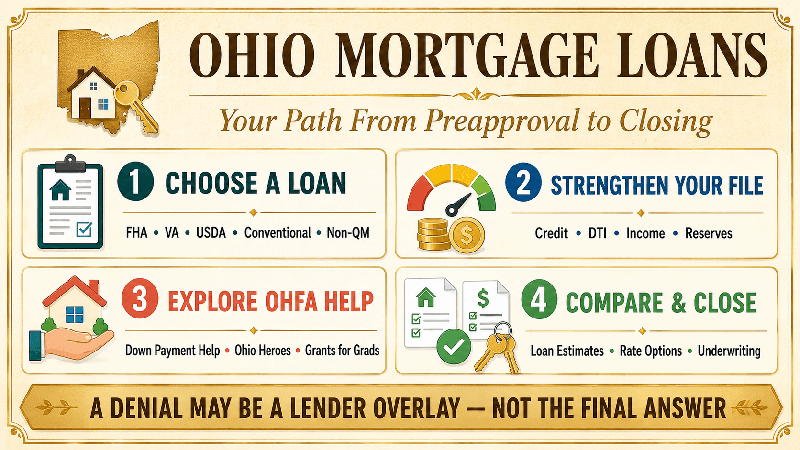
The process for Ohio mortgage loans begins before a buyer makes an offer and continues until the loan funds and ownership transfers. Understanding each step can help buyers respond quickly, prevent avoidable delays, and protect their mortgage approval.
1. Complete a Document-Based Preapproval
The lender reviews the borrower’s income, employment, assets, debts, credit history, and available funds. A strong preapproval should be based on current documents rather than solely on a verbal conversation or a credit score. The loan officer may also determine:
- Which loan programs the borrower may qualify for
- The estimated maximum purchase price
- The down payment and closing costs needed
- Whether manual underwriting may be required
- Whether lender overlays could affect approval
- Whether an OHFA or other assistance program may be available
Preapproval is conditional. It does not guarantee final approval because the property, appraisal, title work, insurance, and updated borrower information must still be reviewed.
2. Establish a Comfortable Homebuying Budget
The maximum amount a lender approves is not necessarily the amount a buyer should spend. Buyers should consider the complete monthly housing expense, including:
- Principal and interest
- Property taxes
- Homeowners insurance
- Mortgage insurance or guarantee fees
- Homeowners association dues
- Utilities, maintenance, and repairs
Buyers should also set aside sufficient funds for the down payment, closing costs, prepaid expenses, moving costs, and emergency reserves.
3. Shop for an Eligible Ohio Property
Once preapproved, the buyer can work with a real estate agent to find a home within the approved price range. The property must meet the requirements of the selected loan program. A condominium, manufactured home, multi-unit property, fixer-upper, or home with health and safety concerns may require additional review. Buyers should tell the loan officer what type of property they are considering before making an offer.
4. Submit an Offer and Purchase Agreement
When the seller accepts the offer, the buyer and real estate agents provide the lender with the fully signed purchase agreement and all addenda. The contract should clearly identify:
- Purchase price
- Earnest-money deposit
- Closing date
- Seller concessions
- Financing contingency
- Inspection contingency
- Personal property included in the sale
- Agreed repairs or credits
The lender must document the source of the earnest-money deposit. Buyers should keep copies of the check, wire receipt, withdrawal, and deposit records.
5. Complete the Formal Mortgage Application
After receiving the property address and a signed contract, the lender updates or completes the formal application. The buyer then receives a Loan Estimate showing the proposed:
- Loan amount and term
- Interest rate
- Estimated monthly payment
- Closing costs
- Prepaid expenses
- Lender credits
- Estimated cash needed to close
Borrowers should compare the Loan Estimate with any earlier quote and ask about unexpected changes. An interest rate is not protected until it is locked, and locking the rate may include an expiration date and other conditions.
6. Schedule the Inspection and Appraisal
The home inspection and appraisal are separate services. The inspection helps the buyer understand the property’s visible condition. Depending on the home, additional evaluations may be appropriate for radon, termites, the sewer line, septic system, well, roof, foundation, mold, or other concerns. The lender orders an appraisal to determine whether the property’s value supports the purchase price and whether it meets applicable loan program requirements. If the appraisal is lower than the purchase price, the buyer may need to renegotiate, increase the down payment, dispute the appraisal with supporting evidence, or cancel under an applicable contract contingency. FHA, VA, and USDA appraisals may include program-specific property requirements. Required repairs must generally be completed and verified before closing, unless the loan program permits an alternative arrangement.
7. Complete Mortgage Underwriting
An underwriter reviews the complete borrower and property file. This may include:
- Income and employment verification
- Bank statements and asset documentation
- Credit history and monthly debts
- Source of the down payment and closing funds
- Purchase contract and earnest money
- Appraisal and property eligibility
- Title report
- Homeowners insurance
- Automated underwriting findings
- Bankruptcy, foreclosure, or other credit-event documents
The underwriter may issue a conditional approval requesting additional documents or explanations. Common conditions include updated pay stubs, bank statements, employment verification, proof of a paid debt, explanations for deposits, insurance information, repair documentation, or clarification of a credit item. Borrowers should submit complete documents promptly. Sending partial bank statements, cropped screenshots, or unsigned explanations can cause additional conditions and delay the file.
8. Protect the Approval Before Closing
The lender may verify credit, employment, income, assets, and debts again before closing. Buyers should avoid making financial changes without first consulting their loan officer. Potential problems include:
- Opening or co-signing a new credit account
- Financing furniture, appliances, or a vehicle
- Increasing credit-card balances
- Changing or leaving a job
- Reducing work hours
- Moving money without keeping records
- Making large cash deposits
- Missing a debt payment
- Spending funds reserved for closing
- Changing the purchase contract without notifying the lender
Even a change made after conditional approval can affect the debt-to-income ratio, cash needed to close, or final loan eligibility.
9. Receive Final Approval and Clear to Close
“Clear to close” generally means the lender has reviewed and accepted the required underwriting conditions and is preparing the loan for closing. It does not mean buyers can stop protecting their credit or finances. The lender may still need to complete final employment verification, confirm the source of closing funds, review an updated credit report, or verify that no material information has changed. Closing may be delayed if a new issue appears before funding.
10. Review the Closing Disclosure
For most covered mortgages, the buyer must receive the Closing Disclosure at least three business days before closing. This document shows the final loan terms, payments, closing costs, credits, and the amount due at closing. Buyers should compare it with the most recent Loan Estimate and verify:
- Loan amount and interest rate
- Fixed-rate or adjustable-rate terms
- Monthly principal and interest
- Mortgage insurance or guarantee fees
- Property taxes and insurance
- Discount points and lender charges
- Seller and lender credits
- Earnest-money deposit
- Final cash needed to close
Questions or errors should be addressed before signing. The CFPB Closing Disclosure guide explains how to review each part of the form.
11. Complete the Final Walk-Through
The final walk-through lets the buyer verify that the property is in the expected condition, that repairs have been completed, and that fixtures and appliances remain in the home. The walk-through is not a new inspection. However, buyers should immediately notify their real estate agent and lender if they discover material damage, missing property, incomplete repairs, or another significant change.
12. Verify Closing Funds and Sign the Documents
Before sending money, buyers should independently verify the wiring instructions with the title company or closing agent using a trusted telephone number. Last-minute emails changing wire instructions may be fraudulent. During the closing process, the purchaser signs the mortgage note, the security instrument, settlement documents, and other necessary disclosures. The buyer should review each document and ask questions before signing anything that does not align with the agreed-upon loan terms. After the documents are signed, required funds are received, and the loan is authorized for funding, the transaction can be completed and ownership transferred. The timing for receiving keys depends on the purchase agreement and closing arrangements. The path from preapproval to closing can vary by borrower, property, and loan program. Prompt communication, complete documentation, and stable finances give buyers the best chance of completing their Ohio home purchase without preventable delays.
Ohio Mortgage Approval Example
The following example is hypothetical and does not guarantee similar results. An Ohio buyer applies for a $240,000 FHA loan with:
- A 612 credit score
- A 3.5% down payment
- A 47% debt-to-income ratio
- Three months of cash reserves
- Stable employment and 12 months of on-time rent payments
The first lender denies the application because its overlays require a minimum credit score of 640, a maximum DTI of 45%, and automated approval. These restrictions are the lender’s internal requirements—not necessarily FHA’s minimum guidelines. A second lender reviews the same file without those overlays. The application is evaluated through manual underwriting, with the borrower’s verified reserves, stable income, and satisfactory housing payment history considered potential compensating factors. After the borrower provides complete documentation, the loan receives conditional approval subject to the appraisal, title review, updated financial documents, and final underwriting. This example shows why a denial does not always end the search for Ohio mortgage loans. However, using a lender with fewer overlays does not guarantee approval. The borrower must still satisfy the applicable mortgage program and demonstrate the ability to repay.
How to Compare Loan Estimates and Rate Options
When comparing Ohio mortgage loans, request Loan Estimates for the same loan type, loan amount, down payment, points, and rate-lock period. Comparing offers issued on the same day provides a clearer picture because mortgage pricing can change daily. Review more than the advertised interest rate. Compare:
- Monthly principal, interest, and mortgage insurance
- Origination charges and discount points
- Lender credits and total closing costs
- Estimated cash needed to close
- Annual percentage rate
- Five-year borrowing cost
- Whether the rate is locked and when the lock expires
A lower rate may require paying discount points, while lender credits may reduce upfront costs in exchange for a higher rate. Calculate the break-even period before paying points, especially if you may sell or refinance within a few years. The best option depends on your budget and how long you expect to keep the mortgage. Use this guide and ask each lender to explain any differences before selecting an offer.
Final Thoughts on Choosing an Ohio Mortgage
The best mortgage is not always the one with the lowest advertised rate or smallest down payment. When comparing Ohio mortgage loans, consider the total monthly payment, closing costs, mortgage insurance, cash reserves, loan terms, and long-term borrowing cost.
Credit challenges, high debt-to-income ratios, or a previous denial do not always end the path to homeownership. Another loan program, manual underwriting, or a lender with fewer overlays may offer a solution.
Before applying, request a document-based preapproval and compare your options carefully. Choose a mortgage that fits both your qualifications and a monthly payment you can comfortably manage. All loans remain subject to underwriting and property approval.
Frequently Asked Questions About Ohio Mortgage Loans
Is Homebuyer Education Required in Ohio?
Not for every mortgage. However, OHFA requires at least one owner-occupant borrower to complete approved homebuyer education before commitment approval.
Can OHFA Finance a Duplex?
Yes. Eligible one- to four-unit homes may qualify, although Grants for Grads is limited to one-unit properties. The borrower must meet occupancy and program rules.
Can Duplex Rent Help Me Qualify?
Possibly. A lender may use qualifying rent from other units based on the appraisal, leases, and loan program requirements.
Can I Receive Cash Back with OHFA Assistance?
Generally, no. Buyers may be reimbursed only for documented eligible expenses already paid; any remaining funds may be applied to the loan principal.
What Happens to OHFA Assistance Rhen I Refinance?
The remaining assistance may become due unless the refinance qualifies for OHFA’s subordination policy. Borrowers should request a payoff and review current rules before refinancing.
Can I have Two FHA Loans in Ohio?
FHA generally insures only one principal residence mortgage per borrower. Limited exceptions may apply for relocation, family-size changes, or certain co-borrower situations.
How Soon Must I Occupy an FHA Home?
At least one borrower generally must move into the property within 60 days and intend to use it as a principal residence. FHA usually expects continued occupancy for at least one year.
This article about “Ohio Mortgage Loans: Programs and Requirements” was updated on July 29th, 2026.
