

Indiana Mortgage Loans in 2026: Programs, Requirements, and Homebuyer Options
Indiana mortgage loans include FHA, VA, USDA, conventional, jumbo, and non-QM options. The type of loan you qualify for depends on your credit, income, monthly debts, the property type, and how you plan to use it. Indiana buyers can get state-sponsored down payment help.
Even if you have poor credit, high DTI, are self-employed, or have past credit issues, you may still have options. Buying a home in Indiana does not mean buyers must qualify for the same mortgage program.
Some buyers need an FHA loan with a low down payment. Veterans may qualify for VA financing with no VA-required down payment. Buyers purchasing in eligible rural areas may finance with USDA loans. Buyers with better credit may prefer a conventional loan, and self-employed buyers and real estate investors may need alternative documentation or non-QM loans. The key is to find the mortgage program that fits your financial situation, rather than assuming you don’t qualify just because one bank or lender said no.
Available in Indiana?
Indiana residents qualify for most major mortgage programs. Meeting the requirements varies based on credit, income, debts, down payment, occupancy, and the property’s eligibility.
FHA Loans in Indiana
These loans tend to be most popular among first-time buyers and those needing less strict credit guidelines. If you have a qualifying credit score of at least 580, you may qualify for an FHA loan with a 3.5% down payment. FHA loans allow borrowers with scores between 500 and 579 to be considered with a 10% down payment; however, lenders may set their own credit score requirements, which may be higher.
FHA loans are useful for borrowers with limited funds and for those with higher debt-to-income ratios, prior credit issues, or a need for manual underwriting.
FHA loans are for primary residences and may be used on eligible one- to four-unit properties if the FHA occupancy and property requirements are met. FHA mortgage insurance lasts for the entire duration of the loan, regardless of the down payment made at closing. The duration of annual mortgage insurance depends on the loan terms and the initial loan-to-value ratio.
VA Loans in Indiana
VA Loans are a great option for veterans, active service members, and surviving spouses who meet the criteria. VA loans require zero percent down and also eliminate monthly mortgage insurance. All loan applicants must meet the following criteria: sufficient income, good credit, an acceptable property, and a valid
Certificate of Eligibility.
VA loans are unique in that they also evaluate an applicant’s income after meeting the necessary obligations. A loan application is not automatically rejected because of a high debt-to-income ratio, as long as the application and the income remaining after necessary obligations support the loan.
USDA Loans in Indiana
USDA mortgages allow 100 percent financing with no down payment for borrowers who meet the USDA loan qualifying guidelines for an eligible home in a rural qualifying area. Farms are not the only loan-eligible areas. Many smaller towns and outlying areas that are not part of the large metropolitan areas also qualify.
The property must be in an area eligible for USDA financing, and the borrower must use the property as their principal residence. Household income cannot exceed the established USDA limit.
USDA loans typically require that most applicants not exceed 115% of the applicable median family income. USDA Loans charge an upfront guarantee fee and an annual fee. Prospective buyers should check both the property address and their household income to make sure they qualify for USDA financing.
Conventional Loans in Indiana
Conventional Loans are loans that are neither FHA, VA, or USDA insured. Buying your home for the first time may make you eligible to purchase a home with as low as a 3% down payment and qualify for certain programs.
Conventional financing may be favorable to borrowers since the mortgage insurance is typically removed after the borrower attains the required credit score and home equity, and has better overall credit scores.
Conventional financing may be used for primary residences and, with program-specific exceptions, may finance second homes and investment properties.
Jumbo Loans in Indiana
A jumbo loan is a conventional loan amount that exceeds the Fannie Mae and Freddie Mac conforming loan limits. For 2026, the conforming loan limit for a one-unit property is $832,750. Since there is no one unified standard for jumbo loans, the requirements vary from lender to lender. Stronger credit, higher reserves, a larger down payment,, and additional income paperwork are among the lender requirements.
Non-QM and Bank Statement Loans in Indiana
Each borrower is unique, and many are outside the traditional government and agency underwriting. Non-QM mortgage programs provide self-employed applicants, business owners and investors, applicants with recent credit issues, and borrowers with atypical income, as evidenced by non-traditional tax return income options, alternative means to qualify for a loan.
Different programs assess the borrower’s income through differing levels of bank statement analysis, 1099 income, profit & loss statements, assets, and cash flow from their rental properties.
Non-QM loans are not no-document loans. The underwriting process establishes that the borrower and the lender is required to evaluate the loan and assess the borrower’s ability to repay the loan in accordance with applicable laws.
2026 Indiana Mortgage Loan Limits
Loan limits define the maximum loan amount for mortgage programs. They do not define the maximum loan amount a borrower can qualify to receive.
2026 Conventional Loan Limits in Indiana
Indiana conforms to the 2026 baseline limits.
For 2026, the Baseline Maximum Amounts Are:
- One-unit property: $832,750
- Two-unit property: $1,066,250
- Three-unit property: $1,288,800
- Four-unit property: $1,601,750
These mortgage limits apply to mortgages eligible for sale to Fannie Mae or Freddie Mac and are within existing guidelines. A one-unit conventional mortgage for an amount greater than $832,750 would be considered a jumbo loan.
2026 FHA Loan Limits in Indiana
The FHA Loan Limits for 2026 in Low Cost Areas for Indiana Include:
- One-unit Property: $541,287
- Two-unit Property: $693,050
- Three-unit Property: $837,700
- Four-unit Property: $1,041,125
- These are the HUD-established FHA Floor Amounts for 2026.
- Buyers should still verify the applicable county limit before underwriting.
VA Loan Limits in Indiana
VA imposes no loan limit for eligible borrowers with full entitlement. This means no approval for the veteran’s loan would be subject to an unlimited loan amount. The veteran would have to qualify, nevertheless, based on income, credit, debts, residual income, property value, and the lender’s underwriting. Conforming loan limits may be important to borrowers who have used VA entitlement and have less-than-full entitlement.
USDA Loan Limits in Indiana
The USDA Guaranteed Loan Program does not use the same county loan limits as FHA or conventional financing. The borrower qualifies based on income, household debts, ability to repay the loan, property value, and the USDA program.
Indiana Mortgage Requirements: Credit, Income, DTI, and Down Payment
There is no single minimum credit score or down payment for every Indiana mortgage loan. Requirements depend on the mortgage program and the complete loan file.
What Credit Score Do You Need to Buy a House in Indiana?
Credit score requirements vary considerably. According to the FHA, borrowers may face a 3.5% down payment requirement for scores of 580 or higher and a 10% requirement for scores between 500 and 579. Individual lenders may have even higher score requirements. There is no single minimum credit score requirement from the VA, and lenders may have different requirements.
Indiana Mortgage Loans 2026: FHA, VA, USDA, Conventional & Non-QM Loans
Find Indiana mortgage loans in 2026 with FHA, VA, USDA, conventional, bad credit, and first-time buyer mortgages with down payment assistance programs. Conventional lenders tend to look at scores around 620, but a complete profile, along with the automated underwriting system, determines final approval.
USDA underwriting does not rely on minimum score requirements as other agencies do. Instead, they evaluate the borrower’s credit history and their ability to repay the loan.
An agency guideline and a lender overlay show the difference between them. An applicant may meet the requirements for the FHA, VA, USDA, Fannie Mae, or Freddie Mac programs and still be rejected by ta lender due to the lender’s more restrictive internal lending rules.
What is the Minimum Down Payment Required to Buy a Home in Indiana?
It depends on the available mortgage programs and options. FHA borrowers can put down as little as 3.5%. A conventional loan program can allow an approximate 3% down payment. Both the VA and USDA loans can provide financing with no required down payment for eligible borrowers.
Debt-to-Income Ratio for Indiana Mortgage Loans
The debt-to-income ratio (DTI) is the ratio of a person’s gross qualifying income to their qualifying monthly obligations. Proposed mortgage lenders evaluate the prospective expenses, such as proposed housing, auto, credit card, student, and other installment loan payments, as well as child support. There are no standard DTI limits for mortgage loans. Automated underwriting systems may lower risk by using a high DTI ratio limit, underwriting based on credit, reserves, down payment, and payment history. This means that a high DTI does not guarantee a denial of a mortgage.
First-Time Homebuyer in Indiana? Start Here
Learn your down payment options, monthly payment range, closing costs, and available loan programs before you start shopping for homes.What Income Can Be Used to Qualify?
Changing income is not stable, even if it is high. Mortgage lenders evaluate many types of qualifying stable income, including, but not limited to, wages and salaries, overtime, commissions, self-employment income, and Social Security, pension, and disability income. Rental income qualifies, especially if the prospective borrower owns the property. Newly established income often does not meet the qualifying standards, even if it is stable.
Indiana Mortgage Loans for Bad Credit
An Indiana mortgage loan is still possible, even with bad credit. The reason behind the bad credit can be as important as the score itself. For instance, a clean payment record with collections that occurred many years ago may present very little risk, whereas new collections made after several recent large payments are a much greater risk.
Can I Get an FHA Loan in Indiana with a 500 Credit Score?
FHA borrowers with credit scores between 500 and 579 can get approved with a 10% down payment. However, a score of 580 or higher may get a 3.5% down payment. FHA’s minimum guidelines may differ from the lender’s. Many mortgage companies set an overlay on top of FHA’s minimum requirement and impose a higher credit score. Borrowers who receive a denial from the lender should find out whether the rejection was due to the FHA’s minimum guidelines or a lender’s overlay.
Manual Underwriting for Indiana Homebuyers
Approval from an automated underwriting system may not be possible, but manual underwriting is still available. A mortgage underwriter reviews the case file and considers the history of housing payments, credit reserves, credit history, and how well a borrower is expected to manage new payment obligations. Manual underwriting should not be confused with relaxing or eliminating mortgage guidelines. It requires more documentation and is more extensive in its examination of the borrower’s financial situation than the relaxed underwriting guidelines.
Indiana First-Time Homebuyer Programs and Down Payment Assistance
The Indiana Housing and Community Development Authority (IHCDA) offers Statewide Homeownership Programs. Current IHCDA programs cover all 92 counties in Indiana, but eligibility is subject to income limits, purchase-price limits, borrower eligibility, and program availability IHCDA updated its income and acquisition limits effective May 25, 2026.
Because limits vary by county, household size, and loan type, buyers should review the current IHCDA income and acquisition limits and confirm eligibility with a participating lender.
Down payment assistance can reduce the upfront amount needed, but it does not automatically make a loan less expensive. Buyers should compare the first-mortgage rate, second-mortgage repayment terms, monthly payment, mortgage insurance, and total borrowing cost. Current details are available through IHCDA Homeownership Programs and the February 2026 IHCDA program guide.
IHCDA First Step Program
First Step Program currently provides eligible borrowers with 5 percent non-forgivable down payment assistance for participating FHA, Fannie Mae, and Freddie Mac 30-year fixed-rate loans. The assistance is structured as a second mortgage and must generally be repaid upon the occurrence of the following events: the removal of the first mortgage or the property no longer being the borrower’s primary residence. The First Step Program does not require the borrower to be a first-time homebuyer unless an exception applies.
IHCDA Next Home
Next Home provides down payment assistance of either 2.5 percent or 3.5 percent for eligible first-time and repeat buyers. The assistance is non-forgivable and is available with participating FHA or conforming fixed 30-year loans.
IHCDA Step Down
Step Down uses participating FHA or conforming fixed 30-year loans and is a rate-based purchase assistance program rather than a down payment assistance program.
Is Down Payment Assistance Always the Best Choice?
Down payment assistance can make purchasing a home possible sooner, but borrowers should compare the entire transaction. Some assistance programs involve a second mortgage, a different interest rate, a repayment requirement, a reservation fee, an income limit, or a purchase-price restriction. Look at the monthly payment, APR, interest rate, cash needed at closing, and long-term costs, both with and without assistance, to see which option makes the most financial sense.
Buying a Home After Bankruptcy or Foreclosure
Bankruptcy and other serious credit events don’t have to stop you from eventually buying your dream home. Certain mortgage programs may require a waiting period following specific mortgage-related events (e.g., credit issues). The waiting period may be short or long, depending on each circumstance and any applicable exceptions
FHA Loans and Chapter 13 Bankruptcy
Most mortgage situations involving an active Chapter 13 bankruptcy order are the most confusing. FHA loans are available for bankruptcy petitioners who have maintained satisfactory payment(s) and have received approval either from the court or trustee to proceed. Manual underwriting is usually required. Bankruptcy petitioners need not wait several years after a discharge of bankruptcy proceedings before seeking the advice of a mortgage professional.
Mortgage Qualification After Chapter 7 Bankruptcy
- Chapter 7 bankruptcy orders typically require applicants to wait a specified period before qualifying for traditional mortgage financing.
- The specific waiting period will depend on whether the applicant intends to apply for an FHA, VA, USDA, Fannie Mae, or Freddie Mac loan.
- Other mortgage types.
- There may be extenuating circumstances.
Mortgage Qualification After Foreclosure or Short Sale
The waiting period for foreclosure and short sale transactions varies greatly depending upon the program for which the applicant intends to qualify. Applicants shouldn’t rely only on generic online waiting period charts. Instead, they should submit their documents and have their dates checked to make sure underwriting uses the correct event date.
Self-employed borrowers can also apply for a mortgage in Indiana. However, for self-employed applicants, underwriters will need to review the applicant’s tax returns, business license, and other supporting documents.
Because mortgage underwriting typically uses taxable qualifying income rather than gross business revenue, tax deductions will affect mortgage qualification.
Self-Employed Borrower Options for Traditional Mortgage Programs
FHA, VA, USDA, Fannie Mae, and Freddie Mac offer mortgage options for qualifying self-employed borrowers. A lender will request documentation for personal and business taxes, tax transcripts, profit and loss statements, balance sheets, and bank statements for the business. The business must remain active and operating.
Bank Statement Loan Options for Indiana Business Owners
For self-employed borrowers who do not maintain sufficient cash flow to cover tax returns, a bank statement loan is an option to consider. Lenders will review funds held in a business checking account. A qualifying loan amount is determined by an expense factor. Programs greatly vary among lenders.
DSCR Mortgage Loan Options for Indiana Real Estate Investors
Loans determined by debt-service coverage ratios (DSCR) are for the purpose of an investment property. Rather than evaluating the property based on the income of the investor, lenders may evaluate if the income estimated to be received from the rented property will pay the mortgage. The requirements for credit, down payment, reserves, DSCR, property type, and prepayment penalties vary by lender and the investor.
How Indiana Property Taxes Will Impact Your Mortgage Payments
Principal and interest are the only components of a mortgage payment for some Indiana borrowers. Most Indiana borrowers should include anticipated property taxes, home insurance, private mortgage insurance (if applicable), flood insurance, and homeowner association fees. The cap for all other real and personal properties is 3%. Certain referendum-related charges may not be covered by these caps.
Indiana’s property tax system has a constitutional cap on gross assessed value. The cap for homestead property is 1%, and 2% for other residential and agricultural properties.
The cap does not define the tax a homeowner will pay. Local taxes, assessed value, deductions, credits, and other factors determine the taxes a homeowner pays. The collection of Indiana property taxes is typically done in two installments. The statewide collection dates for 2026 are May 11 and November 10. So, buyers shouldn’t base their mortgage qualification on what the seller pays in property taxes. The amount you owe could be different. Indiana Mortgage Loans With Low Credit or High DTI Low credit or a high debt-to-income ratio does not automatically prevent someone from buying a home in Indiana. However, approval depends on the complete loan file—not on a single credit score or DTI number. Income stability, recent payment history, available funds, cash reserves, property type, and the selected mortgage program can all influence the decision
How to Get Preapproved for an Indiana Mortgage
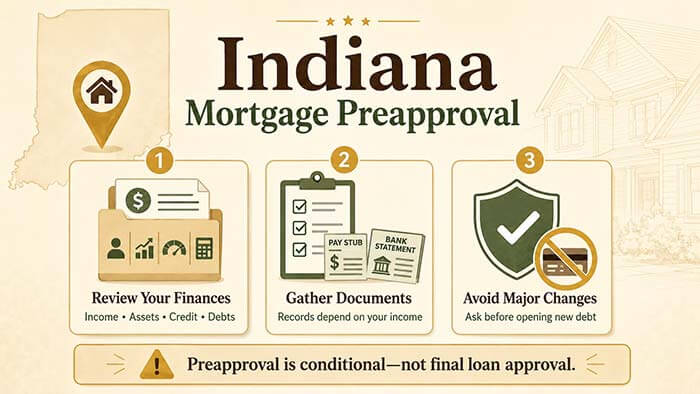
A good mortgage preapproval will look beyond your credit score. Your mortgage professional should assess each of the following: your income and employment, your assets, your credit report and history, your monthly debts, your proposed down payment, your proposed reserves, your plans for the property, and the mortgage programs that may apply to you.
Some of the common documents requested will be your pay stubs, W-2s/tax returns, bank statements, IDs, additional income documents, outstanding debts documents, and supporting tax records.
Self-employed individuals will have to provide business documents. Don’t make changes to your credit during the mortgage process without talking to your lender first. If you have large deposits, open new credit cards, cosign a loan, buy a new car, or make other big financial moves, discuss them with your lender. Mortgage preapprovals are subject to changes in borrower information, completion of the underwriting process, and verification through title, appraisal/review of collateral, insurance, and satisfaction of all loan conditions.
How to Choose an Indiana Mortgage Lender
You should avoid focusing on advertised interest rates when you choose a mortgage company. A low interest rate offer means very little if the borrower does not meet the requirements of the mortgage company’s underwriting process. You should find out if the mortgage company has credit score, DTI, reserve, bankruptcy, and manual underwriting overlays, among other things.
This Becomes Particularly Important for Borrowers Who Have:
- Low credit scores
- High debt to income ratios
- Manual underwriting
- Chapter 13 bankruptcy
- Recent credit issues
- Self employment
- Non-traditional income
- Limited credit history
- Different lenders can evaluate the same borrower differently
Compare Loan Estimates, Not Just Interest Rates
After you have a property and receive mortgage offers, you should compare Loan Estimates, not just interest rates. You should examine interest rates, annual percentage rates, origination fees, discount points, lender credits, mortgage insurance, cash to close, and estimated monthly payments, and confirm if the quoted interest rates are locked. The loan with the lowest interest rate isn’t always the cheapest overall.
Why Mortgage Preapproval Is Necessary Before Making an Offer
You should get preapproved to avoid surprises when you go house shopping. The lender is responsible for determining which income to consider, which debts to reflect, whether down payment assistance is available, whether an application for manual underwriting is warranted, and which mortgage program(s) offer the best chance of approval.
A detailed preapproval will enable the buyer to focus on the realistic range of housing payments instead of rushing to the upper limit of the theoretical loan amount.
The goal should not be to borrow the maximum amount permitted. The goal should be to borrow the right amount to stay within the mortgage lending guidelines and the household budget.
Getting Approved for Challenging Indiana Mortgage Loan Situations
Mortgage approval is rarely a matter of a single number. We come across many borrowers who think they cannot qualify because of one of the following: a low credit score, a high DTI, student loans, a bankruptcy, self-employment, collections, or previous mortgage denials. The full loan file matters.
A borrower who does not qualify for one program may qualify for another. If a borrower is denied by a lender overlay, they may qualify with a lender that follows the underlying agency guidelines.
That’s why complicated mortgage situations should be reviewed individually rather than relying on online calculators that aren’t designed for these cases.
Indiana Mortgage Loans 2026
There are many options available to Indiana homebuyers for mortgage financing in 2026. Flexibility around lower credit scores and smaller down payments may be found with FHA loans. VA loans can be extremely beneficial for veterans and service members. USDA loans can offer 100% financing in specific areas.
For borrowers with stronger credit, conventional loans remain among the most competitive options. Alternative document programs (also known as non-QM) can assist borrowers with alternative income documentation.
Indiana has numerous IHCDA homebuyer programs that can aid eligible borrowers with down payment and financing concerns. The most critical step is pairing the borrower with the most appropriate mortgage program and determining whether the previous denial was directly related to the program’s guidelines or simply a lender’s overlay. Mortgage guidelines are always changing. It’s important to double-check the details of loan programs, interest rates, income limits, property rules, and available assistance before you apply.
Indiana Mortgage Loans Frequently Asked Questions
What Credit Score is Required to Buy a House in Indiana?
Each lender is different, and there is no hard-and-fast rule; therefore, some lenders may require a higher credit score to approve you for a loan. FHA permits potential borrowers with credit scores of 580 or greater to qualify with a 3.5% down payment, and borrowers with credit scores between 500 and 579 to qualify with a 10% down payment. Conventional, VA, USDA, jumbo, and non-QM programs vary by lender.
Can I Buy a House in Indiana with a 500 Credit Score?
As long as you meet other qualifying criteria, FHA guidelines permit credit scores between 500 and 579 underwritten at 10% down, but many lenders set credit score overlays at a higher level. Other considerations may include: income, debt-to-income ratio, credit history, assets, property, and underwriting.
What is the Minimum Down Payment Required to Purchase a House in Indiana?
This is contingent upon the mortgage you are approved for. FHA allows qualified borrowers with credit scores of at least 580 to finance with as little as 3.5% down, and eligible conventional, VA, and USDA mortgages allow at least 3% or no down payment.
Is There Any First-Time Homebuyer Assistance in Indiana?
The Indiana Housing and Community Development Authority is one source for first-time homebuyers and is home to the First Step, Step Down, and Next Home programs. Eligibility is determined by the program, income levels, purchase price, borrower status, property, and more.
How Much Down Payment Assistance Can I Receive in Indiana?
The Indiana Housing and Community Development Authority’s First Step program currently offers qualifying buyers 5% non-repayable down payment assistance. Next Home currently provides either 2.5% or 3.5% assistance based on the transaction. The program terms and conditions may vary and are subject to change.
Can I Get a High DTI Indiana Mortgage?
It is possible. The maximum allowable DTI is determined by the mortgage program, automated underwriting results, credit profile, reserves, compensating factors, and lender overlays. Having a high DTI does not guarantee a mortgage denial.
Can I Get a Mortgage While in Chapter 13 Bankruptcy in Indiana?
Some borrowers may qualify for government-sponsored financing while in Chapter 13 bankruptcy, so long as their payment history has improved, authorization from the court or trustee is granted, and underwriting and program requirements are met. These usually require manual underwriting.
Are There USDA Loans in Indiana?
Yes. USDA Guaranteed Loans are available to eligible Indiana residents for primary residences in USDA-eligible areas of the state. Eligible Indiana residents may receive 100% financing; however, household income and property location are also factors.
Do VA Loans in Indiana Allow a Down Payment?
Yes. VA does not require a down payment for its VA Home Loan benefit, though certain factors may require one. Additionally, VA loans do not require Private Mortgage Insurance.
What is the 2026 FHA loan in Indiana?
For the 2026 loan year, the FHA low-cost one-unit loan limit is $541,287. The limits increase for eligible two, three, and four-unit properties. Buyers need to ensure the county and the desired property unit allow for this limit. (HUD.gov)
What is the 2026 Conventional Loan Limit in Indiana?
The 2026 conforming loan limit on a one-unit property is $832,750. The limit on eligible two, three, and four-unit properties is higher.
Do Self-Employed Borrowers Qualify for Mortgage Loans in Indiana?
Yes. Self-employed borrowers may qualify for mortgage loans. Traditional FHA, VA, USDA, and Fannie Mae/Freddie Mac loans are available to self-employed borrowers who meet the program income requirement. Non-QM loans are available to self-employed borrowers who cannot qualify for a mortgage because their income is not documented on tax returns. Alternative banking statement programs may also be available.
Is a Mortgage Denial From One Indiana Lender the Last Word?
No. Even if mortgage company underwriters follow the guidelines set by the FHA, VA, USDA, Fannie Mae, Freddie Mac, and external investors, they can still add additional qualification criteria (also known as “underwriting overlays”). Someone who is turned down by one company’s criteria may still qualify through other lenders or mortgage programs.
Should I Get Preapproved Before Looking for a Home in Indiana?
Yes. Most preapprovals help borrowers understand their price range, potential issues in their application, projected monthly costs, the appropriate loan program, etc., before making a purchase offer.
How Long Does it Take to Close on a Mortgage in Indiana?
This is a difficult question to answer because many factors contribute to the length of the overall closing process, including the lender, the property, the title underwriters, the completion of the appraisal, the underwriting process, the documentation provided by the borrower, the type of loan, and how quickly the outstanding conditions are satisfied. Buyers should not expect a mortgage closing to occur within a set timeframe, as closing times vary.
About the Author
Gustan Cho, NMLS 873293, specializes in explaining residential mortgage lending and credit guidelines, as well as government and conventional loans. He writes about credit guidelines and loan programs. The goal of this discussion is to help borrowers understand Indiana mortgage guidelines. Mortgage guidelines are constantly changing. As such, borrowers must seek guidance from a licensed mortgage specialist before making financial decisions, as guidelines from lenders and agencies may differ.
