
California mortgage loans include conventional, FHA, VA, USDA, jumbo, and non-QM financing. The right program depends on the property’s county loan limit, required down payment, qualifying income, credit history, occupancy, and property type. Lenders also evaluate the total housing payment, including principal, interest, property taxes, homeowners’ insurance, mortgage insurance, HOA dues, and special assessments. Approval depends on the borrower’s complete financial profile and applicable program requirements.
California Mortgage Loan Limits for 2026
California mortgage loans are subject to different limits based on the county, property type, and loan program. A loan limit applies to the original mortgage amount, not the home’s purchase price. Buyers can purchase a more expensive property when the down payment covers the difference. For 2026, the baseline conforming limit for a one-unit property is $832,750. The maximum high-cost ceiling is $1,249,125. Limits are higher for two- to four-unit properties.
| Property Units | Baseline Conforming Limit | High-Cost Ceiling |
|---|---|---|
| One unit | $832,750 | $1,249,125 |
| Two units | $1,066,250 | $1,599,375 |
| Three units | $1,288,800 | $1,933,200 |
| Four units | $1,601,750 | $2,402,625 |
The exact limit depends on the property’s county. Lower-cost counties such as Riverside and San Bernardino generally use the baseline one-unit limit of $832,750. High-cost counties such as Los Angeles, Orange, San Francisco, San Mateo, and Santa Clara can reach the $1,249,125 ceiling. Other counties fall between the two amounts. For example, San Diego County has a 2026 one-unit conforming limit of $1,104,000. A conventional loan exceeding the applicable county limit is generally considered a jumbo loan. Buyers can use the FHFA conforming loan limit map to check the current limit by county.
FHA Loan Limits in California
FHA loan limits also vary by county and number of units. The 2026 FHA floor for a one-unit property is $541,287, while the maximum high-cost ceiling is $1,249,125.
| Property Units | FHA Low-Cost Floor | FHA High-Cost Ceiling |
| One unit | $541,287 | $1,249,125 |
| Two units | $693,050 | $1,599,375 |
| Three units | $837,700 | $1,933,200 |
| Four units | $1,041,125 | $2,402,625 |
Some California counties use the FHA floor, while higher-priced counties qualify for larger limits. The property must also meet FHA occupancy, appraisal, condition, and underwriting requirements. Buyers can verify the exact amount through the HUD FHA mortgage limit lookup tool.
VA Loan Limits and Entitlement
Eligible veterans and service members with full VA entitlement do not have a VA-imposed maximum loan limit. However, the lender must still approve the requested loan amount based on income, credit, debts, residual income, assets, and the property’s appraised value. County conforming limits can still affect veterans with partial or remaining entitlement, such as borrowers who already have another VA loan. Depending on the available entitlement and purchase price, a down payment may be required. The Certificate of Eligibility helps the lender determine how much entitlement is available. The Department of Veterans Affairs explains full and remaining entitlement through its VA home loan entitlement and limits guide.
FHA, VA, Conventional, Jumbo, or Non-QM? Compare Before You Apply?
Each California mortgage program has different credit score, down payment, DTI, reserve, and property requirements. Get a side-by-side review before choosing.Comparing California Mortgage Loan Programs
California mortgage loans are not one-size-fits-all. The best program depends on the borrower’s credit, income, down payment, military eligibility, property location, occupancy, loan amount, and ability to document income. The final terms depend on the complete loan file and the lender’s requirements.
Conventional Loans
Conventional loans are mortgages that do not have federal insurance or guarantees. Conforming conventional loans must remain within the applicable county loan limit and meet Fannie Mae or Freddie Mac requirements. Eligible borrowers may qualify with as little as 3% down on certain primary-residence programs. Private mortgage insurance may be required when the loan-to-value ratio exceeds 80%. Conventional financing can be used for primary residences, second homes, and investment properties, although requirements become stricter for non-owner-occupied properties.
FHA Loans
FHA loans are insured by the Federal Housing Administration. They are commonly used by buyers with limited savings, lower credit scores, or a history of credit problems. Borrowers with a qualifying score of 580 or higher may be eligible for a 3.5% down payment. Scores from 500 to 579 generally require at least 10% down under FHA’s minimum framework, although individual lenders may require higher scores. FHA loans are limited to eligible owner-occupied one- to four-unit properties. Borrowers must pay mortgage insurance both upfront and annually, and the loan amount cannot exceed the FHA limit for their county. HUD explains that FHA financing may allow a down payment as low as 3.5%.
VA Loans
VA loans are available to eligible veterans, active-duty service members, and certain surviving spouses with a valid Certificate of Eligibility. Qualified borrowers may be able to purchase a primary residence with no down payment when the sales price does not exceed the appraised value. VA loans do not require monthly private mortgage insurance. However, a VA funding fee may apply unless the borrower qualifies for an exemption. Approval also depends on credit, income, debts, residual income, entitlement, and lender underwriting. The Department of Veterans Affairs explains current VA purchase-loan benefits and requirements.
USDA Loans
USDA guaranteed loans may provide 100% financing for qualified borrowers purchasing an eligible primary residence in a designated rural area. Some California communities outside major metropolitan centers may qualify even when they do not appear traditionally rural. Household income generally cannot exceed 115% of the applicable median household income. The property must meet USDA location and condition requirements, and borrowers must demonstrate sufficient repayment ability. USDA loans include an upfront guarantee fee and an annual fee. Buyers can verify the program requirements through the USDA Single Family Housing Guaranteed Loan Program.
Jumbo Loans
A mortgage is generally considered jumbo when its original loan amount exceeds the conforming limit for the property’s county and number of units. Because California limits vary by county, a loan considered jumbo in Riverside County may still qualify as high-balance conforming financing in a more expensive county. Jumbo requirements are set by the lender or investor. Borrowers may need stronger credit, a larger down payment, a lower debt-to-income ratio, and several months of mortgage payment reserves. Requirements can also vary based on occupancy, property type, and loan amount.
Non-QM and Bank-Statement Loans
Non-QM loans serve borrowers whose income, credit, property, or recent financial history does not fit standard agency guidelines. Available options may include bank-statement loans, 1099-only loans, profit-and-loss programs, asset-depletion loans, DSCR loans, and programs for recent credit events. Bank-statement loans do not mean that income is ignored. The lender reviews eligible deposits over a specified period, applies an expense calculation when required, and determines whether the borrower has sufficient qualifying income. Non-QM loans often carry higher rates, larger down payment requirements, or additional reserves because their underwriting standards and risks differ from those of conventional government-backed financing.
Credit Score, Down Payment, and DTI Requirements
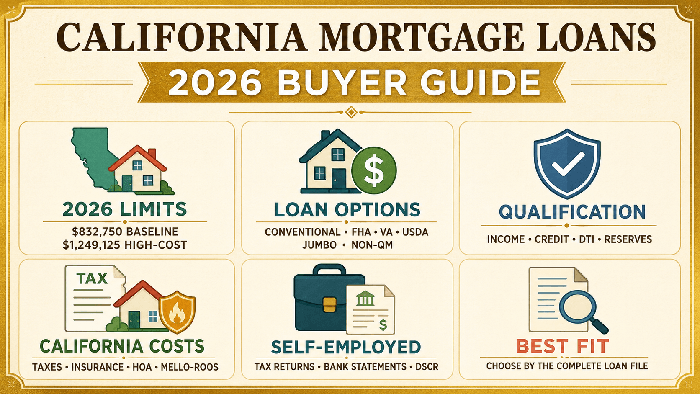
Credit score, down payment, and debt-to-income ratio are important when qualifying for California mortgage loans, but no single number guarantees approval. The lender must review the entire loan file, including income, debts, assets, credit history, occupancy, property type, and projected housing payment.
Agency Guidelines Versus Lender Requirements
Mortgage agencies establish the basic eligibility framework. For example, FHA permits a maximum loan amount with an eligible credit score of 580 or higher, which generally requires a 3.5% down payment. Scores from 500 to 579 are generally limited to a 90% loan-to-value ratio, requiring at least 10% down.
Eligible conventional programs may allow 3% down, while qualified VA and USDA borrowers may receive 100% financing. These are agency guidelines—not automatic approvals.
Lenders, investors, and mortgage insurers may apply additional requirements. These are often called lender overlays. A lender may require a higher credit score, lower DTI, more reserves, or a larger down payment than the agency’s minimum framework. Conventional credit requirements also depend on the underwriting method. Beginning November 15, 2025, Fannie Mae’s Desktop Underwriter stopped requiring a minimum third-party credit score for its automated credit-risk assessment. However, lenders, investors, mortgage insurers, and other loan programs may still impose credit-score requirements.
Automated Versus Manual Underwriting
Most conventional, FHA, VA, and USDA applications are first evaluated through an automated underwriting system. Common systems include Desktop Underwriter, Loan Product Advisor, FHA TOTAL Mortgage Scorecard, VA AUS, and the USDA Guaranteed Underwriting System. An automated approval is an underwriting recommendation—not a final loan commitment. The lender must verify that the income, assets, debts, credit, occupancy, and property information entered into the system is complete and accurate. Manual underwriting may be required when the automated system issues a refer result, the borrower lacks sufficient traditional credit, or program guidelines require additional review. Manual underwriting uses more specific limits and documentation requirements. Not every lender offers manual underwriting, even when the applicable agency permits it.
No Universal Maximum DTI Applies to Every Borrower
DTI compares qualifying monthly debt payments with gross monthly income. However, there is no single maximum DTI that applies to every mortgage borrower. An automated underwriting system evaluates DTI together with credit history, loan-to-value ratio, reserves, employment, payment history, and other risk factors. One borrower may receive automated approval at a different ratio than another borrower can obtain because their overall risk profiles differ. Manual underwriting follows program-specific ratio limits. FHA evaluates documented compensating factors, VA places significant weight on residual income, and USDA may require a documented debt-ratio waiver when a manually underwritten file exceeds its standard ratios. HUD’s FHA Handbook 4000.1 and the USDA ratio-analysis guidance explain their respective underwriting requirements.
Compensating Factors and Cash Reserves
Compensating factors may strengthen a file with a higher DTI or limited credit history. Depending on the loan program, useful factors can include:
- Several months of housing payments remaining in reserves after closing.
- Little or no increase from the current rent or housing payment.
- A documented history of paying comparable housing expenses on time.
- Stable employment and increasing income.
- Minimal discretionary debt.
- A larger down payment.
- Additional verified income not used to qualify.
- Strong VA residual income.
Compensating factors must be documented and must meet the applicable program’s definition. Cash in a bank account does not automatically offset weak income, serious recent credit problems, or an unaffordable monthly payment.
California Housing Expenses Affect Qualification
California borrowers must qualify for the complete monthly housing expense—not just principal and interest. The lender may include:
- Property taxes.
- Homeowners and required flood insurance.
- Mortgage insurance or guarantee fees.
- HOA dues.
- Mello-Roos assessments.
- Special assessments.
- Payments on subordinate financing or down-payment assistance.
Insurance can be especially important in California communities exposed to wildfire risk. A high insurance premium, HOA assessment, or Mello-Roos charge can increase the housing payment enough to change the DTI and maximum loan amount. Buyers should obtain realistic tax, insurance, and HOA figures before relying on a preapproval amount.
CalHFA and California Down-Payment Assistance
CalHFA programs can reduce the upfront cash needed for certain California mortgage loans. However, the assistance is not automatically free money. Buyers must meet program-specific income, occupancy, credit, and homebuyer-education requirements and apply through a CalHFA-approved lender.
MyHome Assistance Program
MyHome provides a deferred-payment junior loan for down payment or closing costs. Assistance is available up to 3.5% of the purchase price or appraised value with an eligible government first mortgage, or 3% with an eligible conventional first mortgage. No regular monthly payment is required on the MyHome second mortgage. The principal and accrued interest are due when the home is sold or refinanced, or when the first mortgage is paid off. Applicants must generally be first-time buyers, meet CalHFA income limits, and occupy an eligible one-unit property in California as their primary residence. As of August 20, 2026, MyHome is listed on CalHFA’s current rates and reservation page and is accepting reservations, subject to funding and program availability.
California Dream For All
Dream For All is a shared-appreciation loan for eligible first-time and first-generation homebuyers. It can provide up to 20% of the purchase price toward the down payment or closing costs, capped at $150,000. When the home is sold, refinanced, transferred, or the first mortgage is paid off, the borrower generally repays the original assistance plus an agreed share of the home’s appreciation. Household income must remain within Dream For All limits, and the property must be the borrower’s primary residence. CalHFA began accepting 2026 lender reservations on July 15 for buyers who received a Dream For All voucher. The public voucher portal closed on March 16, 2026, so new applicants cannot currently register for this funding round.
Grants Versus Repayable Assistance
A true grant generally does not require repayment when its conditions are satisfied. MyHome is a deferred second mortgage that must eventually be repaid. Dream For All is a shared-appreciation loan that requires repayment of the original assistance plus a portion of the property’s appreciation. Buyers should review the repayment terms before choosing either program.
California-Specific Costs That Affect Qualification
Qualification for California mortgage loans depends on the complete monthly housing expense, not only principal and interest. Buyers and lenders should account for the following costs:
- Property taxes: A change in ownership can result in a new property tax bill based on the home’s reassessed value. This bill is separate from the regular annual tax bill and may not be included in the initial escrow account. Learn more from the California State Board of Equalization.
- Homeowners insurance: Premiums can be higher in wildfire-exposed areas. Some properties may require a California FAIR Plan policy, plus supplemental coverage to meet the lender’s insurance requirements.
- Flood and earthquake coverage: Flood insurance is generally required for properties in designated Special Flood Hazard Areas. Standard homeowners policies generally exclude earthquake damage, so buyers may want separate coverage even when the lender does not require it. Check the FEMA Flood Map Service Center and the California earthquake insurance guide.
- HOA dues and assessments: Monthly association dues and required special assessments normally count toward the borrower’s debt-to-income ratio.
- Mello-Roos assessments: These recurring special taxes help finance public facilities and services in certain communities. When applicable, lenders include them in the housing expense.
- High-balance pricing: Loans above the baseline conforming limit but within the county’s high-cost limit may have different rates, fees, down payment requirements, or reserve requirements. Buyers should compare high-balance and jumbo options.
- Condo eligibility: The borrower may qualify while the condominium project does not. Lenders may review the association’s insurance, reserves, litigation, special assessments, deferred maintenance, and structural condition. A project review should begin early in the transaction.
California Mortgage Loans for Self-Employed Borrowers
Self-employed borrowers may qualify for California mortgage loans using tax returns or an eligible alternative-documentation program. The right option depends on how the borrower earns income, reports expenses, maintains financial records, and plans to occupy the property.
Conventional Tax-Return Qualification
Conventional lenders generally analyze personal and, when required, business tax returns to calculate stable qualifying income. The review may include ownership percentage, business cash flow, recurring expenses, income trends, and whether withdrawing funds could harm the business. Depending on the borrower’s history and agency requirements, one or two years of returns may be required.
Bank-Statement Loans
Bank-statement programs use eligible deposits from personal or business accounts instead of relying primarily on tax-return income. Lenders commonly review 12 or 24 months of statements, exclude transfers and unverifiable deposits, and apply an expense factor to business revenue.
1099-Only Programs
A 1099-only program may calculate income from recent IRS Forms 1099, year-to-date earnings, and supporting bank deposits. The lender may deduct an expense factor before determining qualifying income. These programs still require documented, stable earnings.
Profit-and-Loss Programs
Some non-QM lenders offer programs based on a year-to-date or 12-month profit-and-loss statement. The statement may need to be prepared or reviewed by a qualified tax professional and supported by business bank statements, proof of business operation, and other third-party records.
Asset-Depletion Programs
Asset-depletion programs convert eligible liquid assets into calculated monthly income. The lender applies its own formula and may exclude retirement penalties, required reserves, pledged assets, or funds needed for closing. Borrowers must document ownership, value, accessibility, and the source of the assets.
DSCR Loans for Investment Properties
Debt-service coverage ratio loans are designed for investment properties. Qualification focuses primarily on whether the property’s eligible rental income can cover its housing payment. Personal employment income may not be used, but lenders still verify rent, property expenses, assets, credit, and reserves. DSCR loans are generally business-purpose loans and are not intended for owner-occupied homes. Alternative-documentation programs are not automatically “no-income-verification” loans. Each option requires evidence supporting the borrower’s ability to repay and must meet the selected lender’s underwriting guidelines. CFPB guidance also notes that non-qualified mortgages may have different risks and costs than standard qualified mortgages.
California Mortgage Approval Example
The figures below demonstrate how lenders may evaluate California mortgage loans. They are not a rate quote, lending decision, or guarantee of approval. Assume two borrowers purchase a one-unit primary residence in Fresno County using a 30-year conventional loan.
| Qualification detail | Hypothetical figure |
|---|---|
| County | Fresno County |
| 2026 one-unit conforming limit | $832,750 |
| Purchase price | $700,000 |
| Down payment | $35,000, or 5% |
| Base loan amount | $665,000 |
| Combined gross monthly income | $16,500 |
| Existing monthly debts | $1,250 |
| Assumed interest rate | 6.50% |
| Principal and interest | $4,203 |
| Estimated property taxes | $729 |
| Homeowners insurance | $180 |
| HOA dues | $250 |
| Mello-Roos assessment | $150 |
| Estimated mortgage insurance | $275 |
| Total monthly housing expense | $5,787 |
The borrowers’ total monthly obligations would be approximately $7,037, including the proposed housing payment and existing debts. Dividing that amount by $16,500 produces an estimated back-end DTI of 42.6%. The housing-only ratio would be approximately 35.1%. In this example, Desktop Underwriter returns an Approve/Eligible recommendation based on the complete credit, income, asset, debt, and property data. Manual underwriting is not required. Final approval would remain subject to income verification, acceptable assets, appraisal, title, insurance, condominium review when applicable, and all lender conditions. Estimated cash to close is approximately $57,000 before seller or lender credits:
- $35,000 down payment
- Approximately $14,000 in closing costs
- Approximately $8,000 for prepaid interest, insurance, and initial escrow deposits
Actual rates, mortgage insurance, property taxes, Mello-Roos assessments, closing costs, and AUS findings will vary. Buyers should verify the applicable county limit using FHFA’s conforming loan limit resources.
Documents and Steps for California Preapproval
A strong preapproval for California mortgage loans reviews more than a credit score. The lender should examine the borrower’s income, assets, debts, employment, credit history, and expected housing expenses before issuing a preapproval letter.
Documents to Prepare
Borrowers may need to provide:
- Identification: Government-issued photo identification, Social Security number, current address, and residency documents when applicable.
- Employment and income: Recent pay stubs, W-2 forms for the previous two years, employment history, and documentation for bonuses, overtime, commissions, retirement income, disability benefits, or other qualifying income.
- Assets: Recent bank, retirement, investment, and other eligible account statements. Large or unusual deposits may require a documented source.
- Credit and debts: Authorization to obtain a credit report, monthly debt information, and documents explaining bankruptcies, foreclosures, collections, disputes, late payments, or other significant credit events when required.
- Gift funds: A signed gift letter, proof of the donor’s ability to provide the funds, and evidence showing the transfer into the borrower’s account or closing transaction.
- Self-employment: Personal and business tax returns when required, year-to-date profit-and-loss statements, balance sheets, business bank statements, 1099 forms, business licenses, or third-party verification of the business. Alternative documentation programs may require different records.
- Housing history: Current mortgage statements, property tax and insurance information, or landlord contact information, and proof of rent when required.
Property-Specific Documents
After a property is selected, the lender may also need:
- Executed purchase contract and all addenda
- Homeowners insurance quote, including wildfire-related coverage
- Property tax and Mello-Roos information
- HOA dues, special assessments, budgets, and condominium documents
- Flood-zone determination and required flood insurance
- Lease agreements or market-rent documentation for investment and multi-unit properties
- Information about solar agreements, leased equipment, accessory dwelling units, or other property obligations
California Preapproval Steps
- Complete the mortgage application and authorize the credit review.
- Submit income, employment, asset, and identification documents.
- Allow the loan officer to calculate the estimated payment and DTI using taxes, insurance, HOA dues, Mello-Roos, and other housing costs.
- Run the file through the applicable automated underwriting system or evaluate it for manual underwriting.
- Review available loan programs, estimated funds needed, and outstanding conditions.
- Receive a preapproval letter based on the verified information.
A preapproval is not final loan approval. The property, appraisal, title, insurance, updated borrower documents, and all underwriting conditions must still be accepted before closing.
Final Thoughts on California Mortgage Loans
The best California mortgage loan is not determined by credit score or down payment alone. Lenders must evaluate the complete file, including income stability, monthly debts, cash reserves, occupancy, property type, county loan limits, taxes, insurance, HOA dues, and other California-specific expenses. A borrower who does not fit one program may qualify through another. Comparing conventional, FHA, VA, USDA, jumbo, and non-QM options can help identify the financing that best matches the borrower’s qualifications, property, and long-term budget.
Frequently Asked Questions About California Mortgage Loans
Can a California Home Seller Pay the Buyer’s Closing Costs?
Yes. A seller may contribute toward eligible closing costs, prepaid expenses, discount points, and other permitted charges. The maximum contribution depends on the loan program, occupancy, and loan-to-value ratio. Seller credits cannot exceed actual eligible costs, and unused funds are not paid to the buyer as cash. The CFPB explains how seller credits work.
When Should a California Homebuyer Lock the Mortgage Rate?
Buyers commonly consider locking after signing a purchase contract and confirming a realistic closing date. Rate locks often last 30, 45, or 60 days, although lender options vary. The rate generally remains protected only if the loan closes before expiration and no material application details change. The CFPB provides additional rate-lock guidance.
How Long does it Take to Close a Mortgage in California?
Many financed California purchases close within approximately 30 to 45 days, but the timeline depends on underwriting, appraisal, title, insurance, property review, and how quickly requested documents are provided. Borrowers must receive the initial Closing Disclosure at least three business days before closing, according to federal rules.
Can a Non-Occupant Co-Borrower Help Someone Qualify in California?
Some conventional and FHA programs permit an eligible non-occupant co-borrower. The lender may consider that person’s qualifying income, but must also take into account their debts and credit profile. Every borrower becomes legally responsible for the mortgage. Program restrictions may affect the down payment, occupancy, and transaction type, and some assistance programs do not permit non-occupant borrowers.
What Happens When a California Home Appraises for Less Than the Purchase Price?
A low appraisal can lower the loan amount based on the approved loan-to-value ratio. The buyer may renegotiate the price, pay part of the difference, restructure the loan, or request a reconsideration of value when supported by relevant information. The purchase contract determines whether the buyer may cancel under an appraisal or financing contingency. See the CFPB’s guidance about low appraisals.
Can Rental Income from a California Accessory Dwelling Unit Help with Qualification?
Certain California mortgage loans may allow rental income from an existing accessory dwelling unit. For example, Fannie Mae permits eligible ADU income on certain one-unit primary-residence transactions, subject to documentation and limits. Under its standard guidance, qualifying ADU income is limited to 30% of total qualifying income. FHA, Freddie Mac, VA, jumbo, and non-QM requirements may differ. Review Fannie Mae’s rental-income guidelines.
Can Someone Qualify for a California Mortgage with Student Loan Debt?
Yes. Student loans do not automatically prevent mortgage approval. The lender must include the payment required by the selected loan program when calculating DTI. Depending on the program, the lender may use the documented payment or a calculated amount when the reported payment is zero, deferred, or inaccurate. Paying loans through an income-driven plan does not guarantee that a zero payment can be excluded.
This article about “California Mortgage Loans: Programs, Limits, and Requirements” was updated on August 18th, 2026.
