

When buying a condo, it’s important to consider that not all condos offer the same financing options. Some condos are classified as non-warrantable, making it more challenging to get a mortgage. Dale Elenteny, a senior mortgage loan originator at Gustan Cho Associates says the following:
Non-warrantable condos can be harder to finance, but loan options may still be available through portfolio, non-QM, and specialty condo lenders.
But don’t worry! In this updated guide, we’ll break down everything you need to know about non-warrantable condos, the mortgage options available, and what it means for you as a borrower. By the end, you’ll feel confident about moving forward with your condo purchase or refinance.
What Are Non-Warrantable Condos?
Fannie Mae says it won’t buy or back loans for condos or co-ops with these issues. It also won’t buy loans for projects marked as “Unavailable” in its Condo Project Manager or DU findings.
Even with these challenges, you can still buy a non-warrantable condo. You might need to explore different loan options, work with lenders who handle these cases, or provide more paperwork to get approved. A non-warrantable condo does not meet the criteria Fannie Mae and Freddie Mac set to qualify for a conventional mortgage. Why does this matter? Fannie Mae and Freddie Mac buy most of the home loans made by banks, but they only touch loans for condos that meet their standards, which makes financing trickier.
Some Common Reasons a Condo Might Be Considered Non-Warrantable Include:
- Less than 50% of the units are owner-occupied (more than half are rented out).
- The condo development is under litigation.
- The condo complex allows short-term rentals, like Airbnb.
- One entity (like an investor) owns more than 10% of the units.
Lenders often perceive condos as riskier properties, which can lead to a higher interest rate or the need for alternative financing options. A condo is called non-warrantable when the project doesn’t meet the rules set by major lending agencies. These agencies include Fannie Mae, Freddie Mac, FHA, VA, and USDA. Each group has its own rules for both buyers and condo projects. Many buyers are surprised when their loan is denied, even with strong credit, income, and financial standing. Often, the condo project—not the buyer—fails the lender’s review.
Why The Condo Project Matters
When you buy a condo, you also become part of the association. Lenders check the HOA’s budget, upkeep, legal matters, insurance, savings, and owner-occupied units. According to Fannie Mae, the project’s financial strength and eligibility are primary factors in credit performance and underwriting. Fannie Mae’s project standards aim to mitigate risks related to financial stability, condition, litigation, insurance, and owner control and use.
Non-Warrantable Condo
A condo is warrantable if it meets standard mortgage rules. These properties are easier to finance because lenders can sell the loan to Fannie Mae or Freddie Mac, or get insurance through FHA, VA, or USDA programs.
A condo is non-warrantable if it doesn’t meet these guidelines. This doesn’t always mean the property is bad. It just means there are risks that make traditional financing harder.
Warrantable condos are easier for lenders to approve, so buyers have more loan options and fewer strict requirements. If you and the property qualify, you can get a conventional, FHA, VA, or USDA loan.
Reasons Non-Warrantable Condos Are Harder to Finance
Getting a loan for a non-warrantable condo usually means you’ll need something other than a Qualified Mortgage (QM). You might need a portfolio loan, a bank statement loan, a DSCR loan, an investor loan, or private financing.
These options often have higher rates, larger down payments, stricter credit checks, and more cash reserve requirements.
There are many reasons a condo project might be non-warrantable. Some issues are easy to fix, but others require the HOA or board to get involved and could block traditional financing.
The Condo Project has Active Lawsuits.
If the condo project is involved in lawsuits, your loan approval could be delayed or denied. Small cases, like personal injury claims, may not matter much, but bigger issues, like construction defects or financial problems, can make lenders back off.
The Property has Deferred Maintenance.
Lenders want the building to be safe and well-maintained. If a major safety repair is needed, Fannie Mae won’t approve the project until the repair is finished and documented.
Condo insurance is closely reviewed in many states. Even if you’re approved as a buyer, your loan can fall through if the main insurance policy doesn’t meet lender or agency standards.
Missing coverages, insufficient replacement cost coverage, high deductibles, flood insurance, and policies that do not meet Fannie Mae, Freddie Mac, FHA, VA, or lender requirements are all insurance issues.
The Project Functioning Like a Hotel or a Short-Term Rental
Condos that allow short-term rentals might attract buyers, but most lenders see them as risky. Fannie Mae considers hotel-style services, daily rentals, rental pools, and resort management as warning signs that can make a project ineligible.
One With Too Many Units
If one person owns too many units, lenders worry about too much control. Fannie Mae has strict limits on this, and those limits matter more in larger projects.
The HOA Budget or Reserves Are Low
The HOA must show it can manage the property and pay its bills. Lenders worry when reserves are low, dues are rising, or many owners are behind on payments.
The Project Has an Excess of Commercial Space
Mixed-use condos can sometimes get financing, but too much commercial space is a problem. Fannie Mae won’t approve any project in which commercial or mixed-use space occupies 35% or more of a floor.
The HOA Receives a Large Amount of Income from a Business
Some projects have restaurants, clubs, or spas that generate revenue. If the HOA gets a lot of income from these, it’s an issue. Fannie Mae won’t approve the project if 10% or more of the HOA’s income comes from these businesses, unless they’re just small perks for owners or the public. Lenders usually find this out when they review the condo questionnaire.
The Condo Questionnaire is the Most Important Document
Lenders use the condo questionnaire to get detailed information about the project from the HOA or property manager. It covers insurance, lawsuits, savings, owner occupancy, rentals, commercial space, special fees, building repairs, and HOA finances. According to Fannie Mae, the Condominium Project Questionnaire is designed to assist lenders in obtaining the information necessary to assess a condo project’s eligibility.
Why Buyers Should Not Wait Until the Last Minute
Finishing the condo questionnaire can take weeks, and some HOAs charge a fee. Slow responses or missing information can cost you time, money, or even cause a contract to fall through, so start early to reduce last-minute risk.
Mortgage Options for Non-Warrantable Condos
Getting a loan for a non-warrantable condo isn’t easy, but it’s possible. You’ll need to think about why the condo is non-warrantable, your credit, your down payment, how you’ll use the property, and how much risk the lender is willing to take.
Non-QM Loans for Non-Warrantable Condos
Non-QM loans can help buyers of non-warrantable condos. They’re more flexible than regular loans and work well for condos, self-employed buyers, people using bank statements for income, investors, and other special situations. You can use Non-QM loans for your main home, a second home, or an investment property. Expect a larger down payment, higher interest rates, and more detailed financial checks.
Portfolio Loans for Non-Warrantable Condos
Portfolio loans remain with the lender rather than being sold to third parties, giving lenders greater freedom to approve challenging condo projects. Banks, credit unions, private lenders, and specialty mortgage companies all offer portfolio loans. These lenders set their own rules, so there’s more flexibility but less outside oversight.
Concerning Buying a Condo as a Self-Employed Person
If you’re self-employed and looking at a condo that doesn’t qualify for government loans, a bank statement loan might help. Lenders usually want to see 12 to 24 months of bank statements instead of tax returns. This is a good option for business owners whose tax returns show less income than what actually comes into their accounts.
Warrantable vs. Non-Warrantable Condos
So, what’s the difference between warrantable and non-warrantable condos?
- Warrantable condos meet all the guidelines set by Fannie Mae and Freddie Mac. These condos are easier to finance through traditional mortgage products.
- Non-warrantable condos on the other hand, don’t meet these guidelines. As a result, they require non-traditional loans, often through non-QM (non-qualified mortgage) lenders, which are more flexible but may come with higher rates and stricter terms.
For example, if you’re buying a non-warrantable condo, you’ll likely need a larger down payment (typically 20% or more) and a higher credit score than if you’re buying a warrantable condo.
Mortgage Options for Non-Warrantable Condos
The good news is that even if your dream condo is non-warrantable, you still have mortgage options. Let’s go over them.
Non-QM Loans for Non-Warrantable Condos
Non-QM loans are the most commonly chosen method for funding a non-warrantable condo. These loans are tailored for individuals who do not meet traditional lending criteria. This could be due to the condo’s non-warrantable status or your unique financial situation (like being self-employed or using bank statement loans). Non-QM lenders are flexible with guidelines, making them a great option for non-warrantable condos.
DSCR Loans and Condos
If you want to buy or refinance a non-warrantable condo as an investment, a DSCR loan could help. These loans consider the property’s rental income rather than your personal income. DSCR loans are only for investment properties, not your main home. Each lender has its own rules, so requirements can differ.
Hard Money or Private Money Loans
Hard money loans may work for cash-flow deals, short-term plans, or investment properties. They’re usually not recommended for long-term living. These loans are best when you plan to repay them through a sale, refinancing, or property improvements that boost value. Each government-backed loan program has its own rules for condo purchases. If a condo isn’t approved for conventional financing, it usually won’t qualify for government-backed loans like FHA, VA, or USDA.
FHA Condo Loans and Single-Unit Approval
The FHA insures condo loans for units in FHA-approved condo projects. The FHA may allow financing in a project not FHA-approved if the unit meets the FHA’s Single-Unit Approval standards.
HUD states that FHA’s condo eligibility includes project approval standards and Single-Unit Approval standards.
This includes the project’s financial condition, insurance, pending legal action, physical condition, marketability, and other factors. Older articles may refer to these loans as “FHA spot loans.” The current term borrowers should know is “FHA Single-Unit Approval.”
VA Condo Loans
Condo projects usually need to be VA-approved for you to use a VA loan. It’s best to check the project’s approval status early rather than waiting until your loan is almost ready to close.
USDA Condo Loans
You can get a USDA condo loan, but the condo must meet USDA’s rules and be in an eligible area. According to USDA guidance, the lender must make sure the condo project is approved by HUD/FHA, VA, USDA, or GSEs.
Qualifying For a Non-Warrantable Condo Loan
Lenders set their own rules, but non-warrantable condo loans usually have stricter requirements than regular loans.
Credit Score Requirements
Most non-warrantable condo loans require a high credit score. Some lenders may be more flexible, but these loans usually cost more. A better credit score can lower your costs and give you more loan options. You’ll usually need a bigger down payment for non-warrantable condos. Most programs require at least 20 percent, but you might need more depending on the property, how you’ll use it, your credit, and the loan amount.
Debt-to-Income Ratio
Even with flexible programs, lenders check your debt-to-income ratio to ensure you can afford your payments. A better credit score, more savings, and less debt can help.
Reserve Requirements
Reserves are extra money you keep after closing. They act as a safety net for you and the lender if making payments becomes difficult.
Occupancy Type
How you plan to use the condo matters. If you want to use it for short-term rentals or as an investment, expect to put down more money and keep larger reserves.
Buyer Checklist Before Making an Offer on a Condo
Before you make an offer, check if your lender has already reviewed the condo project. If not, ask them to do it as soon as possible. When you submit an offer, confirm with everyone whether the condo is warrantable. The lender will need documents, so gather all the paperwork in advance.
Order the Condo Questionnaire ASAP
Request the condo questionnaire as early as you can to keep your closing on schedule and avoid last-minute problems. High HOA dues can reduce your buying power and make it harder to secure financing, especially if there are special assessments for major repairs or maintenance.
Check for Litigation
Check for any ongoing lawsuits involving the homeowners’ association, whether the association is the defendant or the plaintiff. Look into the nature of disputes, construction defects, insurance issues, and pending claims. Lenders will review the master insurance policy and any extra coverage before approving the loan. Speak with a real estate agent and attorney about the contract, your financing, how much time you have to review condo documents, and any risks to your earnest money.
Seller Checklist for Non-Warrantable Condos
Sellers can make it easier for buyers’ lenders by preparing for any non-warrantable issues in advance.
Know the Project Status Before Listing
Before listing your condo, ask the HOA or management if previous buyers had trouble getting loans. Fix any issues before you move forward.
Right Buyers
If your condo is non-warrantable, you may need to work with cash buyers or those using portfolio or non-QM loans. Focus on qualified buyers, since others might be turned down. Sellers should promptly obtain all homeowners’ association documents to facilitate the sale. These include the questionnaire, insurance policy, budget, meeting minutes, reserve study, and information on pending litigation.
Find Out Why the Condo Is Non-Warrantable
High investor concentration, low reserves, pending litigation, commercial space, short-term rentals, or incomplete project status can affect approval. Get a quick condo project review before you lose time.Can a Condo Become Warrantable?
Yes, some non-warrantable condos can become warrantable over time, but it depends on the specific situation. Missing paperwork, expired condo approvals, or outdated insurance documents can often be fixed quickly. Bigger problems, like structural repairs, lawsuits, or weak HOA finances, can take much longer to resolve.
The association may need to resolve lawsuits, increase reserves, complete repairs, update insurance, reduce commercial use, and maintain accurate records.
However, issues like deferred maintenance, unsafe buildings, large special assessments, high rental rates, high fees, and poor financial management may take years to fix.
Buying a Non-Warrantable Condo
Buying a non-warrantable condo can be a good choice for some people, but it’s not the right fit for everyone.
When It May Make Sense
A non-warrantable condo might make sense if you can put down a large down payment, the project has few issues, you understand the risks, the location is good, and the price is fair.
When You Should Be Cautious
Be cautious if the condo has poor insurance, major structural problems, lawsuits, low reserves, high fees, or a history of failed loans. A low price may not be worth it if big expenses are coming. Refinancing Non-Warrantable Condos Refinancing a non-warrantable condo is difficult if the project still doesn’t meet the rules. You may need a portfolio or non-QM loan to do it.
Rate-and-Term Refinance
The lender must approve the condo project to lower your payment or change the loan terms.
Cash-Out Refinance
If you want a cash-out refinance on a non-warrantable condo, expect stricter loan limits and a larger reserve requirement.
Non-Warrantable Condo Loans
Planning ahead can save you from many headaches when it comes to condo financing.
Waiting Too Long To Order The Condo Questionnaire
Order the condo questionnaire early. Your loan approval could depend on the information it contains.
Assuming FHA or VA Will Automatically Work
FHA and VA loans work for many condos, but not all. The condo project must still meet the program’s rules.
Ignoring HOA Insurance
Insurance problems can stop your loan from closing, even if you’re fully approved otherwise. Some lenders may decline your application because of extra restrictions or limited loan options, while others may approve you if they offer non-QM, portfolio, DSCR, or special condo loans. When buying a non-warrantable condo, remember that the project may stay non-warrantable, which can make it hard for future buyers to get financing.
Warrantable Condos are Harder, But Not Impossible
Non-warrantable condos can be tough because you might qualify, but the property doesn’t. Start your review early: get the condo questionnaire, check the HOA insurance, look into any lawsuits, and shop around for loan options.
You may benefit from working with lenders that offer non-QM, portfolio, bank-statement, DSCR, or specialized condo loans.
Gustan Cho Associates helps many borrowers who have been turned down by other lenders due to overlays, complex properties, unique credit situations, self-employment, and non-traditional lending. To learn more about financing options for non-warrantable condos, please call or text us at 800-900-8569.
Non-QM Lenders are Portfolio Lenders and Normally Offer non-QM Loans. Non-QM Mortgage Loans Usually Come with:
- Higher interest rates compared to conventional loans.
- Larger down payments, typically 20% or more.
- More in-depth scrutiny of your financials.
2. Portfolio Loans
Some financial organizations, such as banks and credit unions, offer portfolio loans. These are loans that the lender keeps in-house rather than selling to Fannie Mae or Freddie Mac. Since these lenders set their own rules, they may be more willing to lend on non-warrantable condos. The rates and terms will differ based on the lender, yet portfolio loans can provide a good option if you prefer to pursue something other than the non-QM path.
Private or Hard Money Loans
If you’re an investor or need fast approval, hard money loans are another option. These loans come from private lenders and are often used for short-term financing. Be aware, though, that hard money loans typically come with very high interest rates (sometimes 10% or higher) and short repayment terms. They’re best suited for investment purposes, not long-term homeownership.
Why Are Non-Warrantable Condos Riskier?
From a lender’s perspective, non-warrantable condos carry more risk. Why? Lenders worry that if a large portion of the units are rented out or owned by one entity, the condo complex may not be financially stable. In addition, if the condo development is involved in litigation, that adds another layer of uncertainty.
These Factors Can Lead To:
- Higher interest rates.
- Stricter underwriting guidelines.
- Larger down payment requirements.
How Do I Know If a Condo is Non-Warrantable?
The only way to know for sure is through a condo questionnaire. The condo association must complete this form. This questionnaire provides crucial information about the financial health of the condo complex, its occupancy status, and other details that determine if the condo is warrantable or non-warrantable. Your lender will require this questionnaire before approving the loan. Getting this information upfront is more important than ever to avoid any surprises during the mortgage process.
Qualifying for a Non-Warrantable Condo Loan
Here are the Key Things Lenders Will Look at When You’re Applying for a Non-Warrantable Condo Mortgage Loans:
Credit Score:
- For non-warrantable condos, a higher credit score is required.
- While traditional loans may accept scores as low as 620, non-QM loans often require at least a 680.
Down Payment:
- For a non-warrantable condo, expect to put down at least 20%, regardless of whether you’re buying as a primary residence, second home, or investment property.
Debt-to-Income Ratio (DTI):
- For non-QM loans, it’s typically recommended that your DTI ratio (the percentage of your monthly income used for debt payments) stay under 43%.
Reserves:
- Depending on the complexity of the deal, lenders may require you to have 6 to 12 months of reserves (cash or assets that can cover your mortgage payments).
Why Choose a Non-Warrantable Condo?
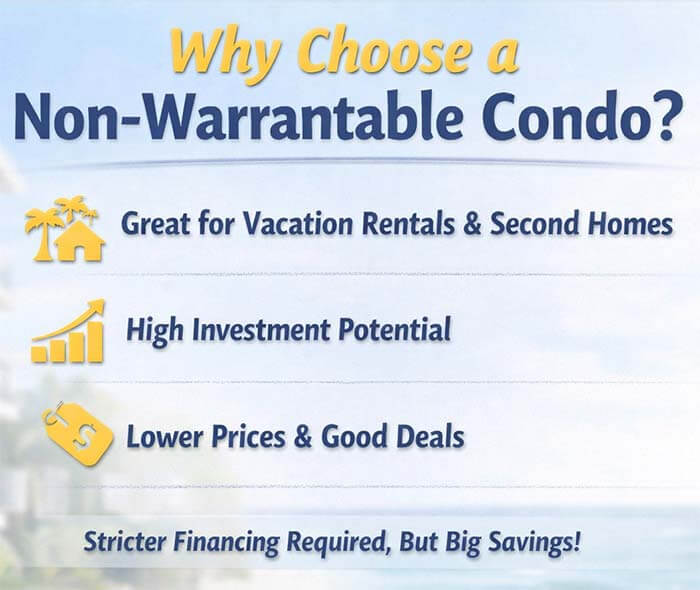
Non-Warrantable Condos Can Be a Fantastic Opportunity for Buyers, especially if You’re Looking For:
- Unique properties that cater to vacation rentals or second homes.
- Investment potential in areas with high rental demand.
- Lower prices in markets where other buyers overlook non-warrantable condos.
Although non-warrantable condos are riskier for lenders, they can often offer great deals to buyers who are prepared to meet the stricter financing requirements.
How Non-Warrantable Condos Can Become Warrantable
Here’s the good news: condo complexes are sometimes stuck as non-warrantable forever. In some cases, the condo association can take steps to make the development warrantable, such as:
- Reducing the number of investor-owned units to less than 50%.
- Ensuring the building complies with Fannie Mae and Freddie Mac guidelines.
- Resolving any pending litigation.
If you’re buying a non-warrantable condo to convert it into a warrantable status, keep these improvements in mind and communicate closely with your condo association.
FHA, VA, and USDA Loans for Condos
It’s worth noting that FHA, VA, and USDA loans have their own set of guidelines for condos. These government-backed loans can offer competitive rates and low-down payment options for warrantable condos. However, non-warrantable condos are usually not eligible for FHA, VA, or USDA financing unless they qualify for special programs like FHA’s Spot Loan program. More condo complexes opt out of renewing their HUD certification, which is required for FHA approval. The FHA Spot Loan Program allows individual condos to be eligible for FHA loans, even if the entire complex isn’t HUD-approved.
Key Tips for Buying a Non-Warrantable Condo
Before jumping into buying a non-warrantable condo, keep these tips in mind:
- Work with an experienced lender: non-QM lenders, like those specializing in non-warrantable condo loans, will be familiar with the nuances of these properties and can help guide you through the process.
- Get the condo questionnaire early: Don’t wait until the last minute to determine if the condo is warrantable. Make sure your lender requests this questionnaire early in the process.
- Be prepared for higher rates: Non-warrantable condos typically come with higher interest rates due to the increased risk, so budget for this in your financial plan.
Should You Refinance Your Non-Warrantable Condo?
If you already own a non-warrantable condo and are looking to refinance brings plenty of opportunities with non-QM lenders. However, refinancing a non-warrantable condo may still have higher rates than conventional loans, so consider your long-term financial goals.
Conclusion: Don’t Let a Non-Warrantable Condo Hold You Back
Purchasing or refinancing a non-warrantable condo doesn’t have to be complicated. With the right knowledge and financing options, you can secure your dream condo and even turn it into a smart investment. When considering non-QM loans, portfolio loans, or alternative financing options, it’s important to comprehend your choices and collaborate with the appropriate lender.
Don’t let a condo’s non-warrantable status stand in the way of owning the perfect home. Explore your financing options today and get ready to move forward with confidence!
Apply now to get pre-qualified for your non-warrantable condo loan and take the next step toward homeownership. Call or text us at 800-900-8569 or email us at gcho@gustancho.com.
FAQ’s About Non-Warrantable Condos:
Can I still Get a Mortgage for a Non-Warrantable Condo?
Yes, you can still get a mortgage for a non-warrantable condo. You’ll likely need a non-QM loan or portfolio loan, which has more flexible terms than conventional loans.
Why are Non-Warrantable Condos Harder to Finance?
Lenders view non-warrantable condos as riskier because they might have issues like too many rental units or pending lawsuits, which makes financing more challenging.
What Type of Loan is Best for Buying a Non-Warrantable Condo?
Non-QM loans are a popular choice for financing non-warrantable condos. These loans offer flexible guidelines but often come with higher interest rates.
What Down Payment Do I Need for a Non-Warrantable Condo?
When buying a non-warrantable condo, typically a 20% minimum down payment is necessary, whether it’s for a primary residence or an investment property.
Are Interest Rates Higher for Non-Warrantable Condos?
Yes, interest rates are usually higher for non-warrantable condos due to the extra risk lenders take on with these properties.
Can I Refinance a Non-Warrantable Condo?
Yes, you can refine, but you’ll need to go through a non-QM lender, which may still have higher rates than conventional loans.
How Can I Find Out if a Condo is Non-Warrantable?
The best way to know is through a condo questionnaire, which your lender will request from the condo association.
Can Non-Warrantable Condos Become Warrantable?
Occasionally, a condominium association can implement modifications to align with Fannie Mae and Freddie Mac’s requirements, thereby transforming a non-warrantable condominium into one that meets the criteria for a warrantable property.
Is Buying a Non-Warrantable Condo a Good Investment?
Non-warrantable condos can be a great investment, especially in areas with high rental demand. However, be prepared for stricter financing terms and higher costs.
This Guide About “Quick Tips to Buy Non-Warrantable Condos with Ease” Was Updated on July 9, 2026.
