

Oregon mortgage loans include FHA, VA, USDA, conventional, jumbo, renovation, and Non-QM programs. The right loan depends on your credit history, qualifying income, down payment, military eligibility, property type, and location.
Eligible homebuyers may also qualify for state or local down payment assistance. Income limits, purchase-price limits, homebuyer education, property location, and funding availability may apply.
Borrowers with lower credit scores, self-employment income, a past bankruptcy, or a previous mortgage denial may still have financing options. Because mortgage guidelines and lender overlays vary, a denial from one lender does not always mean you cannot qualify elsewhere. All loans are subject to underwriting approval, program requirements, and lender availability.
How to Choose Oregon Mortgage Loans
Choosing among Oregon mortgage loans depends on your finances, property type, eligibility, and long-term plans. Compare each program based on:
- Credit history and qualifying income
- Down payment and available reserves
- Monthly payment and closing costs
- Military or USDA eligibility
- Property location, type, and condition
- Expected length of homeownership
- Fixed-rate or adjustable-rate terms
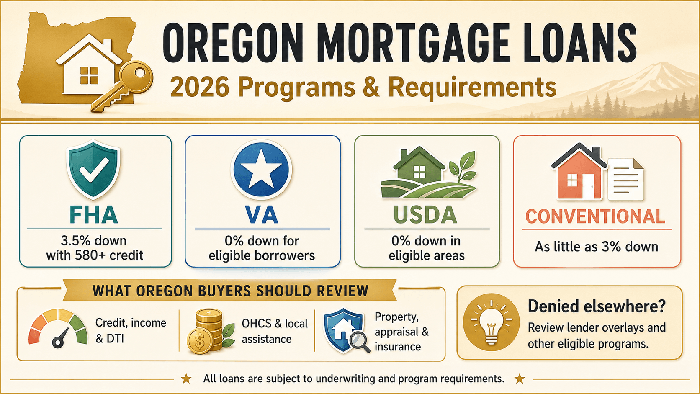
FHA loans may suit borrowers with lower credit scores or limited down payments. VA loans may provide eligible veterans and service members with no-down-payment financing. USDA loans can offer zero-down options for qualified borrowers purchasing eligible rural properties. Conventional loans may work well for borrowers with stronger credit, while jumbo and Non-QM programs can address larger loan amounts or nontraditional income.
How to Shop for Rates in Oregon Mortgage Loans
Compare more than the advertised interest rate. Review the annual percentage rate, lender fees, mortgage insurance, cash required at closing, and total borrowing cost. Request Loan Estimates from several lenders by using identical loan types, amounts, and rate-lock durations. The best option is the loan that fits your budget and circumstances—not simply the one with the lowest advertised rate. All funding is contingent upon underwriting approval and program criteria.
FHA Loan Requirements
FHA loans are a popular option for Oregon homebuyers who have a smaller down payment or less-than-perfect credit. Although the FHA sets the basic program guidelines, individual lenders may impose additional requirements known as lender overlays.
General FHA Loan Requirements Include:
- A minimum 3.5% down payment with a credit score of 580 or higher
- A minimum 10% down payment with a credit score between 500 and 579
- Stable, verifiable income and employment
- Sufficient income to manage the mortgage payment and other monthly debts
- An FHA appraisal confirming the home meets minimum property standards
- An eligible property used as the borrower’s primary residence
- Upfront and annual FHA mortgage insurance premiums
- Funds for the down payment, closing costs, and any required reserves
There is no single FHA debt-to-income limit that applies to every borrower. Approval may depend on automated underwriting findings, credit history, available reserves, and compensating factors. Manual underwriting may be available when a borrower does not receive automated approval. FHA guidelines are generally the same nationwide, but FHA loan limits vary by county. Borrowers comparing Oregon mortgage loans should confirm the current FHA limit for the county where the property is located. All loans remain subject to underwriting approval and lender requirements.
VA Loans for Eligible Oregon Borrowers
VA loans may help eligible veterans, active-duty service members, and certain surviving spouses buy or refinance a primary residence. Qualified borrowers may purchase a home with no down payment, provided the sales price does not exceed the appraised value and the borrower has sufficient entitlement. General VA loan requirements include:
- A valid Certificate of Eligibility
- Satisfactory credit and payment history
- Stable, verifiable income
- Enough residual income after monthly obligations
- A debt-to-income ratio acceptable under VA underwriting guidelines
- A VA appraisal confirming value and minimum property requirements
- Occupancy of the property as the borrower’s primary residence
- Payment of the VA funding fee, unless the borrower qualifies for an exemption
The Veterans Administration does not establish one universal minimum credit score. However, individual lenders may impose minimum-score requirements or other lender overlays. Borrowers comparing Oregon mortgage loans should ask whether the lender follows VA guidelines or applies stricter internal standards.
Benefits of VA Loans
VA loans do not require monthly private mortgage insurance. Borrowers with full entitlement generally do not have a VA loan limit, although approval still depends on income, credit, appraisal results, and the lender’s requirements. County loan limits may remain relevant for borrowers with reduced entitlement. All VA loans are subject to underwriting approval and property eligibility.
USDA Loans and Property Eligibility
USDA loans may offer no-down-payment financing to qualified borrowers purchasing a primary residence in an eligible rural area. Many smaller Oregon communities and some areas outside major cities may qualify, but eligibility must be confirmed using the property’s exact address. General USDA loan requirements include:
- Household income within the applicable USDA limit
- Stable, verifiable income and an acceptable credit history
- Sufficient income to repay the mortgage and other debts
- Use of the property as the borrower’s primary residence
- An eligible property location
- A home that meets USDA appraisal and property standards
- Payment of the applicable upfront guarantee fee and annual fee
For the USDA Guaranteed Loan Program, household income generally cannot exceed 115% of the applicable area median income. USDA does not establish one universal minimum credit score, although individual lenders may apply their own minimum-score requirements or overlays.
USDA Property Eligibility Guidelines
USDA Rural Development Property eligibility is determined by USDA—not simply by whether an address appears rural. Borrowers comparing Oregon mortgage loans should check the exact property address through the USDA Property Eligibility Map. The online map provides preliminary information; USDA makes the final eligibility determination after reviewing a complete application. All loans remain subject to underwriting, appraisal, income, and property requirements.
Conventional Loans
Conventional loans are mortgages that are not insured or guaranteed by a federal agency. Many conforming conventional loans follow Fannie Mae or Freddie Mac requirements, although individual lenders may apply additional underwriting standards. General conventional loan requirements may include:
- A credit score of 620 or above is required for many conforming programs
- A down payment as low as 3% for eligible borrowers
- Stable, verifiable income and employment
- An acceptable debt-to-income ratio
- Sufficient funds for the down payment, closing costs, and required reserves
- An appraisal supporting the property’s value and condition
- Private mortgage insurance is required if the down payment is below 20%
What Are the Benefits of Conventional Loans
Conventional financing may benefit borrowers with stronger credit because it can provide competitive rates and more flexible property options. PMI may also be canceled once the borrower meets applicable equity, payment history, and loan-servicing requirements.
Automatic PMI termination generally occurs when the scheduled principal balance reaches 78% of the home’s original value, provided the loan is current.
Borrowers comparing Oregon mortgage loans should confirm whether the requested amount falls within the current conforming loan limit for the property’s county. Loans exceeding that limit may require jumbo financing. Approval remains subject to automated or manual underwriting, lender requirements, and property eligibility.
Jumbo Loans and 2026 Loan Limits
Jumbo loans cover amounts that surpass the conforming loan limits set by the Federal Housing Finance Agency.
In 2026, the Conforming Loan Limits for Every Oregon County Are:
- $832,750 for a one-unit property
- $1,066,250 for a two-unit property
- $1,288,800 for a three-unit property
- $1,601,750 for a four-unit property
A one-unit loan above $832,750 is generally considered a jumbo loan in Oregon. These limits apply to conventional financing and should not be confused with FHA loan limits, which follow separate rules. FHFA 2026 Conforming Loan Limits Jumbo loans can’t be bought by Fannie Mae or Freddie Mac, so lenders set their own underwriting standards. Depending on the program, borrowers may need:
- Strong credit and an acceptable payment history
- A larger down payment
- A lower debt-to-income ratio
- Several months of cash reserves
- Full income and asset documentation
- One or more property appraisals
Some jumbo programs also allow bank statements, asset depletion, or other alternative income documentation. Borrowers comparing Oregon mortgage loans should review both conforming and jumbo options, as rates, down payment requirements, reserves, and underwriting standards vary by lender. Approval remains subject to the borrower’s qualifications, property value, and program requirements.
Non-QM and Bank-Statement Loans
Non-QM loans may help borrowers whose income or financial profile does not meet the standard requirements of FHA, VA, USDA, Fannie Mae, or Freddie Mac.
Non-QM loans and bank statement loans are commonly used by self-employed borrowers, real estate investors, business owners, and borrowers with substantial assets but limited taxable income.
Bank-statement loans allow qualifying income to be calculated using deposits shown on personal or business bank statements, commonly covering 12 or 24 months. Business expenses and unusual or nonrecurring deposits may be excluded when determining usable income.
Other Non-QM Income-Documentation Options May Include:
- 1099 income
- Profit-and-loss statements
- Asset-depletion calculations
- Debt-service coverage ratio loans for investment properties
- Rental income or other alternative documentation
Requirements vary by lender. Borrowers may need a larger down payment, stronger reserves, an acceptable credit history, and sufficient time in business. Non-QM loans may also carry higher interest rates or fees than comparable conventional financing. Non-QM does not mean no-documentation or guaranteed approval. Lenders must generally make a reasonable, good-faith determination that a borrower can repay a residential mortgage. Consumer Financial Protection Bureau Borrowers comparing Oregon mortgage loans should review the interest rate, annual percentage rate, prepayment terms, closing costs, and income-calculation method before selecting a bank-statement or Non-QM program. All loans remain subject to underwriting approval and lender requirements.
Types of Manufactured-Home Oregon Mortgage Loans
Manufactured homes can qualify for FHA, conventional, VA, USDA, or specialty financing when the borrower, home, land, and installation meet the requirements of the selected program. Eligibility often depends on:
- The home’s construction date and HUD certification labels
- Whether it is permanently attached to an approved foundation
- Whether the home is classified as real property or personal property
- Ownership or acceptable leasehold rights for the land
- The home’s condition, utilities, access, and installation history
- An appraisal supporting the property’s value
Eligibility Requirements on Manufactured Homes
In Oregon, manufactured homes use state ownership documents rather than traditional certificates of title. Borrowers should confirm the recorded owner, security interests, and property status through Oregon’s Manufactured Home Ownership Document System. Unresolved ownership records, unpaid property taxes, missing HUD labels, or foundation problems can delay financing.
A manufactured home that is not permanently attached to owned real estate may require a personal-property loan, commonly called a chattel loan.
These loans may have different down-payment requirements, interest rates, repayment periods, and consumer protections than mortgages secured by real property. FHA Title I financing may be available for eligible manufactured homes, lots, or combined home-and-lot purchases. Renovation financing can combine the home purchase or refinance with eligible repair costs.
Common Options Include:
- FHA Limited or Standard 203(k) loans
- Fannie Mae HomeStyle Renovation
- Freddie Mac CHOICERenovation
- Construction-to-permanent financing
- Specialty manufactured-home renovation programs
Renovation funds are generally held in escrow and released as approved work is completed. The lender may require contractor bids, plans, permits, inspections, contingency reserves, and an appraisal based on the home’s estimated value after completion. Not every renovation program permits every manufactured home or repair. Borrowers comparing Oregon mortgage loans should have the lender review the home’s age, foundation, ownership documents, land status, repair needs, and contractor estimates before making an offer. Manufactured-home and renovation requirements vary by loan program and lender, and approval remains subject to underwriting, appraisal, title, insurance, and property eligibility.
Denied for an Oregon Mortgage?
A previous mortgage denial does not necessarily mean you cannot qualify. Our team can review your credit, income, debt-to-income ratio, and loan options to identify a possible path forward.OHCS FirstHome, NextStep, and Down Payment Assistance
Oregon Housing and Community Services offers its Flex Lending program through approved mortgage lenders. Flex Lending includes two fixed-rate first-mortgage options—FirstHome and NextStep—that may be paired with a second mortgage for down payment and closing cost assistance.
OHCS FirstHome
FirstHome is designed for low- to moderate-income buyers. Borrowers generally must be first-time homebuyers, although exceptions may apply to eligible veterans and buyers purchasing in designated targeted areas. County income and purchase-price limits apply. Eligible borrowers may receive:
- Standard assistance equal to 4% of the first-mortgage amount
- Assistance equal to 5% for qualifying focused demographics
- Help with the down payment, closing costs, prepaid expenses, and other approved costs
- FHA, VA, USDA, or conventional financing through an approved lender
FirstHome borrowers cannot own other real estate at closing. Non-occupant co-borrowers and co-signers are not permitted.
OHCS NextStep
NextStep does not require the borrower to be a first-time homebuyer. It may therefore help both new and repeat buyers who meet the program’s income and property requirements. Borrowers may receive 4% or 5% of the first-mortgage amount as assistance. NextStep permits eligible non-occupant co-borrowers and co-signers. However, the borrower generally cannot own other real estate when the new loan closes. Income limits vary by county and are subject to the program’s statewide maximum.
Additional OHCS Down Payment Assistance
OHCS also funds assistance programs administered by participating organizations across Oregon. First-time or first-generation homebuyers with an income at or below 100% of the area median can receive up to $60,000 or 20% of the purchase price, whichever amount is less.
The actual amount, funding structure, and availability depend on the local program. Assistance may be provided as a grant or forgivable second lien.
Eligible Oregon veterans and their families may also qualify for specialized assistance. Homebuyer education and a meeting with a certified housing counselor are required. Borrowers comparing Oregon mortgage loans should work with an OHCS-approved lender and confirm current income limits, purchase-price limits, assistance terms, and funding availability. Down payment assistance is not automatically forgiven, and receiving assistance may affect the loan’s rate, repayment terms, or total borrowing cost.
Portland and Local Assistance Programs
Homebuyers purchasing within Portland city limits may qualify for assistance through the Portland Housing Bureau. Its Down Payment Assistance Loan Program provides a second mortgage that can be used with an approved first mortgage from a participating lender. Funding is limited and may restrict where the home can be located. Portland’s program generally requires borrowers to:
- Be first-time homebuyers who have not owned a home during the previous three years
- Work with an approved homebuyer counselor and be considered mortgage-ready
- Complete a HUD-approved homebuyer education course
- Meet household income and first-mortgage requirements
- Contribute at least $500, which may come from eligible gift funds
- Purchase and occupy an eligible home within Portland city limits
Assistance may range from $80,000 to $100,000, depending on the funding source and property location. The loan has a 30-year term with 0% interest, and payments are generally deferred until the property is sold, refinanced, or no longer occupied as the borrower’s primary residence. Eligible borrowers who remain in the home and comply with the loan terms may receive partial or complete forgiveness beginning after 15 years. Additional requirements apply when purchasing within the Interstate Corridor Urban Renewal Area.
Oregon Mortgage Loans Down Payment Assistance Programs
Buyers seeking assistance must participate in Portland’s North/Northeast Homeownership Preference Policy, which gives priority to applicants with a history of displacement and family ties to affected neighborhoods. Programs outside Portland may be offered through counties, cities, housing authorities, nonprofit organizations, community land trusts, or OHCS-funded providers.
Assistance can take the form of a grant, a forgivable second mortgage, a deferred-payment loan, a matched-savings program, or a reduced-price home.
Each program establishes its own service area, income limits, homebuyer-education rules, repayment terms, and approved lenders. Borrowers comparing Oregon mortgage loans should contact a housing counselor before making an offer. Local assistance is subject to available funding and cannot automatically be combined with every first-mortgage program. A participating lender must confirm that the assistance, property, and first mortgage meet all applicable requirements.
Buying in Portland, Salem, Eugene, Bend, and Rural Oregon
Mortgage requirements are generally based on the loan program, but location and property type can affect appraisal, insurance, title, and underwriting. Buyers comparing Oregon mortgage loans should consider the following local factors:
Portland
Portland buyers may encounter condominiums, townhomes, older properties, and homes with accessory dwelling units. Condominium financing may require a review of the project’s insurance, budget, reserves, owner-occupancy, and pending litigation. Older homes may also require repairs before they qualify for certain loan programs.
Salem
Salem offers urban, suburban, and nearby rural properties. Buyers should confirm whether a property uses public utilities or a private well and septic system. Homes outside the city may also have acreage, outbuildings, or land-use features requiring additional appraisal and title review.
Eugene
Eugene-area buyers may find older homes, condominiums, manufactured homes, and properties outside city limits. The lender should review any unpermitted additions, accessory units, repair needs, or unusual property features before the appraisal is ordered.
Bend
Buyers in Bend and Central Oregon should obtain homeowners’ insurance quotes early, particularly for properties in areas with elevated wildfire exposure. Higher-priced homes may require jumbo financing when the loan amount exceeds the applicable conforming limit. Acreage, private roads, wells, septic systems, and limited comparable sales can also affect underwriting.
Rural Oregon
Eligible borrowers purchasing in rural Oregon may qualify for USDA financing with no down payment required. Eligibility depends on household income and the property’s exact address; a rural mailing address alone does not establish eligibility. USDA provides an online tool for preliminary property-eligibility checks. Rural-property buyers should also review:
- Private well quality, flow, and required testing
- Septic-system condition and capacity
- Legal access and private-road agreements
- Acreage and agricultural use
- Outbuildings and additional dwellings
- Property insurance availability
- Distance from comparable home sales
- Manufactured-home ownership and foundation records
Oregon DEQ recommends a professional septic system evaluation when buying a home served by an on-site system. Buyers should also request maintenance, pumping, and repair records when available. A property that appears acceptable during a showing may still require additional documentation or repairs for mortgage approval. Buyers should provide the lender with the complete property listing and disclose unusual features before making an offer.
Credit, Income, and DTI Requirements
There is no single credit score, income level, or debt-to-income limit that applies to all Oregon mortgage loans. Requirements depend on the loan program, automated underwriting findings, lender overlays, down payment, reserves, and the borrower’s overall financial profile.
Credit Requirements
Lenders Review More Than the Credit Score. They May Also Consider:
- Recent mortgage, rent, credit card, and installment-loan payments
- Collections, charge-offs, judgments, or disputed accounts
- Bankruptcy, foreclosure, or short-sale history
- Length and depth of established credit
- Recent credit inquiries and newly opened accounts
FHA financing allows credit scores as low as 500 with a 10% down payment or 580 with a 3.5% down payment. Many conventional programs generally require a score of at least 620. VA and USDA requirements differ, and lenders may impose higher minimum scores than the agency requires.
Qualifying Income
Income must generally be stable, verifiable, and reasonably expected to continue. Depending on the borrower and program, qualifying income may include:
- W-2 wages and salary
- Overtime, bonuses, and commissions
- Self-employment or 1099 income
- Social Security, pension, and retirement income
- Disability or VA benefits
- Alimony or child support when applicable requirements are met
- Rental income
- Investment or asset-depletion income
Documentation may include pay stubs, W-2s, tax returns, bank statements, benefit letters, employment verification, or business financial statements. A two-year history is common for variable or self-employment income, though exceptions may apply.
Debt-to-Income Ratio
The debt-to-income ratio compares monthly debt obligations with gross qualifying monthly income. The calculation generally includes the proposed mortgage payment, property taxes, homeowners’ insurance, mortgage insurance, HOA dues, student loans, car payments, credit cards, and other required obligations. For example, a borrower with $6,000 in qualifying monthly income and $2,700 in total monthly obligations has a 45% DTI: $2,700 ÷ $6,000 = 45% Acceptable DTI ratios vary.
Debt-to-Income Ratio Guidelines on Manual vs Automated Underwriting System Approvals
Automated underwriting may approve a higher ratio when the borrower has strong credit, reserves, stable employment, or other favorable factors. Manually underwritten loans may have more restrictive limits. VA underwriting also evaluates residual income—the money remaining after major monthly obligations—not DTI alone. Borrowers with a high DTI may improve their eligibility by reducing debts, increasing the down payment, selecting a lower-priced home, documenting additional eligible income, or choosing a different loan program. Approval remains subject to underwriting and lender requirements.
Oregon Property and Appraisal Considerations
The property must meet the appraisal, condition, title, and insurance requirements of the selected loan program. An appraisal is completed to estimate market value and identify observable conditions that may affect the property’s eligibility. It is not a substitute for a professional home inspection. Oregon properties may require additional review when they include:
- Private wells or septic systems
- Acreage, farmland, or income-producing features
- Manufactured homes or accessory dwelling units
- Private roads or shared-access agreements
- Unpermitted additions or converted living areas
- Condominiums with insurance, reserve, or litigation concerns
- Limited comparable sales in rural or coastal communities
- Repairs involving health, safety, or structural conditions
Buying a Home in Oregon in Rural Area
For a property served by a domestic well, Oregon law generally requires the seller to test the water for specified contaminants during the real estate transaction and provide the results to the buyer. The lender or loan program may require additional testing. A septic system should be professionally evaluated because an appraisal does not determine its full condition or remaining useful life. Buyers should request installation, pumping, maintenance, and repair records when available. Wildfire and flood exposure can also affect financing. Buyers should obtain homeowners’ insurance quotes before the appraisal or financing contingency expires, especially in Central, Southern, or rural Oregon.
Buying a Property Located in a Flood Area in Oregon
A property located in a FEMA-designated Special Flood Hazard Area may require flood insurance as a condition of the mortgage. Buyers can review preliminary flood information through the FEMA Flood Map Service Center. Government-backed loans may require certain safety or property-condition problems to be repaired before closing.
Conventional and Non-QM programs may allow more flexibility, but major defects can still affect value, insurability, or eligibility.
Borrowers comparing Oregon mortgage loans should give the lender the complete property listing before making an offer. Early review of unusual features, utilities, access, insurance, and planned property use can help prevent appraisal and underwriting delays. All properties remain subject to appraisal, title, insurance, and program requirements.
What to Do After a Mortgage Denial
A mortgage denial does not always mean you are unable to qualify. The application may have been denied because of the selected loan program, a lender overlay, insufficient documentation, credit history, debt-to-income ratio, income calculation, appraisal, or property eligibility. Take the following steps before applying again:
- Review the adverse action notice. The lender must provide the principal reasons for the denial or explain how to request them.
- Ask whether an agency guideline or lender overlay caused the denial. Lenders can set tougher credit scores, debt-to-income (DTI) ratios, reserve, or property requirements than those of FHA, VA, USDA, Fannie Mae, or Freddie Mac.
- Check your credit reports. Dispute inaccurate balances, late payments, collections, or accounts that do not belong to you. Do not pay or dispute legitimate accounts without first asking how the action could affect underwriting.
- Review the income calculation. Over time, bonuses, commissions, self-employment income, rental income, and other variable earnings may require additional history or documentation.
- Address the specific problem. Depending on the denial reason, this may involve reducing debt, documenting more income, increasing the down payment, building reserves, correcting credit errors, or choosing a different property.
- Consider another eligible loan program or lender. FHA, VA, USDA, conventional, renovation, jumbo, and Non-QM programs have different requirements. A borrower who does not qualify for one program may qualify for another.
Borrowers comparing Oregon mortgage loans should have an experienced loan officer review the denial before submitting a new application. If the problem resulted from a lender overlay, another lender may offer a suitable program. If the borrower does not yet meet the underlying program guidelines, the loan officer should provide a realistic plan for becoming eligible. Applying with another lender does not guarantee approval. The borrower must still satisfy the selected program’s credit, income, asset, appraisal, and property requirements.
Oregon Borrower Case Example
Consider an Oregon homebuyer with stable W-2 income, a 590 credit score, and enough savings for a 3.5% down payment. The borrower was initially denied conventional financing because the lender required a higher credit score and the borrower’s debt-to-income ratio exceeded its limit. A second review found that the borrower could qualify for an FHA loan. The loan officer recalculated the borrower’s income, identified a car loan that would soon be paid off, and verified that the remaining funds could cover the down payment and closing costs.
Understanding Agency Guidelines vs Lender Overlays
After the car loan was paid and the updated documents were reviewed, the borrower received an automated underwriting approval. Before closing, the property appraisal identified a safety-related repair. The seller completed the work, and the appraiser confirmed that the issue had been corrected.
The borrower then completed underwriting and purchased the home using FHA financing. This example shows why borrowers comparing Oregon mortgage loans should determine whether a denial resulted from an agency guideline, a lender overlay, a documentation issue, or a property issue. Another lender or loan program may provide an eligible solution, but approval is never guaranteed. This is an illustrative example. Loan terms, underwriting results, and borrower circumstances vary.
Steps From Preapproval Through Closing
The mortgage process begins before making an offer and continues until the loan funds and the deed are recorded. Although timelines vary, most Oregon home purchases follow these steps:
- Obtain a mortgage preapproval. The lender reviews your credit, income, assets, debts, and loan eligibility. A preapproval estimates how much you may be able to borrow, but it is not a final loan approval.
- Choose a property and submit an offer. Work with your real estate agent to prepare an offer that addresses the purchase price, earnest money, financing, inspection, appraisal, and closing date.
- Complete the formal loan application. After the seller accepts the offer, provide the signed purchase agreement and updated financial documents to the lender. You will get a Loan Estimate within three business days after submitting your complete application.
- Schedule inspections. A home inspection can identify defects that may not appear in the appraisal. Oregon properties with wells, septic systems, private roads, manufactured homes, or wildfire exposure may require additional evaluations.
- Order the appraisal. The lender orders an appraisal to estimate the property’s market value and determine whether it meets the selected loan program’s requirements. Repairs or additional documentation may be required.
- Complete mortgage underwriting. The underwriter reviews your credit, income, assets, debts, appraisal, title work, and property documentation. Avoid opening new credit accounts, changing jobs, moving money without records, or making large purchases during this stage.
- Satisfy underwriting conditions. You may need to provide updated bank statements, pay stubs, letters of explanation, proof of insurance, or other documents. Responding promptly can help prevent closing delays.
- Receive final approval and review the Closing Disclosure. Once all conditions are satisfied, the lender can issue final approval. You must generally receive the Closing Disclosure at least three business days before closing. Compare it with the Loan Estimate and ask about unexpected changes.
- Complete the final walkthrough. Inspect the home shortly before closing to confirm its condition, verify the agreed-upon repairs, and ensure the property is ready for possession.
- Sign, fund, and record the transaction. At closing, sign the loan and title documents and provide any required verified funds. The deal is done once the lender disburses the loan funds and the deed is officially recorded with the county.
Borrowers using Oregon mortgage loans should stay in contact with their lender, real estate agent, title company, and insurance provider throughout the process. Preapproval does not guarantee closing; final approval depends on updated borrower information, satisfactory property review, and compliance with all underwriting requirements.
Final Thoughts on Oregon Mortgage Loans
Choosing among Oregon mortgage loans requires more than comparing advertised interest rates. The right program depends on your credit, income, debts, available funds, property type, location, and long-term plans.
Oregon borrowers may have access to FHA, VA, USDA, conventional, jumbo, renovation, manufactured-home, and Non-QM financing. Eligible buyers may also qualify for OHCS or local down payment assistance, subject to program limits and funding availability.
If another lender denied your application, review the exact reason before giving up. A lender overlay, an income calculation, a documentation issue, or an unsuitable loan program may have caused the denial. Another eligible option may be available, but approval is never guaranteed. Compare Loan Estimates, understand the total cost of borrowing, and work with a lender familiar with Oregon properties and assistance programs. All loans remain subject to credit approval, underwriting, appraisal, property eligibility, and current program requirements.
Frequently Asked Questions About Oregon Mortgage Loans
How Long Does a Mortgage Preapproval Last in Oregon?
There is no state-wide expiration period. The lender sets the validity period and should show it on the preapproval letter. If the letter expires before you find a home, the lender may request updated pay stubs, bank statements, debts, employment information, and credit authorization.
Can Gift Funds be Used for an Oregon Home Purchase?
Many FHA, VA, USDA, and conventional programs allow eligible gift funds for some or all of the down payment or closing costs. The lender may require a gift letter, proof of the donor’s funds, and evidence that the money was transferred. Donor eligibility and borrower-contribution requirements vary by program.
Can an Home Seller Pay the Buyer’s Closing Cost on Oregon Mortgage Loans?
A seller may agree to provide a credit toward eligible closing costs. The maximum contribution depends on the loan program, down payment, occupancy, and property type. Seller credits generally cannot be used for the borrower’s required down payment or converted into cash at closing.
Can Closing Costs be Added to Oregon Mortgage Loans?
Ordinary purchase closing costs usually cannot simply be added to the loan above the program’s maximum financing limit. Buyers may reduce their upfront expense through seller credits, lender credits, gift funds, or eligible assistance. Some program charges, such as an FHA upfront mortgage insurance premium or VA funding fee, may be financed. Refinancing borrowers may be able to include eligible costs in the new balance when sufficient equity is available and program approval is obtained.
Does Earnest Money Count Toward the Down Payment?
Earnest money is generally credited toward the buyer’s total cash required at closing rather than charged as an additional cost. The lender must verify the deposit and may request a copy of the canceled check, a wire confirmation, or a bank statement showing the source of the funds. The Loan Estimate’s cash-to-close calculation subtracts deposits already paid to the seller.
When is the First Mortgage Payment Due After Closing?
For most mortgages, the first payment is due after one complete calendar month has passed. For example, a borrower who closes on August 15 will commonly make the first payment on October 1. Prepaid interest collected at closing covers the period between closing and the end of that month. Confirm the exact due date on the promissory note and Closing Disclosure.
Are Oregon Property Taxes and Homeowners Insurance Included in the Mortgage Payment?
They are included when the loan has an escrow account. The servicer collects part of the estimated taxes and insurance with each payment and pays the bills when due. Without an escrow account, the homeowner must pay these expenses directly. Because taxes and insurance premiums can change, the total monthly payment can increase even when the principal-and-interest payment is fixed.
What Happens if Mortgage Rates Change After Preapproval?
A preapproval does not automatically lock the interest rate. Until the rate is locked, it may change with market conditions. Rate locks commonly cover a set period, such as 30, 45, or 60 days, but terms and fees vary. A lock may need to be extended if closing is delayed, and changes to the application can affect the locked terms.
This Guide About “Oregon Mortgage Loans: FHA, VA, USDA and More” Was Updated on August 5, 2026.
