

Buying a home in Utah can feel overwhelming because home prices, county loan limits, income requirements, and down payment needs can vary by location. A buyer in Salt Lake City may need a different mortgage strategy than someone buying in Ogden, Provo, St. George, or a rural USDA-eligible area.
Choosing the appropriate Utah mortgage loans depends on several factors, including your credit score, income, debt-to-income ratio, down payment, eligibility for military service, the location of the property, and the home’s price.
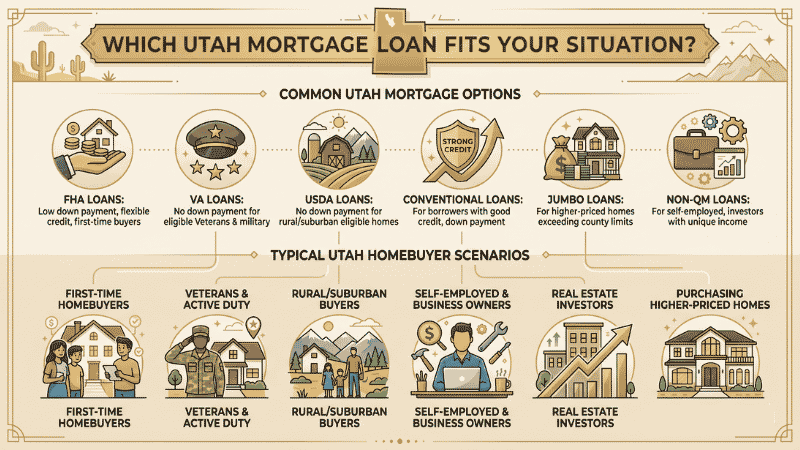
First-time homebuyers may benefit from FHA loans or Utah down payment assistance programs. Eligible veterans and active-duty service members may qualify for VA loans with no down payment. Buyers in rural or suburban areas may be eligible for USDA financing. Self-employed borrowers, real estate investors, and buyers with unique income may need Non-QM mortgage options. This guide explains the main Utah mortgage loans, including FHA, VA, USDA, conventional, jumbo, and Non-QM loans, so you can compare your options and pick the loan option that works best for you.
Utah Mortgage Loans: Which Loan Program Fits Your Situation?
Not every Utah homebuyer needs the same type of mortgage. The best loan program depends on your credit score, income, down payment, property location, military service eligibility, and whether the loan amount fits within county loan limits. Here is a simple breakdown of the most common Utah mortgage loans and who they may fit best.
FHA Loans for Low Down Payment Buyers
FHA loans are a great choice for first-time homebuyers and those who need some leeway with their credit. If you qualify, you might be able to buy a home with a low down payment, and FHA rules are often more flexible than conventional loan guidelines. They’re especially helpful for folks with limited savings, past credit problems, or higher debt-to-income ratios.
VA Loans for Eligible Veterans and Active Duty Service Members
VA loans are available to eligible veterans, active-duty service members, certain National Guard and Reserve members, and qualified surviving spouses. A VA loan can help eligible buyers buy a home with no down payment or pay for monthly mortgage insurance. This can make VA financing one of the strongest mortgage options in Utah for eligible borrowers.
USDA Loans for Eligible Rural and Suburban Homes
USDA loans make it easier for people to buy homes without needing a down payment, especially in rural and suburban areas that qualify. The property must meet USDA location rules, and the borrower must meet income and occupancy requirements. USDA financing may be a good fit for Utah buyers looking outside major metro areas who want affordable monthly payments and full financing.
Conventional Loans for Strong-Credit Borrowers
Conventional loans are often a good option for borrowers with stronger credit, steady income, and enough savings for a down payment. These loans may offer more property flexibility than some government-backed programs. Conventional financing can work well for repeat buyers, first-time buyers with good credit, and borrowers who want options for primary homes, second homes, or investment properties.
Jumbo Loans for Higher-Priced Utah Homes
Jumbo loans are used when the loan amount exceeds the conforming loan limit for the county. In higher-priced Utah markets, some buyers may need jumbo financing to purchase a larger or more expensive home. Jumbo loans usually require stronger credit, more reserves, and more detailed income and asset documentation.
Non-QM Loans for Self-Employed Borrowers and Investors
Non-QM loans may help borrowers who do not fit standard FHA, VA, USDA, or conventional loan guidelines. These programs can be useful for self-employed borrowers, business owners, real estate investors, and buyers with unique income situations. Common Non-QM options include bank statement loans, DSCR loans, asset-depletion loans, and other alternative-documentation programs.
Common Utah Homebuyer Scenarios and Best Loan Options
Various buyers in Utah may require tailored mortgage strategies. It’s important to note that the best Utah mortgage loans aren’t necessarily those with the lowest advertised rates. Instead, the ideal option depends on factors such as your credit score, income, down payment, property location, loan amount, and your long-term financial goals.
First-Time Homebuyers in Utah
A first-time homebuyer in Salt Lake City, Provo, Ogden, or St. George may compare FHA and conventional loans. FHA loans can be a strong option for buyers who need a lower down payment or more flexible credit guidelines. Conventional loans may be better for buyers with stronger credit, stable income, and enough savings to qualify with better pricing or lower mortgage insurance options.
Veterans and Active-Duty Service Members
If you’re a veteran or currently serving in the military and looking to buy a home in Utah, VA financing could help you. VA loans can offer no down payment, no monthly mortgage insurance, and flexible qualifying guidelines for eligible borrowers. This can make VA loans among the strongest mortgage options in Utah for qualified borrowers.
Buyers in Rural or Suburban Utah Areas
A buyer looking outside major metro areas may want to check USDA eligibility. USDA loans can offer no down payment if the property is in an eligible area and the borrower meets income and occupancy rules. This may help buyers in certain rural or suburban Utah communities purchase a home with less money up front.
Self-Employed Borrowers and Business Owners
A self-employed borrower in Utah’s tech, construction, trucking, real estate, or gig economy may have strong cash flow but lower taxable income after deductions. If tax returns do not show sufficient qualifying income, a bank statement loan, an asset depletion loan, or another Non-QM option may be worth reviewing.
Real Estate Investors in Utah
Real estate investors may not always qualify using traditional income documentation. A DSCR loan may help investors qualify based on a property’s rental income rather than their personal income. This can be useful for borrowers buying rental properties, short-term rental homes, or investment properties in growing Utah markets.
Buyers Purchasing Higher-Priced Homes
In Utah, buyers may need a jumbo loan if their desired loan amount exceeds the conforming loan limit for their county. Jumbo loans are often used in high-priced areas and typically require higher credit scores, larger down payments, and more comprehensive income documentation. Those considering Utah mortgage loans in this scenario should seek full pre-approval before making an offer.
Looking to Refinance Your Utah Home?
Lower your payment, pull cash out, or switch programs with our full menu of Utah refinance mortgage loansUtah Down Payment Assistance Programs

Utah Housing Assistance Programs
Utah Housing may offer homebuyer assistance options for qualified borrowers who meet program requirements. These programs often work with common mortgage options such as FHA, VA, USDA, and conventional loans, depending on the buyer’s situation and the program rules. Borrowers should ask whether the assistance is structured as a second mortgage, a deferred loan, a forgivable loan, a grant, or repayable assistance. It is also important to understand how the program may affect the monthly payment, closing costs, debt-to-income ratio, and final loan approval.
Local City and County Homebuyer Programs
Certain cities and counties in Utah may provide their own homebuyer assistance programs, which can be beneficial when seeking Utah mortgage loans. However, these programs often depend on available funding. They may have specific criteria for income, location, property type, occupancy, and purchase price. While local assistance can be advantageous, it’s important to evaluate it early in the mortgage process. Keep in mind that not all lenders accept every assistance program, and some may require additional approvals, inspections, education courses, or extended processing time.
What Buyers Should Check Before Applying
Before pursuing a down payment assistance program in Utah, buyers should verify the income limits, purchase price limits, property location criteria, repayment terms, and the potential for combining the program with their Utah mortgage loans. It’s also important to inquire whether homebuyer education is required and whether the assistance might delay closing. The most effective strategy is to start with full pre-approval, then assess which Utah assistance programs align with the buyer’s loan type, budget, and closing schedule. This proactive approach helps prevent any unexpected issues after the purchase contract is signed.
Which Utah Mortgage Loan Is Easier to Qualify For?
 The easiest Utah mortgage loans to qualify for depends on the borrower’s full financial profile. Lenders review credit score, income, debt-to-income ratio, assets, employment history, property type, occupancy, loan amount, automated underwriting findings, and lender overlays before approving a loan.
FHA loans may be a good fit for first-time buyers or borrowers who need more flexible credit and down payment guidelines. VA loans can be one of the strongest options for eligible veterans, active-duty service members, and qualified surviving spouses because they may allow no down payment and no monthly mortgage insurance.
USDA loans may help eligible buyers purchase homes in approved rural or suburban areas with no down payment. Conventional loans work better for borrowers with stronger credit, stable income, and more savings. Jumbo loans may be needed when the loan amount exceeds the conforming loan limit for the county. Non-QM loans may help self-employed borrowers, business owners, investors, or buyers who do not fit standard agency guidelines. A mortgage denial does not necessarily indicate that the borrower is unqualified. Often, the problem lies with a lender overlay rather than the actual guidelines for FHA, VA, USDA, conventional, jumbo, or Non-QM loans. For Utah mortgage loans, the most effective strategy is to thoroughly review the entire file, align the borrower with the appropriate loan program, and determine if approval is possible within standard agency guidelines or through alternative lending solutions.
Moving to Utah for Work or Lifestyle? Get Pre-Approved Before You Arrive
New job in Utah, remote work, or just chasing the mountains and sunshine—we’ll help line up your financingHow Utah County Loan Limits and Home Prices Affect Your Mortgage
Utah home prices can vary a lot from one county to another. This matters because the price of the home, the loan amount, and the county loan limit can affect which mortgage program you can use. A buyer purchasing in a higher-priced Utah county may need a larger conventional loan, high-balance loan, or jumbo loan. A buyer purchasing in a more affordable county may have more options for FHA, VA, USDA, or standard conventional financing.
County loan limits are important because they help determine whether a loan is considered conforming, high-balance, FHA, or jumbo. If the loan amount is above the conforming loan limit for that county, the borrower may need jumbo financing.
Jumbo loans often have stricter credit, reserve, income, and documentation requirements than standard conventional loans. Home prices really affect how much buyers need for a down payment and their monthly payments. Even if two individuals qualify for the same loan program, the buyer purchasing a higher-priced home may require more cash to close, a higher income, or greater reserves. Additionally, factors such as property taxes, homeowners’ insurance, HOA dues, and mortgage insurance can influence the final payment and debt-to-income ratio, especially for those considering Utah mortgage loans.
Why County Loan Limits Matter for Utah Buyers
Before making an offer, Utah buyers should confirm that the home price and loan amount fall within FHA, conventional, VA, USDA, or jumbo loan guidelines. This is especially important in higher-priced markets where the loan amount may be close to or above the county loan limit.
How Home Prices Can Change Your Loan Options
Buying a lower-priced home can simplify qualifying for a low-down-payment loan, while a higher-priced home might require better credit, higher income, a larger down payment, or even jumbo loan approval. This highlights the importance of getting fully pre-approved before house hunting. A strong pre-approval gives buyers clarity on which Utah mortgage loans align with their budget before they begin making offers.
Utah Conforming Loan Limits and Jumbo Mortgage Rules
For 2026, the standard loan limit for a one-unit home is set at $832,750. If you’re in a pricey area, you can get even higher limits. Buyers whose loan amount exceeds the conforming loan limit for their county may need a jumbo mortgage or another loan option. Loan limits matter because they can affect the type of mortgage you qualify for, the down payment needed, the documentation required, and how strict the underwriting may be. A Utah buyer purchasing a higher-priced home may still qualify, but the loan may need to be structured differently depending on the county, property type, and loan amount.
When a Utah Buyer May Need a Jumbo Loan
A Utah buyer may need a jumbo loan when the loan amount exceeds the conforming loan limit for the county. Jumbo loans are common in higher-priced markets or when buyers purchase larger homes, luxury homes, second homes, or properties with higher sales prices. Jumbo loan approval is usually more detailed than standard conventional approval. Lenders may require stronger credit scores, lower debt-to-income ratios, larger down payments, more cash reserves, and full income documentation. Self-employed borrowers may also need additional business and income paperwork.
Why FHA Loan Limits Should Be Checked by County
FHA loan limits are different from conforming loan limits and should be checked by county. FHA limits can vary based on local home prices, property type, and whether the county is considered a higher-cost area. This is important because a buyer utilizing FHA financing may meet qualifications in one Utah county but require a different approach in another if the home price or loan amount exceeds the FHA limit. Before submitting an offer, buyers in Utah should verify the current FHA loan limit and conforming loan limit, and determine whether the property requires FHA, conventional, high-balance, or jumbo financing, especially when considering Utah mortgage loans.
What Affects Utah Mortgage Rates?
Utah mortgage rates can change based on market conditions, but your personal loan profile also matters. Lenders review your credit, loan program, down payment, property type, occupancy, reserves, and overall risk before pricing your mortgage. The goal is not just to find the lowest rate. The goal is to choose the right loan program with a payment you can afford.
Credit Score and Credit Card Balances
Your credit rating can influence the interest rate on your mortgage. However, credit is more than just a number. High credit card balances, recent late payments, new accounts, disputes, and credit inquiries can all affect loan approval and pricing. Before applying for a Utah mortgage loan, avoid opening new credit, keep credit card balances low, and review your credit report for errors. Paying down revolving debt may improve your credit profile and lower your debt-to-income ratio.
Loan Program and Down Payment
The loan program you choose can affect your rate, mortgage insurance, closing costs, and monthly payment. FHA, VA, USDA, conventional, jumbo, and Non-QM loans are priced differently because each program has different risk factors and guidelines. A larger down payment may help with some loan programs, but it is not always the best move for every borrower. Some buyers may be better off using a low down payment loan and keeping extra cash reserves after closing.
Reserves, Property Type, and Occupancy
Lenders may review how much money you will have left after closing. These funds are called reserves. Having reserves may strengthen your file, especially for jumbo loans, investment properties, second homes, or borrowers with higher debt-to-income ratios. The property type also matters. A primary residence may be priced differently from a second home or investment property. Condos, multi-unit properties, and higher-priced homes may also require additional review.
When to Lock Your Mortgage Rate
A mortgage rate lock protects your rate for a set period while your loan moves toward closing. Utah buyers should discuss rate lock options with their lender once they are under contract and have a realistic closing timeline. Do not wait until the last minute to talk about rate locks. Your lender should explain the lock period, possible extension costs, and whether locking early or floating the rate makes more sense for your situation.
Utah Mortgage Pre-Approval Checklist
Getting pre-approved before shopping for a home can help Utah buyers understand their budget, compare loan options, and avoid delays after making an offer. A full pre-approval is stronger than a basic pre-qualification because the lender reviews your income, assets, credit, and documents before you start house hunting. Before applying, gather your most recent pay stubs, W-2s, tax returns if self-employed, bank statements, photo ID, and authorization for the lender to review your credit. If you are using VA, USDA, jumbo, or Non-QM financing, your lender may request additional documents depending on the program. Avoid opening new credit, making large purchases, changing jobs, or moving money between bank accounts without proper documentation. Large unexplained deposits, new debts, missing bank statement pages, or recent credit inquiries can slow down underwriting. The most important step is choosing the right loan program before making an offer. A Utah buyer may qualify better with FHA, VA, USDA, conventional, jumbo, or Non-QM financing, depending on credit, income, down payment, property location, loan amount, and lender overlays. Getting fully pre-approved early gives you a clearer path from offer to closing.
Final Thoughts on Utah Mortgage Loans
Choosing the right Utah mortgage loan starts with understanding your full financial picture. Your credit score, income, down payment, debt-to-income ratio, property location, loan amount, and long-term goals all affect which program may work best for you. FHA, VA, USDA, conventional, jumbo, and Non-QM loans each serve a different type of buyer.
The best loan is not always the one with the lowest advertised rate. A first-time buyer may need flexible FHA guidelines. An eligible veteran may benefit from a VA loan with no down payment.
A rural or suburban buyer may want to check USDA eligibility. A self-employed borrower or real estate investor may need a Non-QM option if traditional income paperwork does not tell the full story. Before making an offer, get fully pre-approved and compare your options. A strong pre-approval can help you understand your true budget, avoid loan limit issues, prepare for closing costs, and choose the Utah mortgage loan that gives you the clearest path to approval. At Gustan Cho Associates, borrowers can review multiple loan options and work with a team that understands agency guidelines, lender overlays, and flexible mortgage solutions for Utah homebuyers.
Frequently Asked Questions About Utah Mortgage Loans
Can I Switch Loan Programs After Getting Pre-Approved In Utah?
Yes, but switching loan programs after pre-approval can change your payment, down payment, closing costs, appraisal rules, and underwriting requirements. For example, moving from FHA to conventional or from conventional to jumbo may require updated documents and a new approval review. It is better to compare loan options early, so you choose the right program before making an offer.
Do Utah Mortgage Lenders Use The Same Guidelines?
No. Many lenders follow the same basic FHA, VA, USDA, Fannie Mae, Freddie Mac, or jumbo guidelines, but they may add their own lender overlays. An overlay is an extra rule added by the lender. This is why one lender may deny a borrower, while another may approve the same file.
Can I Use Gift Funds To Buy A Home In Utah?
Yes, many Utah mortgage programs allow gift funds from an acceptable donor, but the rules vary by loan type. FHA, VA, USDA, and conventional loans often let you use gift money for your down payment or closing costs, as long as you have the right paperwork. Lenders usually require a gift letter along with evidence of where the funds originated.
Are Closing Costs Different From The Down Payment?
Yes. The down payment is the amount you contribute toward the purchase price. Closing costs are separate expenses tied to getting the loan and buying the home, such as lender fees, title fees, appraisal fees, escrow setup, prepaid taxes, and homeowners’ insurance. Some Utah buyers may use seller concessions, lender credits, or assistance programs to help reduce upfront costs.
Can I Buy A Home In Utah If I Recently Changed Jobs?
Possibly. A job change does not automatically stop mortgage approval, but lenders will review the type of job change, income stability, pay structure, and whether there was a gap in employment. Moving from W-2 employment to self-employment can create additional challenges, as self-employed income typically requires a longer history.
Is It Better To Get Pre-Qualified Or Pre-Approved Before Buying In Utah?
A full pre-approval is usually stronger than a pre-qualification. A pre-qualification may be based on basic information, while a pre-approval usually includes a deeper review of income, assets, credit, and loan documents. In a competitive Utah housing market, a stronger pre-approval can help buyers make cleaner offers and avoid delays after going under contract.
This article about “Utah Mortgage Loans Made Simple for Buyers” was updated on May 28th, 2026.
