
Buying a home in Alaska comes with mortgage challenges different from those in most other states. Remote property locations, seasonal access, heating systems, private utilities, rural eligibility, higher loan limits, and Alaska Housing Finance Corporation programs can all affect which loan works best.
The good news is that Alaska homebuyers have several financing options. Depending on your credit, income, military eligibility, property location, down payment, and loan amount, you may qualify for FHA, VA, USDA, Conventional, Jumbo, or Non-QM mortgage loans.
This guide explains how Alaska mortgage loans work, what makes Alaska properties different, which loan programs may fit your situation, and how AHFC assistance may help with down payment or closing costs. Whether you are buying in Anchorage, Fairbanks, Wasilla, Juneau, or a rural Alaska community, the right mortgage program can make homeownership more affordable and realistic.
Alaska Mortgage Loans: The Unique Experience Of Buying In Alaska
Purchasing a home in Alaska is a one-of-a-kind adventure, with lenders and underwriters weighing several factors unique to the Last Frontier:
- Property access and location: Appraisers and lenders pay close attention to remote places, roads that disappear during certain seasons, and unusual utilities, all of which can affect whether you get approved for a loan.
- Heating and utilities: Lenders insist on safe, permanent heating to guarantee your home stays warm and livable through Alaska’s long, icy winters.
- Condition and property type: Rustic cabins, log homes, homes not connected to regular utilities, or houses that need repairs can all affect your loan choices.
- Because Alaska has higher loan limits, buyers in the state can often borrow more than in most other parts of the country.
2026 Alaska Mortgage Loan Limits: FHA, Conventional, VA, and Jumbo
Mortgage loan limits in Alaska influence eligibility for various loan programs, the amount you can borrow, and the classification of the loan as conventional, FHA, VA, or jumbo. Due to unique statutory loan limit regulations and higher-cost housing issues in certain markets, Alaska mortgage loans are handled differently from those in many other states. For 2026, the baseline conforming loan limit for a one-unit home in most U.S. counties is $832,750, while higher-cost areas may go up to $1,249,125. Alaska, Hawaii, Guam, and the U.S. Virgin Islands have their own special rules, so if you’re looking to buy in Alaska, make sure to check the exact limits based on the county, property type, and the number of units you’re after before making an offer. FHFA and Fannie Mae both provide official resources for looking up conforming loan limits.
FHA loan limits in Alaska also vary by county and property size. A one-unit home may have a different FHA limit than a two-unit, three-unit, or four-unit property. HUD provides an official FHA mortgage limit lookup tool that allows buyers to search by state, county, or metropolitan area.
VA loans work differently. For eligible veterans, active-duty service members, and qualifying surviving spouses with full VA entitlement, there may be no VA loan limit. However, the borrower still needs to qualify based on income, credit, residual income, debt-to-income ratio, property approval, and lender guidelines. Borrowers with partial entitlement may still be affected by county loan limits. If you’re looking to buy a place in Alaska and the price tag is above the county’s standard loan limit for that property type, consider a jumbo loan. Because Alaska has higher loan limits than many other states, some buyers who would need jumbo financing elsewhere may still fit within conforming loan limits in Alaska. For the most accurate numbers, homebuyers should check the official FHFA/Fannie Mae conforming loan limit lookup and the HUD FHA mortgage limit lookup before deciding which Alaska mortgage loans fit their purchase price.
Best Types of Alaska Mortgage Loans
Alaska homebuyers have several mortgage options, but the right loan depends on the borrower’s credit, income, down payment, property location, military eligibility, and loan amount. A buyer purchasing a home in Anchorage may need a different mortgage strategy than someone buying in a rural community, a high-cost area, or a remote property with private utilities. Below are the most common types of Alaska mortgage loans and when each option may make sense.
FHA Loans in Alaska
FHA loans are a great option for first-time homebuyers, people with lower credit scores, and those who don’t have much saved for a down payment. These loans allow a down payment as low as 3.5% for borrowers who meet certain credit and underwriting requirements. Because FHA loans are insured by the Federal Housing Administration, lenders may be more flexible with credit history and debt-to-income ratios than they are with some conventional loans. FHA loan limits vary by Alaska county and property type, so buyers should verify the local FHA limit before shopping for a home.
VA Loans in Alaska
VA loans are one of the strongest mortgage options for eligible veterans, active-duty service members, National Guard members, reservists, and qualifying surviving spouses. VA loans may offer no down payment, no monthly mortgage insurance, and flexible underwriting. VA approval still depends on credit history, income, residual income, debt-to-income ratio, Certificate of Eligibility, property condition, and lender requirements. For eligible military borrowers buying in Alaska, a VA loan can be one of the most affordable ways to finance a home.
USDA Loans in Alaska
USDA loans may help eligible buyers purchase homes in approved rural areas with no down payment. Since much of Alaska consists of rural, less densely populated communities, USDA financing may be worth considering if the property is outside major city areas. USDA loans have income limits, property location rules, and occupancy requirements. The home must be located in a USDA-eligible area, and the borrower must meet USDA income and underwriting guidelines.
Conventional Loans in Alaska
Conventional loans are often best for borrowers with steady income, stronger credit, and enough savings for a down payment and closing costs. Some conventional loan programs may allow low down payments for eligible buyers, including first-time homebuyers. Conventional loans can be used for primary homes, second homes, investment properties, condos, and other eligible property types. They may also allow private mortgage insurance to be removed later when enough equity is built, unlike FHA mortgage insurance in many cases.
Jumbo Loans in Alaska
Jumbo loans come into play when you need to borrow more than what’s allowed for your area and type of home. Because Alaska has higher loan limits than many other states, some buyers may qualify for a conforming loan rather than jumbo financing. When a jumbo loan is required, lenders usually look for stronger credit, larger reserves, lower debt-to-income ratios, and more detailed income documentation. Jumbo loans are often used for higher-priced homes, luxury properties, or unique financing situations.
Non-QM Loans in Alaska
Non-QM loans may help borrowers who do not fit standard FHA, VA, USDA, or conventional loan guidelines. These programs are commonly used by self-employed borrowers, real estate investors, borrowers with large write-offs, and buyers with strong assets but irregular income. Common options for Alaska mortgage loans include bank statement loans, DSCR loans for investment properties, asset-depletion loans, and jumbo Non-QM programs. These Non-QM loans can be particularly beneficial in Alaska when a borrower has a solid overall profile but doesn’t meet traditional income-documentation requirements.
Less-Than-Perfect Credit in Alaska? You May Still Qualify
Reach out today and let us review your file for FHA, VA, conventional, jumbo, and non-QM Alaska mortgage loans with no lender overlays on government loans
Characteristics of Jumbo Loans in Alaska:
- Loans that exceed conforming limits ($832,750 in most counties in Alaska for 2026).
- Available for primary, secondary, and investment properties.
- Requires good credit, typically a score of 680 or above.
- Depending on your credit profile, competitive interest rates for jumbo loans are available. Homebuyers in Alaska can apply for grants and other funding programs through the Alaska Housing Finance Corporation (AHFC) and other local agencies.
Jumbo loans are for amounts above your area’s normal loan limit. Since Alaska’s limits are higher than most states, you may not need a jumbo loan if you are shopping and larger higher priced homes.
- The FHFA sets these limits for Alaska.
- For special financial situations,
- Non-QM loans can offer creative solutions.
Alaska Down Payment Assistance and AHFC First-Time Buyer Programs
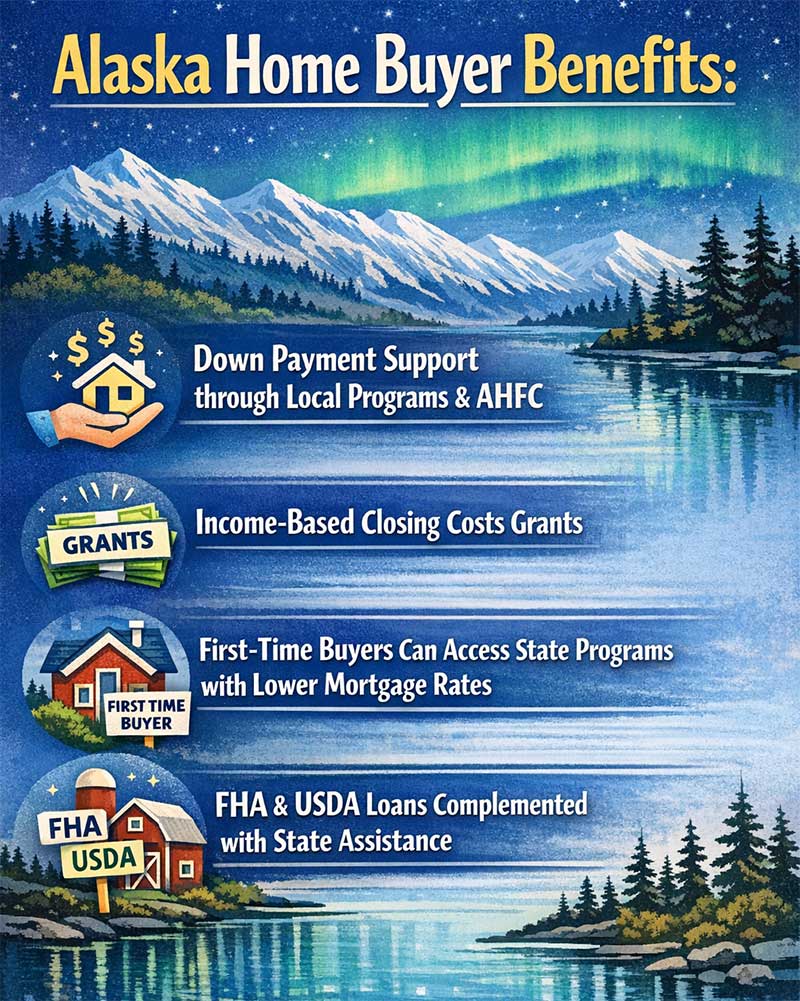
Buying a home in Alaska can be expensive, especially when you add the down payment, closing costs, prepaid taxes, homeowners’ insurance, appraisal fees, and other upfront costs. The Alaska Housing Finance Corporation (AHFC) offers several programs that may help eligible homebuyers reduce the cost of buying a home. AHFC programs can work alongside FHA, VA, USDA, and conventional loans, depending on various factors such as the buyer, property, lender, and specific program requirements. Certain assistance programs are tailored for first-time homebuyers, while others aim to assist low- to moderate-income buyers, rural buyers, veterans, or individuals from eligible communities. This flexibility also applies to Alaska mortgage loans, providing various options to meet different needs. Program availability, income limits, purchase price limits, and assistance amounts can change, so Alaska homebuyers should check current AHFC guidelines and speak with an approved lender before making an offer.
AHFC First Home and First Home Limited
AHFC offers first-time homebuyer programs that may help eligible buyers get a more affordable mortgage. A first-time homebuyer is usually someone who hasn’t owned a primary home in the last 3 years, but it’s always good to check the specific rules.
The First Home program offers eligible buyers the opportunity to purchase a home with options for reduced interest rates. Specifically tailored for lower-income buyers, the First Home Limited program typically imposes stricter limits on income and purchase prices.
These initiatives can be beneficial for those looking for Alaska mortgage loans, particularly for buyers with stable incomes who are looking for a more affordable way to enter the housing market.
AHELP Down Payment Assistance
The Affordable Housing Enhanced Loan Program, commonly referred to as AHELP, offers down payment and closing cost assistance through designated nonprofit or government partners. This assistance can take various forms, such as grants, deferred-payment loans, forgivable loans, or secondary financing. It is important to note that AHELP funds may not always be accessible in every region or for every buyer. Eligibility criteria often hinge on factors such as income, location, homebuyer education, property type, and the specific nonprofit partner providing the assistance. For those seeking Alaska mortgage loans, AHELP can be particularly beneficial for buyers with limited savings, as it helps to minimize the cash needed at closing.
Home Opportunity Program
The Home Opportunity Program, commonly referred to as HOP, provides assistance to low-income families and individuals in the form of down payment and closing cost support. Often in collaboration with nonprofits, this program may only be accessible when funding is available. HOP can be particularly beneficial for buyers who can manage the monthly mortgage payments associated with Alaska mortgage loans but need assistance with the initial costs of purchasing a home. Buyers should inquire about this assistance early in the pre-approval process, as these programs may require additional documentation and entail longer approval timelines.
Regional and Alaska Native Housing Assistance
Some Alaska buyers may also qualify for regional or community-based housing assistance. Alaska Native housing organizations, tribal housing authorities, and regional housing programs may offer down payment assistance, homebuyer education, or special financing to eligible members. For example, some regional programs may serve Alaska Native families, rural communities, or buyers purchasing in specific parts of the state. Rural buyers may also have access to USDA-related resources or self-help housing programs where available. Because these Alaska mortgage loans are location-specific, buyers should check with AHFC, local housing authorities, tribal housing organizations, and approved lenders to see what assistance is available in their area.
What Is the Easiest Mortgage to Qualify for in Alaska?
The easiest Alaska mortgage loans depend on your credit score, income, debt-to-income ratio, down payment, property location, military eligibility, and the type of home you want to buy. There is no single loan program that is easiest for every borrower, but some programs are more flexible for certain situations.
VA Loans for Eligible Military Borrowers
If you’re a veteran, on active duty, in the National Guard, a reservist, or a qualifying surviving spouse, a VA loan could be one of the best mortgage options for you in Alaska. VA loans may allow no down payment, no monthly mortgage insurance, and flexible credit guidelines. However, VA loans still require underwriting. Borrowers must meet income, credit, residual income, debt-to-income ratio, Certificate of Eligibility, and property requirements. Some lenders might have their own overlays, so teaming up with one who really knows VA loans can be super helpful.
FHA Loans for Flexible Credit Guidelines
For non-veterans, first-time buyers, and borrowers with past credit challenges, FHA loans are often one of the most accessible mortgage options in Alaska. FHA loans make it easier to buy a home because they usually require a smaller down payment and have looser credit requirements than conventional loans. FHA loans can be helpful for borrowers with limited savings, lower credit scores, higher debt-to-income ratios, or past financial setbacks. The borrower still needs a stable income, an acceptable credit history, and a property that meets FHA standards.
USDA Loans for Eligible Rural Buyers
USDA loans may be a strong option for Alaska buyers purchasing in eligible rural areas. Many parts of Alaska may qualify, but eligibility depends on the exact property address and USDA income limits. USDA loans may allow qualified buyers to make no down payment. They can be a good fit for low- to moderate-income borrowers who want to buy outside major city areas and meet USDA property and income guidelines.
Non-QM Loans for Self-Employed Borrowers and Investors
Non-QM loans may be easier for borrowers who do not fit traditional lending guidelines. These programs can help self-employed borrowers, real estate investors, borrowers with large tax write-offs, retirees with assets, or buyers with irregular income. Common Non-QM options include bank statement loans, DSCR loans for investment properties, asset depletion loans, and jumbo Non-QM programs. These loans usually require stronger compensating factors, such as a larger down payment, reserves, or strong overall credit.
Choosing the Right Alaska Mortgage Loans
The best loan is not always the one with the lowest down payment. The right Alaska mortgage loan should match your credit profile, income documentation, property location, cash-to-close, and long-term payment comfort. A borrower with military eligibility may benefit most from a VA loan. A buyer with flexible credit needs may consider an FHA loan. A rural buyer may qualify for USDA. A self-employed borrower or investor may need a Non-QM option. The easiest path depends on the full mortgage file, not just one guideline.
Affordable Places to Buy a Home in Alaska
Home prices in Alaska can fluctuate significantly by city, borough, property type, access, utilities, and proximity to major employment centers. Those seeking more affordable options might consider comparing larger cities with nearby communities, smaller towns, and rural areas, especially when looking into Alaska mortgage loans.
Matanuska-Susitna Borough
Matanuska-Susitna Borough, often called Mat-Su, is a popular area for buyers seeking more space and lower housing costs than in some Anchorage neighborhoods. Many buyers consider this area because it offers access to communities like Wasilla and Palmer while still being within commuting distance of Anchorage for some workers.
Wasilla and Palmer
Wasilla and Palmer are common options for Alaska homebuyers seeking more space, suburban living, and access to local services. These areas may appeal to first-time buyers, families, and borrowers who want to compare USDA, FHA, VA, conventional, or AHFC program options.
Fairbanks North Star Borough
Fairbanks North Star Borough may offer opportunities for buyers looking outside Alaska’s coastal markets. Buyers should consider heating costs, winter conditions, job location, and property condition when comparing homes in this area.
Kenai Peninsula
The Kenai Peninsula may appeal to buyers who want smaller communities, outdoor access, and price points different from those in larger city markets. Depending on the property location, buyers may want to check USDA eligibility, local housing resources, and commute distance before choosing a home.
Anchorage Neighborhoods
Anchorage is Alaska’s largest city and offers more employment options, services, schools, medical access, and housing variety. While some neighborhoods may be more expensive, buyers may still find affordable options depending on property size, condition, condo availability, and loan program. Before choosing where to buy, Alaska homebuyers should compare home prices, commute, employment access, property taxes, insurance, heating costs, utilities, road access, and loan eligibility. A lower purchase price may not always mean a lower total monthly cost if the property has higher maintenance, utility, or travel expenses.
How to Get the Best Mortgage Rate in Alaska
Getting the best mortgage rate in Alaska depends on more than finding the lowest advertised number. Your rate is affected by your credit score, debt-to-income ratio, loan program, down payment, property type, occupancy, loan amount, and overall risk profile. A buyer with strong credit, stable income, lower debt, and more money down may receive better pricing than a buyer with lower credit, higher debt, or limited reserves. The type of loan also matters. FHA, VA, USDA, conventional, jumbo, and Non-QM loans can all price differently.
Improve Your Credit Before Applying
Your credit score is one of the biggest factors in mortgage pricing. Paying down credit cards, avoiding new debt, correcting credit report errors, and making payments on time help you qualify for better loan terms.
Lower Your Debt-to-Income Ratio
Having a lower debt-to-income ratio boosts your mortgage application. Paying down monthly debts or increasing your qualifying income may improve your approval chances and may help with pricing.
Compare Loan Programs, Not Just Rates
The lowest interest rate is not always the best loan. Buyers should compare the interest rate, APR, lender fees, discount points, mortgage insurance, closing costs, and total cash needed to close.
Understand Fixed-Rate Loans and ARM Loans
Fixed-rate mortgages keep the same principal and interest payment for the life of the loan. Adjustable-rate mortgages, also called ARMs, may start with a lower initial rate than fixed-rate loans, but the payment can increase after the fixed period. Before choosing an ARM, make sure you understand when the rate can adjust, how much it can increase, and whether you can afford the payment if rates rise later.
Lock Your Rate at the Right Time
Once you are under contract and ready to move forward, ask your lender about rate lock options. In Alaska, closing timelines may be affected by appraisal access, remote property locations, weather, repairs, and title work, so the lock period should match the expected closing timeline.
Step-by-Step Guide to Mortgage Loan Approval in Alaska
Getting approved for Alaska mortgage loans starts with a strong pre-approval. Before shopping for a home, review your credit, income, down payment, target location, and property type. Ask your lender which loan program best fits, whether AHFC or local assistance is available, and whether the property may have Alaska-specific issues, such as seasonal access, heating, private utilities, repairs, or rural eligibility. Once you are under contract, lock your rate with enough time for appraisal, title work, underwriting, and possible weather or access delays.
Alaska Mortgage Loans FAQs
Do I Have To Live In Alaska To Use An AHFC Mortgage Program?
Yes. To qualify for an Alaska Housing loan, AHFC says you need to be in Alaska in person and plan to stick around in the state. Buyers should confirm residency, credit score, property, and program requirements with an AHFC-approved lender before applying.
Who Counts As A First-Time Homebuyer In Alaska?
AHFC generally defines a first-time homebuyer as someone who has not owned a primary residence in the last three years. This matters because some Alaska Housing programs are designed specifically for first-time buyers and may have income or purchase price limits.
Does AHFC Have A Minimum Credit Score?
AHFC’s lender FAQ states that Alaska Housing requires a minimum credit score of 620. However, loan approval can still depend on the full file, including income, debts, assets, property type, loan program, and lender requirements.
Can I Buy A Home In Rural Alaska With A USDA Loan?
Possibly. USDA Rural Development offers home loan options for eligible low- and very-low-income buyers in rural areas. The property must meet USDA location rules, and the borrower must meet income and underwriting guidelines.
Should Alaska Buyers Complete Homebuyer Education Before Applying?
Yes, especially first-time buyers. AHFC provides first-time buyer resources, including homebuyer education tools and its HomeChoice Steps to Homeownership workbook. Education can help buyers understand budgeting, loan options, inspections, closing costs, and long-term ownership costs.
What Can Delay A Mortgage Closing In Alaska?
Alaska closings may take longer when the property is remote, hard to access during winter, has private utilities, needs repairs, requires specialized appraisal review, or has title issues. Buyers should get pre-approved early, ask about rate-lock timing, and choose a lender familiar with Alaska property conditions.
This article about “Alaska Mortgage Loans Made Simple for Buyers” was updated on May 27th, 2026.
